. 2010 Feb;84(3):1464-76.
doi: 10.1128/JVI.02129-09. Epub 2009 Nov 11.

Molecular epidemiology of simian immunodeficiency virus infection in wild-living gorillas

Affiliations

Molecular epidemiology of simian immunodeficiency virus infection in wild-living gorillas

Cécile Neel et al. J Virol. 2010 Feb.

Abstract

Chimpanzees and gorillas are the only nonhuman primates known to harbor viruses closely related to HIV-1. Phylogenetic analyses showed that gorillas acquired the simian immunodeficiency virus SIVgor from chimpanzees, and viruses from the SIVcpz/SIVgor lineage have been transmitted to humans on at least four occasions, leading to HIV-1 groups M, N, O, and P. To determine the geographic distribution, prevalence, and species association of SIVgor, we conducted a comprehensive molecular epidemiological survey of wild gorillas in Central Africa. Gorilla fecal samples were collected in the range of western lowland gorillas (n = 2,367) and eastern Grauer gorillas (n = 183) and tested for SIVgor antibodies and nucleic acids. SIVgor antibody-positive samples were identified at 2 sites in Cameroon, with no evidence of infection at 19 other sites, including 3 in the range of the Eastern gorillas. In Cameroon, based on DNA and microsatellite analyses of a subset of samples, we estimated the prevalence of SIVgor to be 1.6% (range, 0% to 4.6%), which is significantly lower than the prevalence of SIVcpzPtt in chimpanzees (5.9%; range, 0% to 32%). All newly identified SIVgor strains formed a monophyletic lineage within the SIVcpz radiation, closely related to HIV-1 groups O and P, and clustered according to their field site of origin. At one site, there was evidence for intergroup transmission and a high intragroup prevalence. These isolated hot spots of SIVgor-infected gorilla communities could serve as a source for human infection. The overall low prevalence and sporadic distribution of SIVgor could suggest a decline of SIVgor in wild populations, but it cannot be excluded that SIVgor is still more prevalent in other parts of the geographical range of gorillas.


Figures
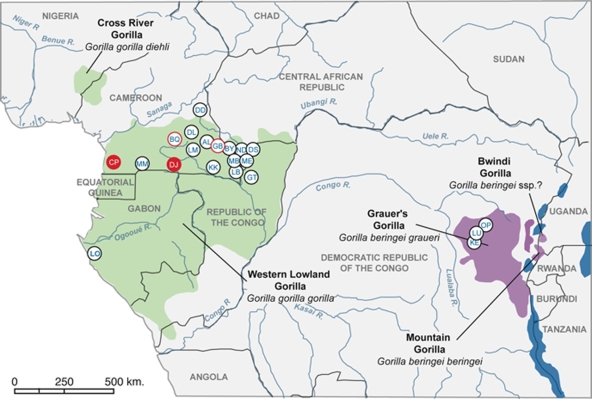
FIG. 1.
FIG. 1.
Locations of study sites of wild gorillas and/or chimpanzees in central Africa. Red filled circles indicate sampling sites where positive gorillas were identified in the current study. Red open circles indicate sites where SIVgor infection was previously identified (BQ) (36) or suspected (GB) (see Materials and Methods) and where no additional positive animals were identified in this survey. KE, LU, and OP are located in the range of Gorilla beringei graueri (purple), while all other sites are located in the range of Gorilla gorilla gorilla (dark green).
FIG. 2.
FIG. 2.
Phylogenetic analysis of partial pol (polymerase gene; 286 bp) (a) and env (gp41 envelope transmembrane region; 355 bp) (b) sequences of newly identified SIVgor and SIVcpzPtt strains. Representative HIV-1 group M (U455 and HXB2), N (YBF30 and YBF106), O (Ant70 and MVP5180), and P (RBF168) sequences are included, as well as SIVcpzPts sequences (ANT and TAN1-3), which form the outgroup. Trees were inferred by maximum likelihood phylogeny (PhyML) with previously characterized SIVcpz/SIVgor/HIV-1 strains (31, 36, 37). The support values in black above the branches are from 1,000 maximum likelihood bootstraps (shown as ‰; only values above 700‰ are shown), and posterior probabilities (only values above 0.80) from nucleotide Bayesian analysis are represented by gray asterisks below the branches. The scale bar represents the number of substitutions per site. HIV-1 strains are shown in gray italic letters. New SIVgor strains identified in this epidemiologic survey are highlighted in black boxes. For SIVgor strains highlighted by a pound sign, the full-length genome sequence has been reported (31). New SIVcpzPtt strains identified in this study are highlighted in gray boxes.
FIG. 3.
FIG. 3.
Localization of the Campo Ma'an Reserve (a) and the six different collection sites (b). Black circles represent the three sites where new SIVgor-infected gorillas were discovered (MV, GR, and OV). (c) The positions of the 13 identified SIVgor-positive gorillas at the MV, GR, and OV areas within the CP site are shown in detail. Each individual was identified by microsatellite analysis and is represented by an ID, corresponding to CPg-IDx in Table 3. The numbers in parentheses correspond to the samples collected from each individual. Previously collected samples are represented with striped gray symbols, and new samples are shown with black symbols. Circles represent samples collected at nesting sites, while squares represent those collected on trails. The three different identified groups (A, B, and C) are highlighted in gray boxes. Triangles represent SIVcpz-positive chimpanzees (Table 4).
FIG. 4.
FIG. 4.
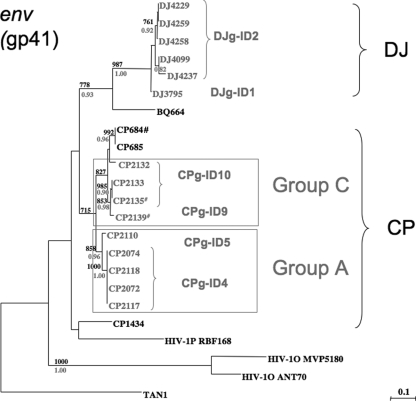
Phylogenetic analysis of partial env (gp41; 266 bp) nucleotide sequences of new SIVgor strains (in gray) identified in this survey. The strains for which the full-length genome has been reported previously (31) are highlighted with a pound sign. The tree was inferred by maximum likelihood phylogeny (PhyML) with previously characterized SIVcpzPts/SIVgor/HIV-1 strains (26, 31, 36). The support values in black above the branches are from 1,000 maximum likelihood bootstraps (shown as ‰; only values above 700‰ are shown), and posterior probabilities (shown as proportions; only values above 0.80 are shown) from nucleotide Bayesian analysis are shown in gray below the branches. The scale bar represents the number of substitutions per site. Groups A and C correspond to identified groups (Fig. 3). Samples identified in this study are highlighted in gray.
FIG. 5.
FIG. 5.
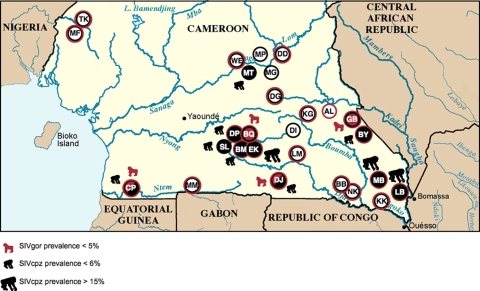
Locations of study sites of wild chimpanzees and gorillas from this and previous surveys in Cameroon. Red and black circles indicate sampling sites where gorillas and chimpanzees were sampled, respectively. Red filled circles indicate sites where SIVgor-positive gorillas were identified, and black filled circles indicate sites where SIVcpzPtt-positive chimpanzees were identified. Circles with half red and half black indicate sites where SIVgor-infected gorillas and SIVcpzPtt-infected chimpanzees were identified. MF, TK, MP, and WE are located in the range of Pan troglodytes vellerosus, while all other sites are located in the range of Pan troglodytes troglodytes. TK was located in the area of the cross-river gorillas (Gorilla gorilla dielhi), and all other locations were in the range of western lowland gorillas (Gorilla gorilla gorilla).

References

    1. Aghokeng, A. F., E. Mpoudi-Ngole, H. Dimodi, A. Atem-Tambe, M. Tongo, C. Butel, E. Delaporte, and M. Peeters. 2009. Inaccurate diagnosis of HIV-1 group M and O is a key challenge for ongoing universal access to antiretroviral treatment and HIV prevention in Cameroon. PLoS One 4:e7702. - PMC - PubMed
    1. Bibollet-Ruche, F., F. Gao, E. Bailes, S. Saragosti, E. Delaporte, M. Peeters, G. M. Shaw, B. H. Hahn, and P. M. Sharp. 2004. Complete genome analysis of one of the earliest SIVcpzPtt strains from Gabon (SIVcpzGAB2). AIDS Res. Hum. Retrovir. 20:1377-1381. - PMC - PubMed
    1. Birx, D., M. de Souza, and J. N. Nkengasong. 2009. Laboratory challenges in the scaling up of HIV, TB, and malaria programs: the interaction of health and laboratory systems, clinical research, and service delivery. Am. J. Clin. Pathol. 131:849-851. - PubMed
    1. Boom, R., C. J. Sol, M. M. Salimans, C. L. Jansen, P. M. Wertheim-van Dillen, and J. Van Der Noordaa. 1990. Rapid and simple method for purification of nucleic acids. J. Clin. Microbiol. 28:495-503. - PMC - PubMed
    1. Bradley, B. J., D. M. Doran-Sheehy, and L. Vigilant. 2008. Genetic identification of elusive animals: re-evaluating tracking and nesting data for wild western gorillas. J. Zool. 275:333-340.

Publication types

LinkOut - more resources