


Review
doi: 10.1159/000243791.
Epub 2009 Nov 10.
The role of hepcidin in iron metabolism
Affiliations
- PMID: 19907144
- PMCID: PMC2855274
- DOI: 10.1159/000243791
Item in Clipboard
Review
The role of hepcidin in iron metabolism
Acta Haematol.
2009.
Abstract
Hepcidin is the central regulator of systemic iron homeostasis. Dysregulation of hepcidin production results in a variety of iron disorders. Hepcidin deficiency is the cause of iron overload in hereditary hemochromatosis, iron-loading anemias, and hepatitis C. Hepcidin excess is associated with anemia of inflammation, chronic kidney disease and iron-refractory iron deficiency anemia. Diagnostic and therapeutic applications of this new knowledge are beginning to emerge. Dr. Ernest Beutler played a significant role in advancing our understanding of the function of hepcidin. This review is dedicated to his memory.
Copyright 2009 S. Karger AG, Basel.
Figures
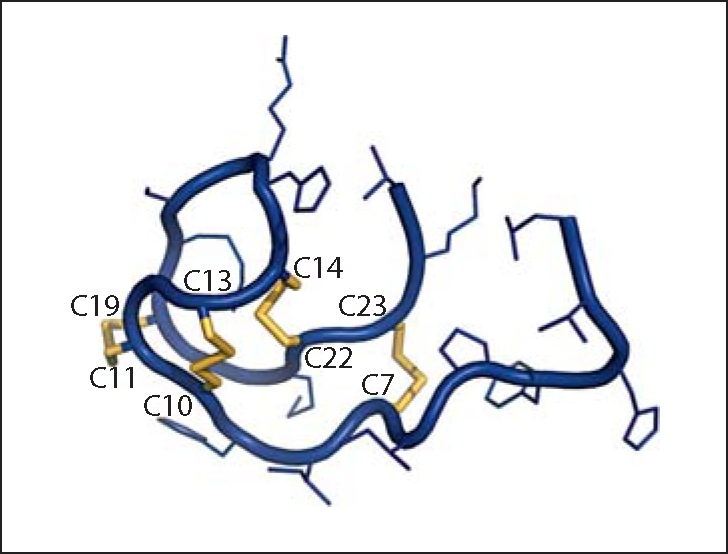
Hepcidin structure with revised disulfide connectivities.
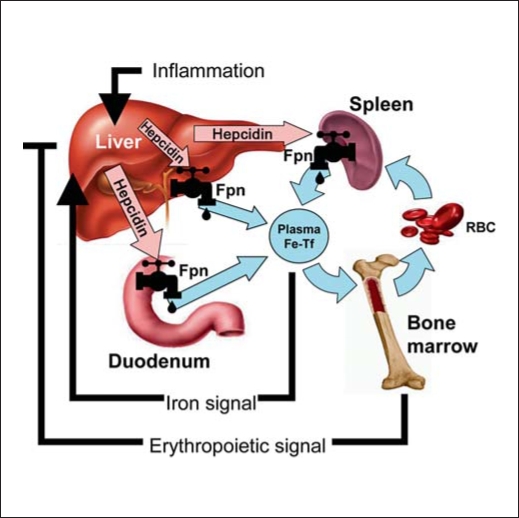
Hepcidin-ferroportin (Fpn) interaction determines the flow of iron into plasma. Hepcidin concentration is in turn regulated by iron, erythropoietic activity and inflammation.
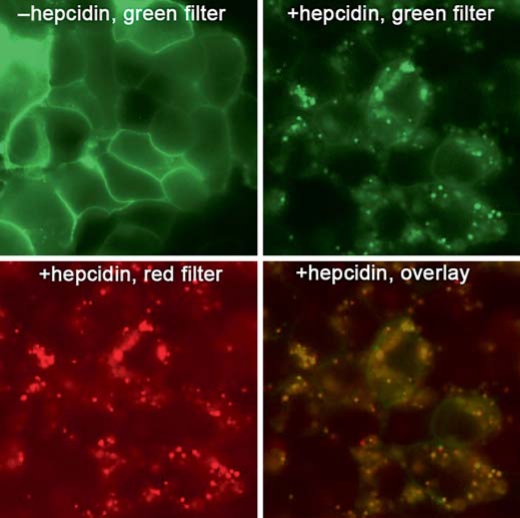
Hepcidin binding to ferroportin causes internalization of the receptor-ligand complex, and their eventual degradation. HEK293 cells expressing ferroportin-GFP were treated with Texas-red-labeled hepcidin and imaged using fluorescent microscopy.
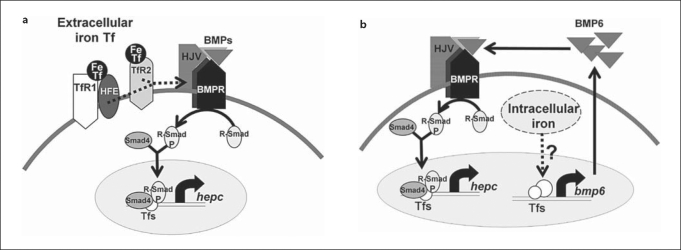
A model of hepcidin regulation by iron Tf (a) and intracellular iron (b). a Increased iron Tf concentrations stabilize TfR2 protein, HFE is displaced from TfR1 and associates with TfR2. The HFE-TfR2 complex likely interacts with the HJV-BMP receptor (BMPR), BMP signaling is potentiated and hepcidin transcription increases. b Elevated intracellular iron increases BMP6 production. Secreted BMP6 binds to the HJV-BMPR complex, stimulates Smad signaling, and increases hepcidin transcription.
References
-
- Peslova G, Petrak J, Kuzelova K, Hrdy I, Halada P, Kuchel PW, Soe-Lin S, Ponka P, Sutak R, Becker E, Huang ML, Suryo RY, Richardson DR, Vyoral D. Hepcidin, the hormone of iron metabolism, is bound specifically to alpha-2-macroglobulin in blood. Blood. 2009;113:6225–6236. - PubMed
-
- Ganz T, Olbina G, Girelli D, Nemeth E, Westerman M. Immunoassay for human serum hepcidin. Blood. 2008;112:4292–4297. - PubMed
Publication types
MeSH terms
Substances
Grants and funding
LinkOut - more resources
Full Text Sources
Other Literature Sources
Medical
