


doi: 10.1097/WNR.0b013e32833370cf.
Extreme hypoxia tolerance of naked mole-rat brain
Affiliations
- PMID: 19907351
- PMCID: PMC12142806
- DOI: 10.1097/WNR.0b013e32833370cf
Item in Clipboard
Extreme hypoxia tolerance of naked mole-rat brain
Neuroreport.
.
Abstract
Mammalian brains have extremely high levels of aerobic metabolism and typically suffer irreversible damage after brief periods of oxygen deprivation such as occur during stroke or cardiac arrest. Here we report that brain tissue from naked mole-rats, rodents that live in a chronically low-oxygen environment, is remarkably resistant to hypoxia: naked mole-rat neurons maintain synaptic transmission much longer than mouse neurons and can recover from periods of anoxia exceeding 30 min. We suggest that brain tolerance to hypoxia may result from slowed or arrested brain development in these extremely long-lived animals.
Figures
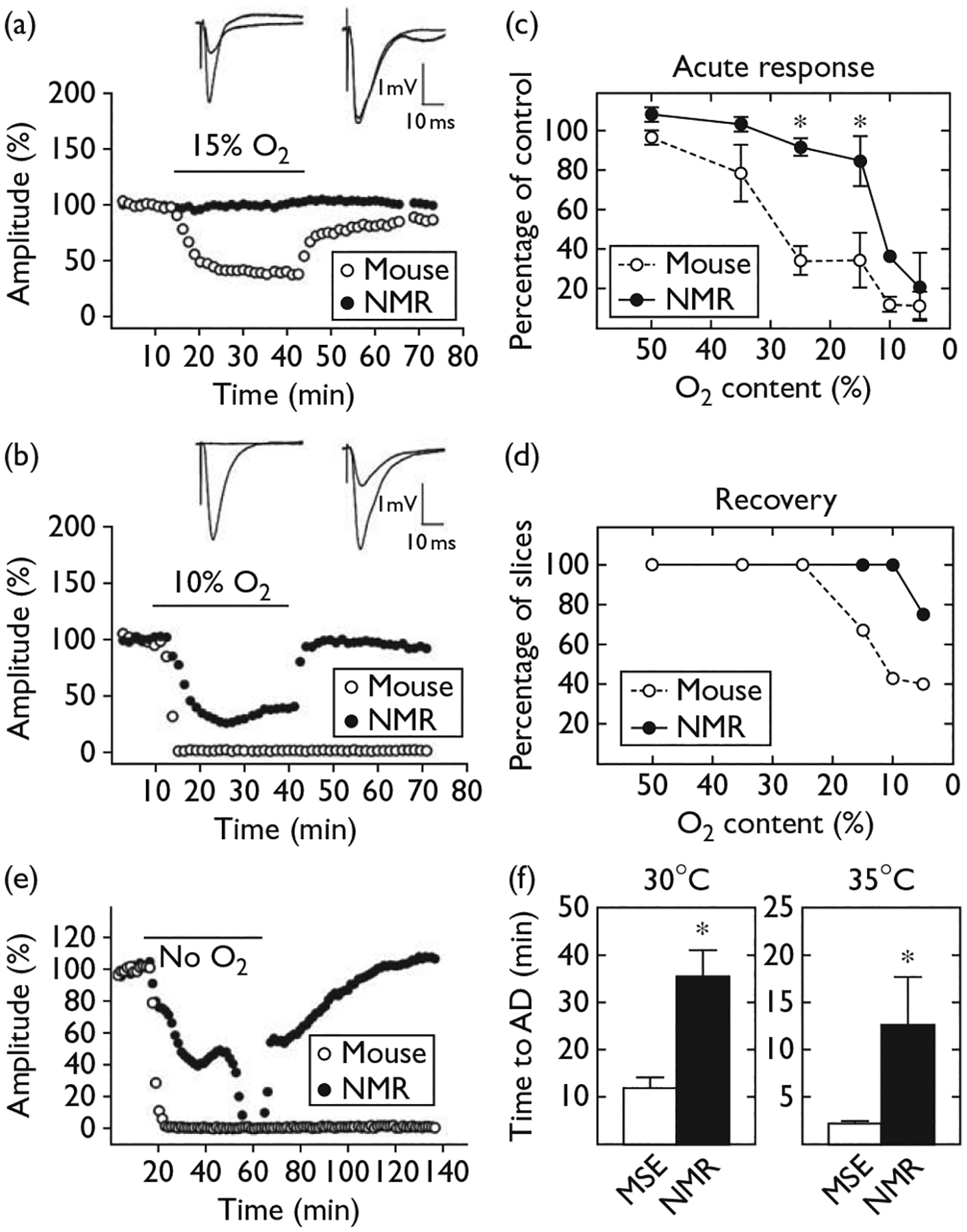
Resistance of naked mole-rat (NMR) hippocampus to hypoxia. Field excitatory postsynaptic potential (EPSP) amplitude in hippocampal slices before, during (horizontal bar), and after replacement of 95% oxygen (O2) in the slice chamber with 15% O2/80% N2 (a) or 10% O2/85% N2 (b) for 30 min. Inset traces show EPSPs recorded before and during hypoxia for mouse (left) and mole-rat (right). (c) Decrease in field EPSP amplitude in NMR (n = 25) and mouse (n = 48) slices at varying O2 content (mean ± SEM). (d) Percent of slices showing any functional recovery after reoxygenation. (e) Response to removal of all O2 from the chamber atmosphere. (f) Duration of exposure to O2-free atmosphere needed to produce anoxic depolarization (AD) in slices from mice (MSE, n = 19) and NMR (n = 13) incubated at 30 or 35°C. All NMRs were at least 1 year old and mice were at least 2 months old. *P < 0.01.

Immature properties of adult naked mole-rat neurophysiology. (a) Lack of paired-pulse facilitation. Graphs show excitatory postsynaptic potential (EPSP) initial slope for second response as a percentage of the first response of the pair with interpulse intervals (IPIs) of 50–1600 ms. Slices from mouse (n = 42) show robust facilitation; slices from naked mole-rat (NMR, n = 13) show only a small facilitation at 50 ms and depression at longer intervals. Standard error bars are smaller than symbols. (b) Attenuated response to adenosine in NMR slices. Histograms show average (mean ± SEM) percent change in field EPSP amplitude after application of 300 μM adenosine. Slices from NMR showed significantly less inhibition than slices from mice. *P < 0.05.
References
-
- Bennett NC, Faulkes CG. African mole-rats: ecology and eusociality. Cambridge: Cambridge University Press; 2000.
-
- Jarvis JU. Eusociality in a mammal: cooperative breeding in naked mole-rat colonies. Science 1981; 212:571–573. - PubMed
-
- Jarvis JUM, Bennett NC. Ecology and behavior of the family Bathyergidae. In: Sherman PW, Jarvis JUM, Alexander RD, editors. The biology of the naked mole-rat. Princeton: Princeton University Press; 1991. pp. 66–96.
-
- Urison NT, Buffenstein R. Kidney concentrating ability of a subterranean xeric rodent, the naked mole-rat (Heterocephalus glaber). J Comp Physiol B 1994; 163:676–681. - PubMed
-
- McNab BK. The influence of body size on the energetics and distribution of fossorial and burrowing mammals. Ecology 1979; 60:1010–1021.
Publication types
MeSH terms
Substances
Grants and funding
LinkOut - more resources
Full Text Sources
