


Gender Differences in Quit Support by Partners of Health-Compromised Smokers
- PMID: 19907672
- PMCID: PMC2774926
- DOI: 10.1177/002204260903900206
Gender Differences in Quit Support by Partners of Health-Compromised Smokers
Abstract
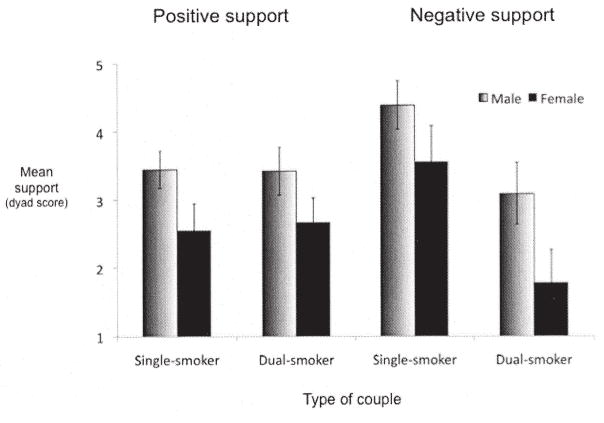
In a study of spousal support for smoking cessation, 34 couples in which one partner continued to smoke despite having a heart or lung problem used an adaptation of Cohen & Lichtenstein's (1990) Partner Interaction Questionnaire to describe the spouse's attempts to help the primary (ill) smoker quit. Female smokers received less support for quitting from their spouse or partner than male smokers did, regardless of whether the support was positive or negative, whether the partner also smoked, or whether the smoker or partner rated the partner's support behavior Female patients in a treatment sub-sample were also less likely than men to achieve stable 1-year cessation if the couple had rated partner support at baseline as coercive or unhelpful. Given known gender differences in relapse risk, cessation interventions for health-compromised female smokers might profitably include partners in addition to the smokers themselves.
Figures
References
-
- Affleck G, Zautra A, Tennen H, Armeli S. Multilevel daily process designs for consulting and clinical psychology: A preface for the perplexed. Journal of Consulting and Clinical Psychology. 1999;67:746–754. - PubMed
-
- Borrelli B, Bock B, King T, Pinto B, Marcus BH. The impact of depression on smoking cessation in women. American Journal of Preventive Medicine. 1996;12:378–387. - PubMed
-
- Brown PC, Smith TW. Social influence, marriage, and the heart: Cardiovascular consequences of interpersonal control in husbands and wives. Health Psychology. 1992;11:88–96. - PubMed
-
- Christensen A, Sullaway M, King C. Systematic error in behavioral reports of dyadic interaction: Egocentric bias and content effects. Behavioral Assessment. 1983;5:129–140.
Grants and funding
LinkOut - more resources
Full Text Sources