


Transcriptome analysis of genes controlled by luxS/autoinducer-2 in Salmonella enterica serovar Typhimurium
- PMID: 19909098
- PMCID: PMC3132110
- DOI: 10.1089/fpd.2009.0372
Transcriptome analysis of genes controlled by luxS/autoinducer-2 in Salmonella enterica serovar Typhimurium
Abstract
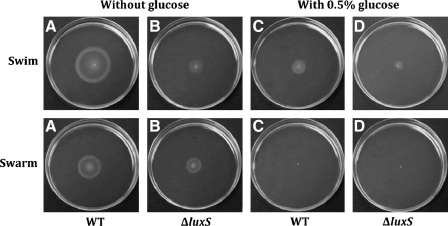
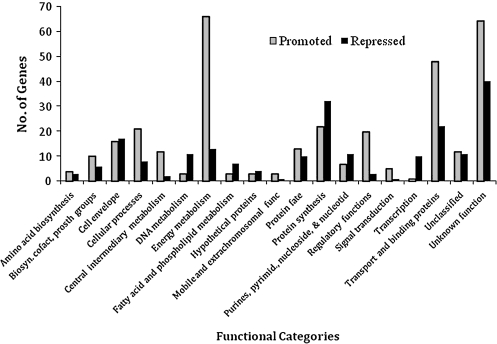
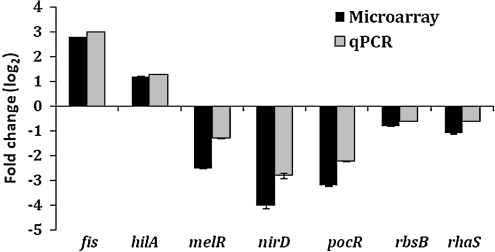
The enteric pathogen Salmonella enterica serovar Typhimurium uses autoinducer-2 (AI-2) as a signaling molecule. AI-2 requires the luxS gene for its synthesis. The regulation of global gene expression in Salmonella Typhimurium by luxS/AI-2 is currently not known; therefore, the focus of this study was to elucidate the global gene expression patterns in Salmonella Typhimurium as regulated by luxS/AI-2. The genes controlled by luxS/AI-2 were identified using microarrays with RNA samples from wild-type (WT) Salmonella Typhimurium and its isogenic DeltaluxS mutant, in two growth conditions (presence and absence of glucose) at mid-log and early stationary phases. The results indicate that luxS/AI-2 has very different effects in Salmonella Typhimurium depending on the stage of cell growth and the levels of glucose. Genes with p < or = 0.05 were considered to be significantly expressed differentially between WT and DeltaluxS mutant. In the mid-log phase of growth, AI-2 activity was higher (1500-fold) in the presence of glucose than in its absence (450-fold). There was differential gene expression of 13 genes between the WT and its isogenic DeltaluxS mutant in the presence of glucose and 547 genes in its absence. In early stationary phase, AI-2 activity was higher (650-fold) in the presence of glucose than in its absence (1.5-fold). In the presence of glucose, 16 genes were differentially expressed, and in its absence, 60 genes were differentially expressed. Our microarray study indicates that both luxS and AI-2 could play a vital role in several cellular processes including metabolism, biofilm formation, transcription, translation, transport, and binding proteins, signal transduction, and regulatory functions in addition to previously identified functions. Phenotypic analysis of DeltaluxS mutant confirmed the microarray results and revealed that luxS did not influence growth but played a role in the biofilm formation and motility.
Figures


References
-
- Bassler BL. Wright M. Showalter RE. Silverman MR. Intercellular signalling in Vibrio harveyi: sequence and function of genes regulating expression of luminescence. Mol Microbiol. 1993;9:773–786. - PubMed
-
- Bell AW. Buckel SD. Groarke JM, et al. The nucleotide sequences of the rbsD, rbsA, and rbsC genes of Escherichia coli K12. J Biol Chem. 1986;261:7652–7658. - PubMed
-
- Benjamini Y. Hochberg Y. Controlling the false discovery rate: a practical and powerful approach to multiple testing. J Royal Stat Soc B Meth. 1995;57:289–300.
-
- Chen X. Schauder S. Potier N, et al. Structural identification of a bacterial quorum-sensing signal containing boron. Nature. 2002;415:545–549. - PubMed
Publication types
MeSH terms
Substances
LinkOut - more resources
Full Text Sources
Molecular Biology Databases
