


Review
doi: 10.1186/bcr2416.
Epub 2009 Nov 9.
Epithelial to mesenchymal transition and breast cancer
Affiliations
- PMID: 19909494
- PMCID: PMC2815537
- DOI: 10.1186/bcr2416
Item in Clipboard
Review
Epithelial to mesenchymal transition and breast cancer
Breast Cancer Res.
2009.
Abstract
Epithelial-mesenchymal plasticity in breast carcinoma encompasses the phenotypic spectrum whereby epithelial carcinoma cells within a primary tumor acquire mesenchymal features and re-epithelialize to form a cohesive secondary mass at a metastatic site. Such plasticity has implications in progression of breast carcinoma to metastasis, and will likely influence response to therapy. The transcriptional and epigenetic regulation of molecular and cellular processes that underlie breast cancer and result in characteristic changes in cell behavior can be monitored using an increasing array of marker proteins. Amongst these markers exists the potential for emergent prognostic, predictive and therapeutic targeting.
Figures
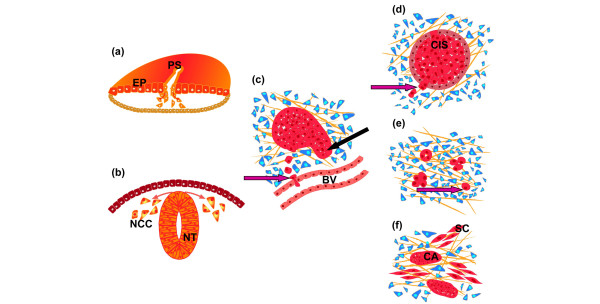
Epithelial to mesenchymal transition processes in development and cancer. (a) Epithelial to mesenchymal transition (EMT) in chicken embryo at the gastrulation stage. Epiblast cells (EP) delaminate at the primitive streak (PS) and undergo extensive migration before giving rise to different mesodermal derivatives. (b) EMT in the ontogeny of the neural crest. Neural crest cells (NCC) delaminate from the dorsal neural tube (NT; trunk level in chicken embryos). (c) EMT in murine mammary carcinoma tumors either in transgenic or fat pad orthotopic tumor implantation models. EMT is one of the mechanisms allowing solitary cells to reach blood vessels (BV) and intravasate (purple arrow). The involvement of macrophages in the invasion and intravasation of solitary carcinoma cells is not shown in the schematic diagram. Carcinoma can also invade the stroma (black arrow) through collective cell migration [87]. (d) EMT in breast ductal carcinoma in situ (CIS) at the microinvasive stage. Arrow points to cells delaminating from the in situ carcinoma mass. (e) EMT in invasive ductal carcinoma. High grade invasive carcinoma contains single cells among cell clusters. Some cells can also intravasate blood vessels (not shown) and form a transient interaction with macrophages [82]. An EMT signature is found to be mostly associated with the basal subtype [28]. (f) EMT in sarcomatoid carcinoma. Sarcoma-like malignant cells (SC) are closely apposed to carcinoma islands (CA). It is not known whether carcinoma cells can reversibly acquire the sarcoma-like phenotype; however, both subtypes share genetic alterations and the sarcoma subtype exhibits an EMT signature [88]. Blue cells in the schematic diagrams represent stromal cells.
References
-
- Perou CM, Sørlie T, Eisen MB, Rijn M van de, Jeffrey SS, Rees CA, Pollack JR, Ross DT, Johnsen H, Akslen LA, Fluge O, Pergamenschikov A, Williams C, Zhu SX, Lønning PE, Børresen-Dale AL, Brown PO, Botstein D. Molecular portraits of human breast tumours. Nature. 2000;406:747–752. doi: 10.1038/35021093. - DOI - PubMed
Publication types
MeSH terms
LinkOut - more resources
Full Text Sources
Other Literature Sources
Medical
