


Genomic profiling of plasmablastic lymphoma using array comparative genomic hybridization (aCGH): revealing significant overlapping genomic lesions with diffuse large B-cell lymphoma
- PMID: 19909553
- PMCID: PMC2789747
- DOI: 10.1186/1756-8722-2-47
Genomic profiling of plasmablastic lymphoma using array comparative genomic hybridization (aCGH): revealing significant overlapping genomic lesions with diffuse large B-cell lymphoma
Abstract
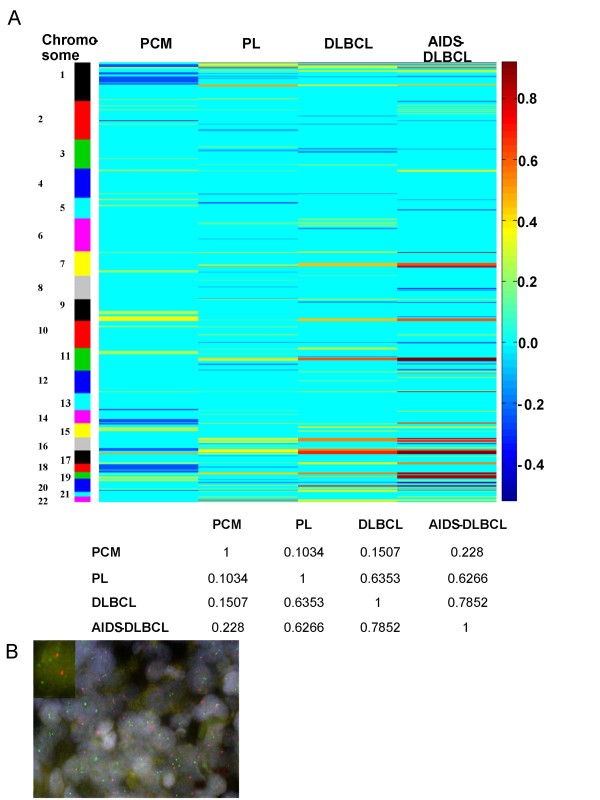
Background: Plasmablastic lymphoma (PL) is a subtype of diffuse large B-cell lymphoma (DLBCL). Studies have suggested that tumors with PL morphology represent a group of neoplasms with clinopathologic characteristics corresponding to different entities including extramedullary plasmablastic tumors associated with plasma cell myeloma (PCM). The goal of the current study was to evaluate the genetic similarities and differences among PL, DLBCL (AIDS-related and non AIDS-related) and PCM using array-based comparative genomic hybridization.
Results: Examination of genomic data in PL revealed that the most frequent segmental gain (> 40%) include: 1p36.11-1p36.33, 1p34.1-1p36.13, 1q21.1-1q23.1, 7q11.2-7q11.23, 11q12-11q13.2 and 22q12.2-22q13.3. This correlated with segmental gains occurring in high frequency in DLBCL (AIDS-related and non AIDS-related) cases. There were some segmental gains and some segmental loss that occurred in PL but not in the other types of lymphoma suggesting that these foci may contain genes responsible for the differentiation of this lymphoma. Additionally, some segmental gains and some segmental loss occurred only in PL and AIDS associated DLBCL suggesting that these foci may be associated with HIV infection. Furthermore, some segmental gains and some segmental loss occurred only in PL and PCM suggesting that these lesions may be related to plasmacytic differentiation.
Conclusion: To the best of our knowledge, the current study represents the first genomic exploration of PL. The genomic aberration pattern of PL appears to be more similar to that of DLBCL (AIDS-related or non AIDS-related) than to PCM. Our findings suggest that PL may remain best classified as a subtype of DLBCL at least at the genome level.
Figures
References
-
- Delecluse HJ, Anagnostopoulos I, Dallenbach F, Hummel M, Marafioti T, Schneider U, Huhn D, Schmidt-Westhausen A, Reichart PA, Gross U, Stein H. Plasmablastic lymphomas of the oral cavity: a new entity associated with the human immunodeficiency virus infection. Blood. 1997;89:1413–1420. - PubMed
-
- Gates AE, Kaplan LD. AIDS malignancies in the era of highly active antiretroviral therapy. Oncology (Huntingt) 2002;16:657–665. - PubMed
-
- Gatter K, Warnke R. In: Pathology and Genetics of Tumours of Haematopoietic and Lymphoid Tissues. 3. Jaffe ES, Harris NL, Stein H, Vardiman JW, editor. Lyon: IARC Press; 2001. From Diffuse large B-cell lymphoma; pp. 171–174.
Publication types
MeSH terms
Grants and funding
LinkOut - more resources
Full Text Sources
Other Literature Sources
