


Comparative Study
doi: 10.1016/j.mrfmmm.2009.03.009.
Epub 2009 Apr 2.
Spontaneously arising red cells with a McLeod-like phenotype in normal donors
Affiliations
- PMID: 19909712
- PMCID: PMC2794671
- DOI: 10.1016/j.mrfmmm.2009.03.009
Item in Clipboard
Comparative Study
Spontaneously arising red cells with a McLeod-like phenotype in normal donors
Mutat Res.
.
Abstract
Very few human genes can be used to identify spontaneous inactivating somatic mutations. We hypothesized that because the XK gene is X-linked, it would be easy to identify spontaneously arising red cells with a phenotype resembling the McLeod syndrome, which results from inherited XK mutations. Here, by flow cytometry, we detect such phenotypic variants at a median frequency of 9 x 10(-6) in neonatal cord blood samples and 39 x 10(-6) in healthy adults (p=0.004). It may be possible to further investigate the relationship between aging, mutations, and cancer using this approach.
Figures
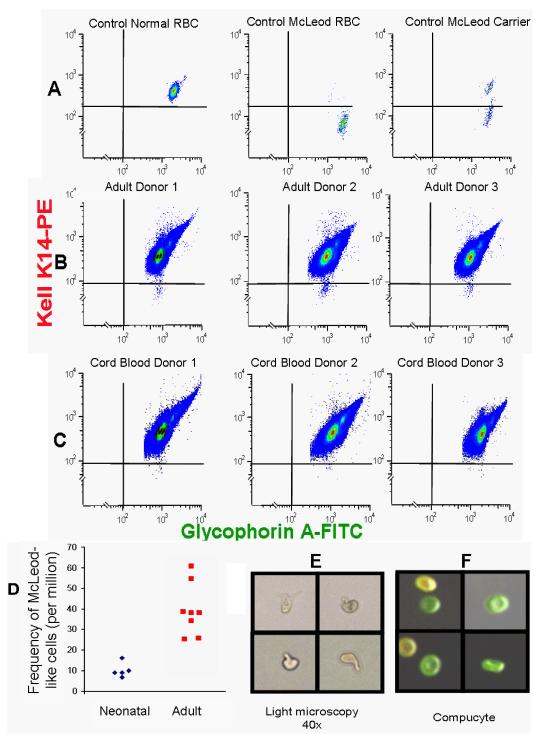
(A) Bivariate flow cytometry plots demonstrating that red blood cells from a patient with the McLeod syndrome express significantly lower levels of the Kell protein antigen recognized by the K14 antibody, but normal levels of glycophorin-A, compared with a normal donor. An obligate heterozygote carrier female exhibits a bimodal distribution due to random X-chromosome inactivation of either the wild type or mutant XK allele. (B) Representative analyses from three normal adult donors. In each case there is a small, distinct population of cells, in the lower right quadrant, that express much lower levels of K14 antigen. The frequency of phenotypic variants is calculated as the number of events in the lower right quadrant divided by the total number of gated events analyzed, see Table I. (C) Representative analyses from neonatal cord blood samples. (D) Distribution of the frequency of phenotypic variants for adults and neonates. (E) Red cells from normal donors with a McLeod-like phenotype were enriched by sorting (top left, top right panels) or bead and column depletion of K14 expressing cells (bottom right, bottom left panels). Cells with acanthocyte-like projections are shown. (F) iCyte analysis of red cells from a normal donor that were first enriched by bead depletion of K14 expressing cells, then stained sequentially with rabbit anti-mouse PE and anti-glycophorin A-FITC antibodies. Gates were set to visualize the glycophorin A-positive, K14-negative population, which appeared as bright green discocytes. The gated K14 positive population (not shown) and incidentally visualized neighboring K14 positive cells (top left, bottom left) produce a merged yellow fluorescence.
References
-
- Morley A, Trainor K, Seshadri R, Ryall R. Measurement of in vivo mutations in human lymphocytes. Nature. 1983;302:155–156. - PubMed
-
- Albertini R, Nicklas J, O’Neill J, Robison S. In vivo somatic mutations in humans: measurement and analysis. Annu Rev Genet. 1990;24:305–326. - PubMed
-
- Grist S, McCarron M, Kutlaca A, Turner D, Morley A. In vivo human somatic mutation: frequency and spectrum with age. Mutation Research. 1992;266:189–196. - PubMed
Publication types
MeSH terms
Substances
Grants and funding
LinkOut - more resources
Full Text Sources
Medical
