


A role for heparan sulfate in viral surfing
- PMID: 19909728
- PMCID: PMC2812628
- DOI: 10.1016/j.bbrc.2009.11.027
A role for heparan sulfate in viral surfing
Abstract
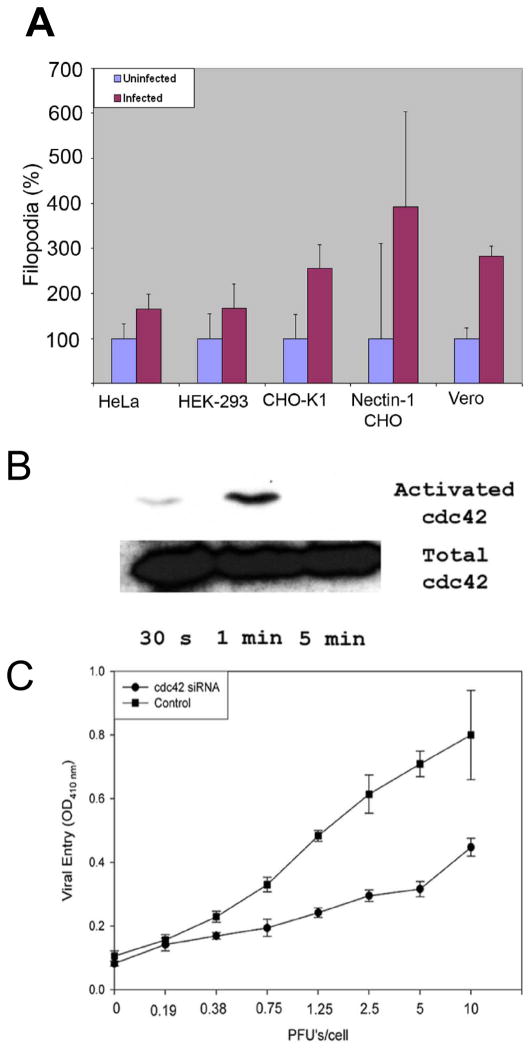
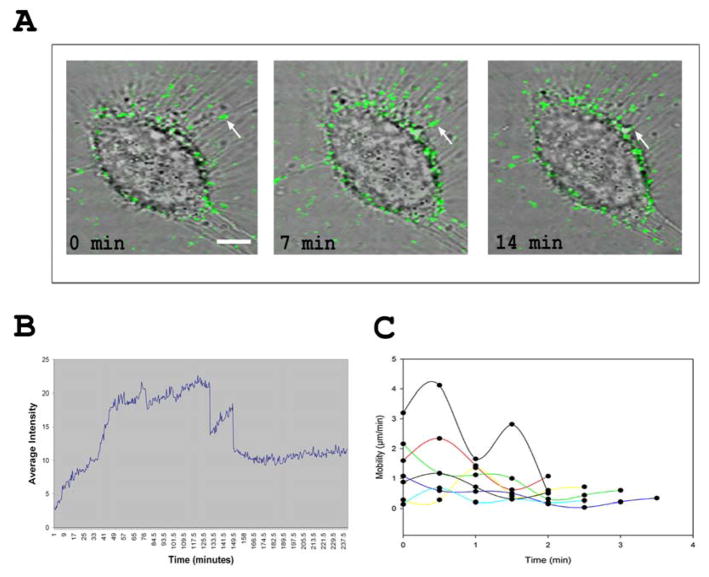
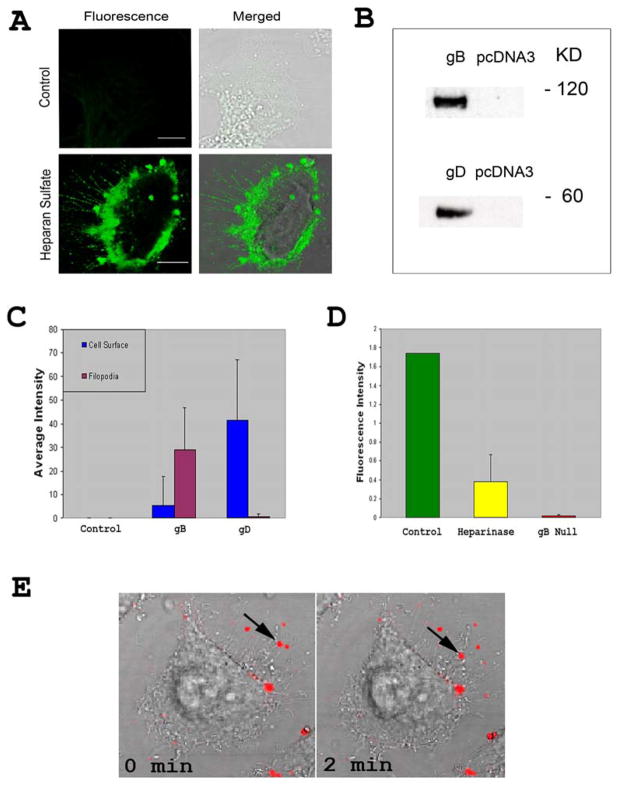
Heparan sulfate (HS) moieties on cell surfaces are known to provide attachment sites for many viruses including herpes simplex virus type-1 (HSV-1). Here, we demonstrate that cells respond to HSV-1 infection by enhancing filopodia formation. Filopodia express HS and are subsequently utilized for the transport of HSV-1 virions to cell bodies in a surfing-like phenomenon, which is facilitated by the underlying actin cytoskeleton and is regulated by transient activation of a small Rho GTPase, Cdc42. We also demonstrate that interaction between a highly conserved herpesvirus envelope glycoprotein B (gB) and HS is required for surfing. A HSV-1 mutant that lacks gB fails to surf and quantum dots conjugated with gB demonstrate surfing-like movements. Our data demonstrates a novel use of a common receptor, HS, which could also be exploited by multiple viruses and quite possibly, many additional ligands for transport along the plasma membrane.
Copyright 2009 Elsevier Inc. All rights reserved.
Figures
References
-
- Gorsi B, Stringer SE. Tinkering with heparan sulfate sulfation to steer development. Trends Cell Biol. 2007;17:173–177. - PubMed
-
- Liu J, Thorp SC. Cell surface heparan sulfate and its roles in assisting viral infections. Med Res Rev. 2002;1:1–25. - PubMed
-
- O’Donnell CD, Tiwari V, Oh MJ, Shukla D. A role for heparan sulfate 3-O-sulfotranferase isoform 2 in herpes simplex virus type 1 entry and spread. Virology. 2006;346:452–459. - PubMed
Publication types
MeSH terms
Substances
Grants and funding
LinkOut - more resources
Full Text Sources
Other Literature Sources
Miscellaneous
