


Review
doi: 10.1016/j.addr.2009.11.006.
Epub 2009 Nov 10.
Targeted hyperthermia using metal nanoparticles
Affiliations
- PMID: 19909777
- PMCID: PMC2827640
- DOI: 10.1016/j.addr.2009.11.006
Item in Clipboard
Review
Targeted hyperthermia using metal nanoparticles
Adv Drug Deliv Rev.
.
Abstract
Despite the use of hyperthermia to treat cancer for thousands of years, the challenge of only heating malignant cells remains daunting. In pre-clinical and early clinical trials, metal nanoparticles induce hyperthermic cytotoxicity when exposed to near-infrared radiation or radiofrequency fields. We discuss the emerging roles of nanoparticles, especially gold, in the hyperthermic treatment of cancer. In addition, we discuss the similarities of radiofrequency ablation and nanoparticle mediated cytotoxicity.
Copyright 2009 Elsevier B.V. All rights reserved.
Figures
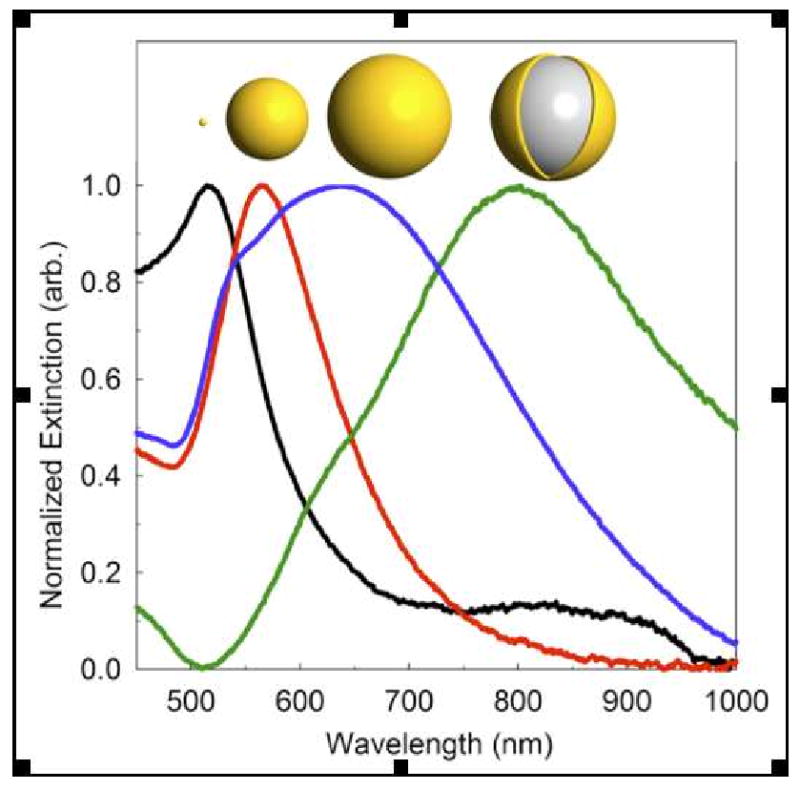
Size dependent gold nanoparticle extinction spectra. Plasmon absorption depends on nanoparticle size and composition; shown are the extinction spectra of solid gold nanoparticles (black = 10 nm dia., red = 100 nm dia., blue = 150 nm dia.) and the red shifted silica core gold nanoshell spectrum (green = 150 nm dia.). Nanoparticle illustrations above each corresponding spectra are drawn to relative scale and spectra have been normalized to ease viewing of relative peak positions.
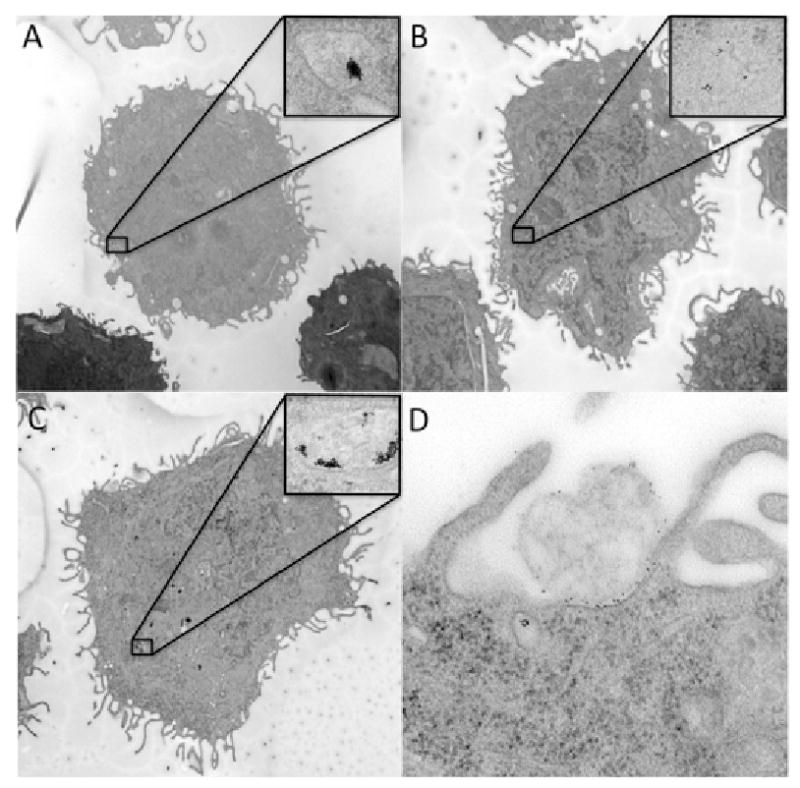
TEM images of gold nanoparticles targeted against PANC-1 cancer cells incubated for 30 minutes. A. Gold nanoparticles without antibody labels show poor internalization. B. Gold nanoparticles labeled with IgG antibodies that are nonspecific for cancer cells show low uptake. C. Gold nanoparticles labeled with C225 (cetuximab) antibodies show pronounced internalization in cells. D. Magnified 100,000×, PANC-1 cells with gold nanoparticles at the periphery of the cells.
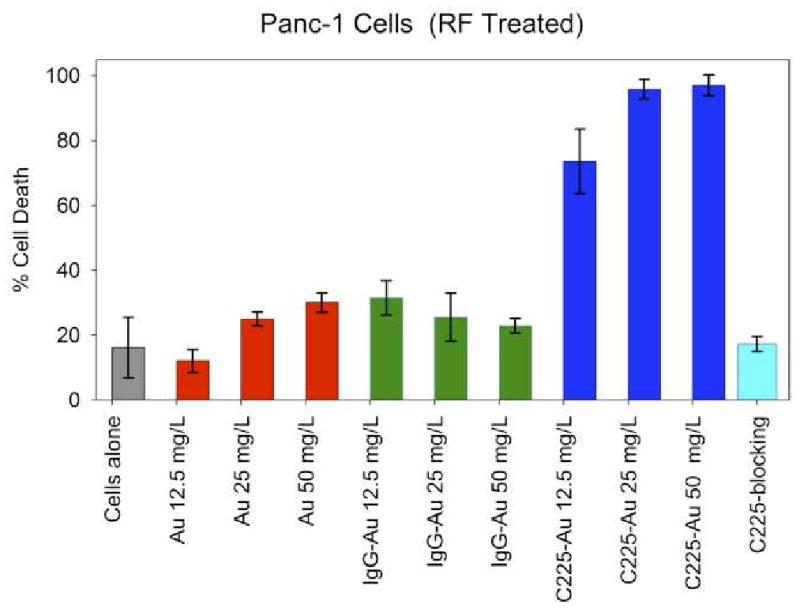
RF induced hyperthermia of cells targeted with gold nanoparticles and exposed to two-minutes RF field treatment. Treatment of Panc-1 cells with RF alone (gray bar) produced low levels of cytotoxicity. Cells treated with either unlabeled gold nanoparticles (red bars) or IgG-conjugated gold nanoparticles (green bars) were also not associated with marked increases in RF-induced thermal cytotoxicity. Treatment of Panc-1 cells with C225-conjugated gold nanoparticles (dark blue bars) led to marked enhancement in RF-induced thermal cytotoxicity, which correlated to the increased intracytoplasmic vesicles seen in Figure 3. The enhanced cytotoxicity observed with C225-conjugated gold nanoparticles was completely blocked by first incubating Panc-1 cells with C225 alone (not conjugated to gold nanoparticles) 30 minutes prior to adding the C225-conjugated gold nanoparticles (light blue bar).
References
-
- Link S, El-Sayed MA. Optical properties and ultrafast dynamics of metallic nanocrystals. Annu Rev Phys Chem. 2003;54:331–66. - PubMed
-
- Hartman KB, Wilson LJ, Rosenblum MG. Detecting and treating cancer with nanotechnology. Mol Diagn Ther. 2008;12:1–14. - PubMed
-
- Sumer B, Gao J. Theranostic nanomedicine for cancer. Nanomed. 2008;3:137–40. - PubMed
-
- Cho K, Wang X, Nie S, Chen ZG, Shin DM. Therapeutic nanoparticles for drug delivery in cancer. Clin Cancer Res. 2008;14:1310–6. - PubMed
-
- Hartman KB, Wilson LJ. Carbon nanostructures as a new high-performance platform for MR molecular imaging. Adv Exp Med Biol. 2007;620:74–84. - PubMed
Publication types
MeSH terms
Substances
Grants and funding
LinkOut - more resources
Full Text Sources
Other Literature Sources
