


Familial atypical cold urticaria: description of a new hereditary disease
- PMID: 19910034
- PMCID: PMC2794966
- DOI: 10.1016/j.jaci.2009.09.035
Familial atypical cold urticaria: description of a new hereditary disease
Abstract
Background: Acquired cold urticaria (ACU) is usually a self-limited, sporadic, cutaneous disease diagnosed based on history and a positive cold stimulation time test (CSTT) result. We describe 3 unrelated families (A, B, and C) with lifelong atypical cold urticaria distinguished from ACU and familial cold autoinflammatory syndrome.
Objective: We sought to describe a new hereditary disease of cold urticaria and study its pathogenesis.
Methods: Questionnaires, interviews, physical examinations, skin testing, and biopsies were performed. Absolute values, means, and prevalence percentages of data are reported.
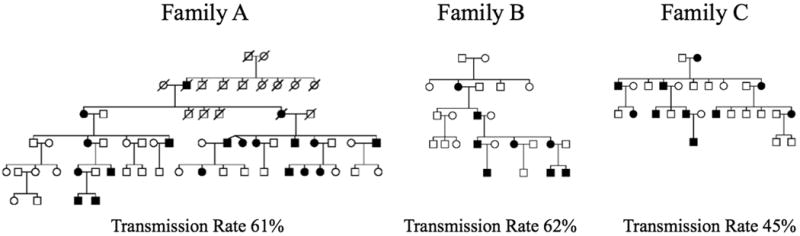
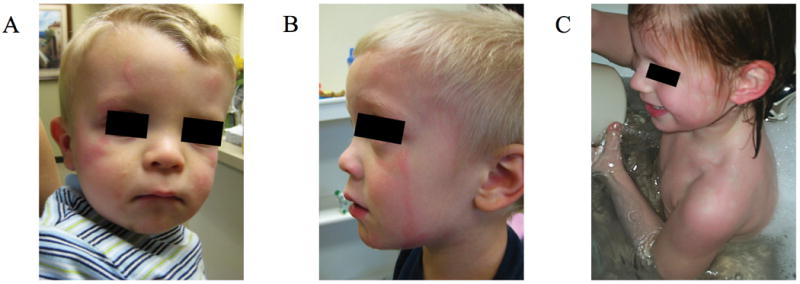
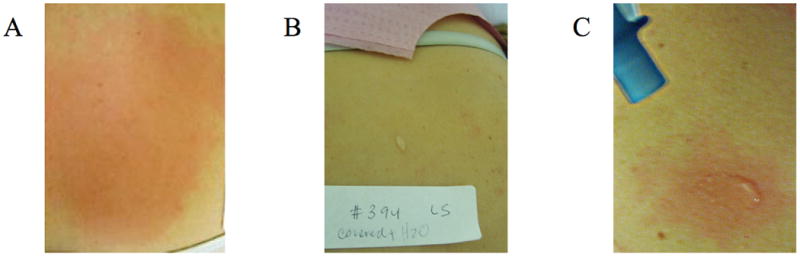
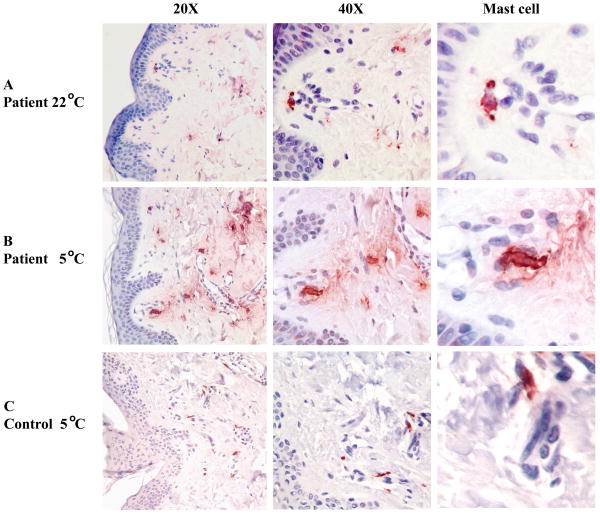
Results: Thirty-five subjects are described with familial atypical cold urticaria (FACU; family A, 17; family B, 8; and family C, 10) displaying an autosomal dominant pattern of inheritance. All tested subjects had negative CSTT results. Completed questionnaires from affected and unaffected members of families A and B (n = 35) revealed that all affected subjects had lifelong symptoms that began in early childhood with pruritus, erythema, and urticaria after cold exposure. Angioedema (family A, 23%; family B, 42%) and syncope, near syncope, or both (family A, 46%; family B, 86%) were also present. Triggers included cold atmosphere (100%), aquatic activities (family A, 92%; family B, 100%), handling cold objects (family A, 54%; family B, 71%), and ingestion of cold foods or beverages (family A, 69%; family B, 100%). Skin biopsy specimens demonstrated a mast cell infiltrate with the appearance of degranulation after cold challenge.
Conclusions: FACU is a new cold-induced inherited disease that is different than ACU in its natural history, atmospheric cold elicitation, severity of systemic reactions, and CSTT results. FACU differs from familial cold autoinflammatory syndrome in symptom timing and the absence of fever, chills, and joint pain. The cause is suspected to be mast cell related. Treatment of reactions is similar to that for ACU. Further evaluation of pathogenesis and genetics is warranted.
Conflict of interest statement
There is no conflict of interest.
Figures
References
-
- Wanderer AA, Hoffman HM. The spectrum of acquired and familial cold-induced cold urticaria/urticaria-like syndromes. Immunol Allergy Clin North Am. 2004;15:701–23. - PubMed
-
- Wanderer AA, Grandel KE, Wasserman SI, Farr RS. Clinical characteristics of cold-induced systemic reactions in acquired cold urticaria syndromes: recommendations for prevention of this complication and a proposal for a diagnostic classification of cold urticaria. J Allergy Clin Immunol. 1986;78:417–23. - PubMed
-
- Siebenhaar F, Weller K, Mlynek A, Magerl M, Altrichter S, Vieira dos Santos R, et al. Acquired cold urticaria: clinical picture and update on diagnosis and treatment. Clin Exp Dermatol. 2007;32:241–5. - PubMed
-
- Kaplan AP, Garofalo J. Identification of a new physically induced urticaria: cold-induced cholinergic urticaria. J Allergy Clin Immunol. 1981;68:438–41. - PubMed
-
- Kaplan AP. Unusual cold-induced disorders: cold-dependent dermatographism and systemic cold urticaria. J Allergy Clin Immunol. 1984;73:453–6. - PubMed
Publication types
MeSH terms
Grants and funding
LinkOut - more resources
Full Text Sources
Other Literature Sources
Medical
Molecular Biology Databases
