Teenage pregnancy and social disadvantage: systematic review integrating controlled trials and qualitative studies
- PMID: 19910400
- PMCID: PMC2776931
- DOI: 10.1136/bmj.b4254
Teenage pregnancy and social disadvantage: systematic review integrating controlled trials and qualitative studies
Abstract
Objectives: To determine the impact on teenage pregnancy of interventions that address the social disadvantage associated with early parenthood and to assess the appropriateness of such interventions for young people in the United Kingdom.
Design: Systematic review, including a statistical meta-analysis of controlled trials on interventions for early parenthood and a thematic synthesis of qualitative studies that investigated the views on early parenthood of young people living in the UK.
Data sources: 12 electronic bibliographic databases, five key journals, reference lists of relevant studies, study authors, and experts in the field. Review methods Two independent reviewers assessed the methodological quality of studies and abstracted data.
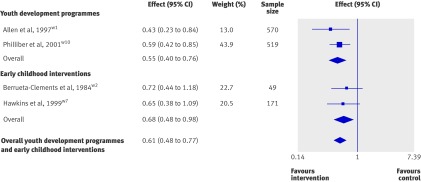
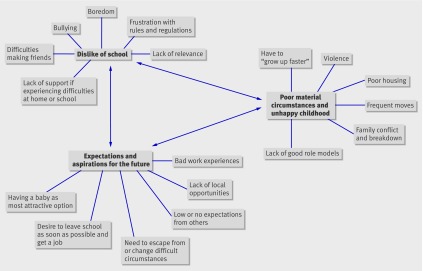
Results: Ten controlled trials and five qualitative studies were included. Controlled trials evaluated either early childhood interventions or youth development programmes. The overall pooled effect size showed that teenage pregnancy rates were 39% lower among individuals receiving an intervention than in those receiving standard practice or no intervention (relative risk 0.61; 95% confidence interval 0.48 to 0.77). Three main themes associated with early parenthood emerged from the qualitative studies: dislike of school; poor material circumstances and unhappy childhood; and low expectations for the future. Comparison of these factors related to teenage pregnancy with the content of the programmes used in the controlled trials indicated that both early childhood interventions and youth development programmes are appropriate strategies for reducing unintended teenage pregnancies. The programmes aim to promote engagement with school through learning support, ameliorate unhappy childhood through guidance and social support, and raise aspirations through career development and work experience. However, none of these approaches directly tackles all the societal, community, and family level factors that influence young people's routes to early parenthood.
Conclusions: A small but reliable evidence base supports the effectiveness and appropriateness of early childhood interventions and youth development programmes for reducing unintended teenage pregnancy. Combining the findings from both controlled trials and qualitative studies provides a strong evidence base for informing effective public policy.
Conflict of interest statement
Competing interests: None declared.
Figures
References
-
- Department for Education and Skills. Teenage Pregnancy: accelerating the strategy to 2010. Department for Education and Skills, 2006. http://www.dcsf.gov.uk/everychildmatters/resources-and-practice/ig00156/.
-
- Holgate HS, Evans R, Yuen FKO. Teenage pregnancy and parenthood: global perspectives, issues and interventions. Routledge, 2006.
-
- United Nations International Children’s Emergency Fund. A league table of teenage births in rich nations. Innocenti Report Card No. 3. UNICEF Innocenti Research Centre, 2001.
-
- Hoffman SD. Teenage childbearing is not so bad after all—is it? A review of new literature. Int Fam Plan Perspect 1998;30:236-9. - PubMed
-
- Bonell CP. Why is teenage pregnancy conceptualised as a social problem? A review of quantitative research from the USA and UK. Cult Health Sex 2004;6:1-18. - PubMed
Publication types
MeSH terms
Grants and funding
LinkOut - more resources
Full Text Sources
Medical