


Predominant membrane localization is an essential feature of the bacterial signal recognition particle receptor
- PMID: 19912622
- PMCID: PMC2780400
- DOI: 10.1186/1741-7007-7-76
Predominant membrane localization is an essential feature of the bacterial signal recognition particle receptor
Abstract
Background: The signal recognition particle (SRP) receptor plays a vital role in co-translational protein targeting, because it connects the soluble SRP-ribosome-nascent chain complex (SRP-RNCs) to the membrane bound Sec translocon. The eukaryotic SRP receptor (SR) is a heterodimeric protein complex, consisting of two unrelated GTPases. The SRbeta subunit is an integral membrane protein, which tethers the SRP-interacting SRalpha subunit permanently to the endoplasmic reticulum membrane. The prokaryotic SR lacks the SRbeta subunit and consists of only the SRalpha homologue FtsY. Strikingly, although FtsY requires membrane contact for functionality, cell fractionation studies have localized FtsY predominantly to the cytosolic fraction of Escherichia coli. So far, the exact function of the soluble SR in E. coli is unknown, but it has been suggested that, in contrast to eukaryotes, the prokaryotic SR might bind SRP-RNCs already in the cytosol and only then initiates membrane targeting.
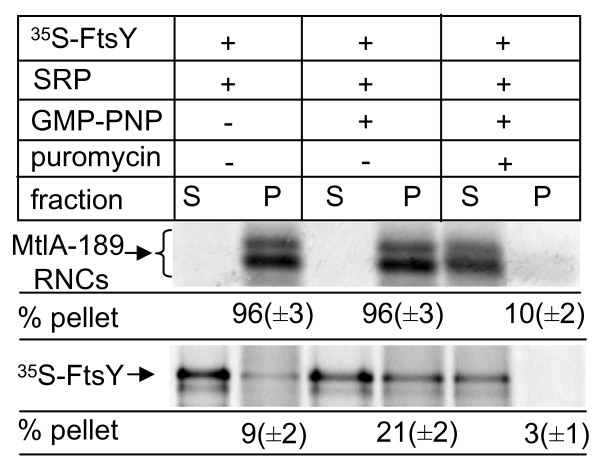
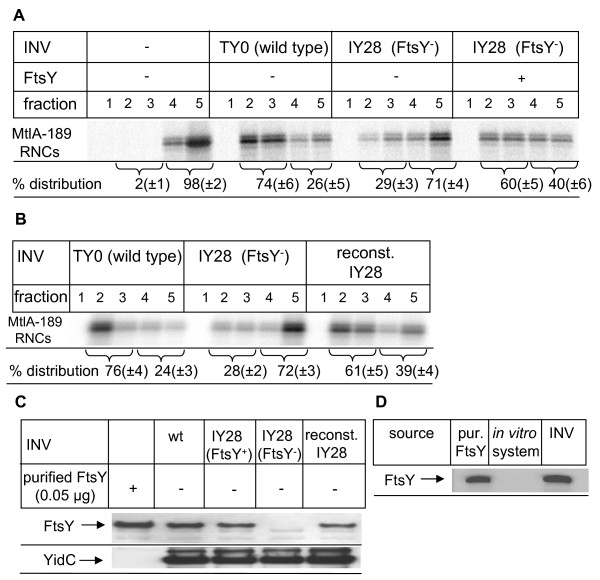
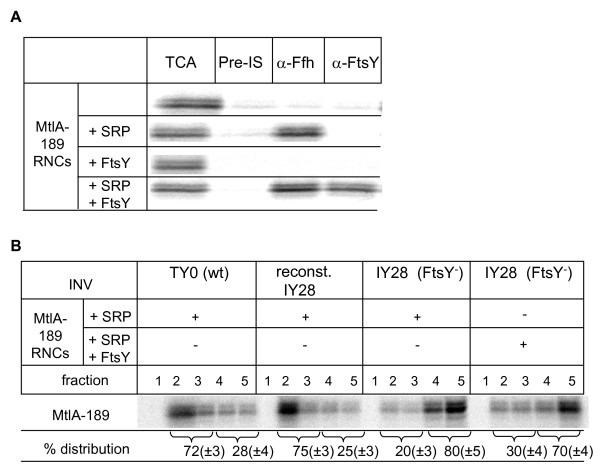
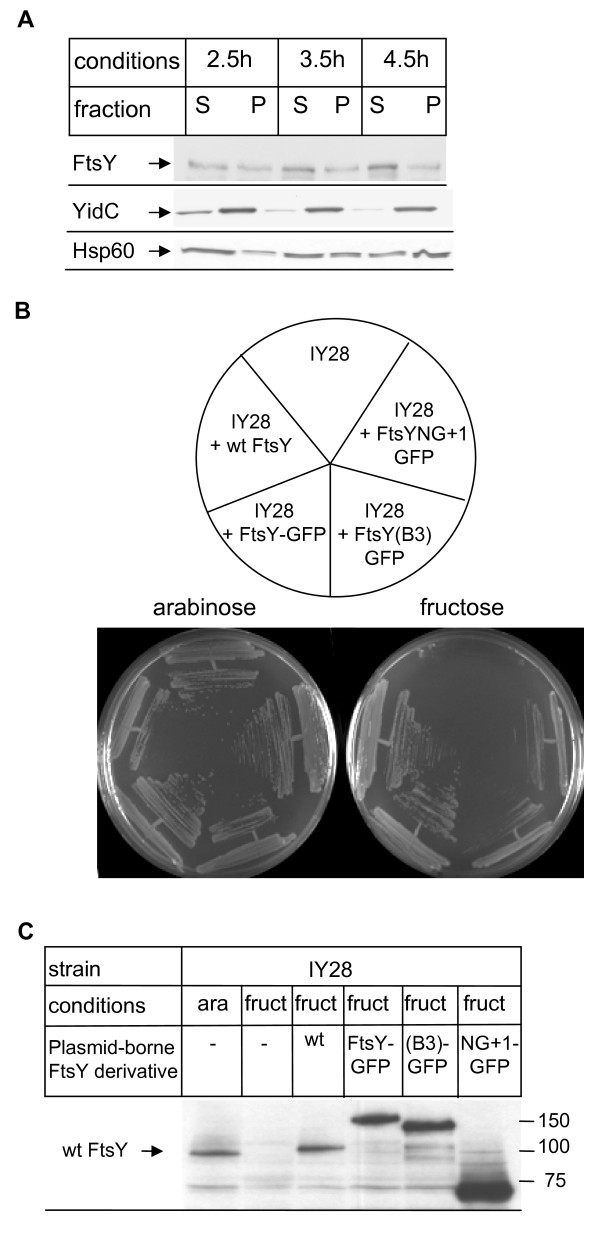
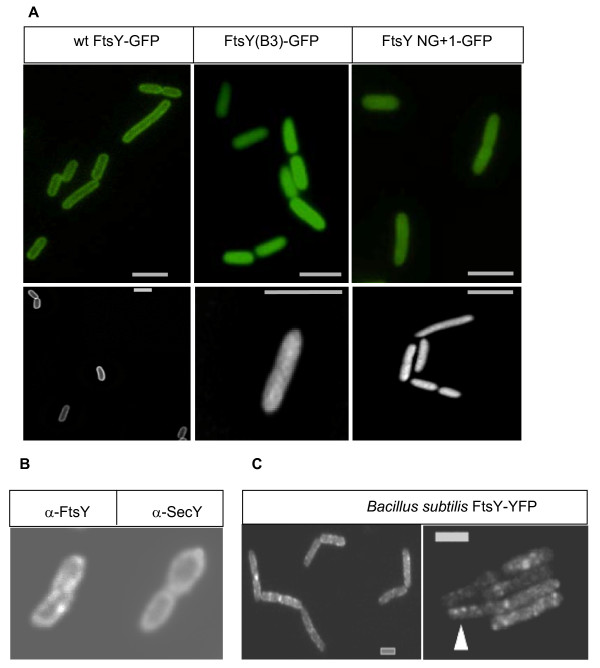
Results: In the current study we have determined the contribution of soluble FtsY to co-translational targeting in vitro and have re-analysed the localization of FtsY in vivo by fluorescence microscopy. Our data show that FtsY can bind to SRP-ribosome nascent chains (RNCs) in the absence of membranes. However, these soluble FtsY-SRP-RNC complexes are not efficiently targeted to the membrane. In contrast, we observed effective targeting of SRP-RNCs to membrane-bond FtsY. These data show that soluble FtsY does not contribute significantly to cotranslational targeting in E. coli. In agreement with this observation, our in vivo analyses of FtsY localization in bacterial cells by fluorescence microscopy revealed that the vast majority of FtsY was localized to the inner membrane and that soluble FtsY constituted only a negligible species in vivo.
Conclusion: The exact function of the SRP receptor (SR) in bacteria has so far been enigmatic. Our data show that the bacterial SR is almost exclusively membrane-bound in vivo, indicating that the presence of a soluble SR is probably an artefact of cell fractionation. Thus, co-translational targeting in bacteria does not involve the formation of a soluble SR-signal recognition particle (SRP)-ribosome nascent chain (RNC) intermediate but requires membrane contact of FtsY for efficient SRP-RNC recruitment.
Figures
References
-
- Koch HG, Moser M, Müller M. Signal recognition particle-dependent protein targeting, universal to all kingdoms of life. Rev Physiol Biochem Pharm. 2003;146:55–94. - PubMed
-
- Bornemann T, Jöckel J, Rodnina M, Wintermeyer W. Signal sequence-independent membrane targeting of ribosomes containing short nascent peptides within the exit tunnel. Nat Struct Mol Biol. 2008;15:494–499. - PubMed
-
- Song W, Raden D, Mandon E, Gilmore R. Role of Sec61α in the regulated transfer of the ribosome-nascent chain complex from the signal recognition particle to the translocation channel. Cell. 2000;100:333–343. - PubMed
-
- Halic M, Gartmann M, Schlenker O, Mielke T, Pool MR, Sinning I, Beckmann R. The SRP receptor exposes the ribosomal translocon binding site. Science. 2006;312:745–747. - PubMed
Publication types
MeSH terms
Substances
LinkOut - more resources
Full Text Sources
Molecular Biology Databases
Research Materials
