


BMP antagonists and FGF signaling contribute to different domains of the neural plate in Xenopus
- PMID: 19913009
- PMCID: PMC2812634
- DOI: 10.1016/j.ydbio.2009.11.008
BMP antagonists and FGF signaling contribute to different domains of the neural plate in Xenopus
Abstract
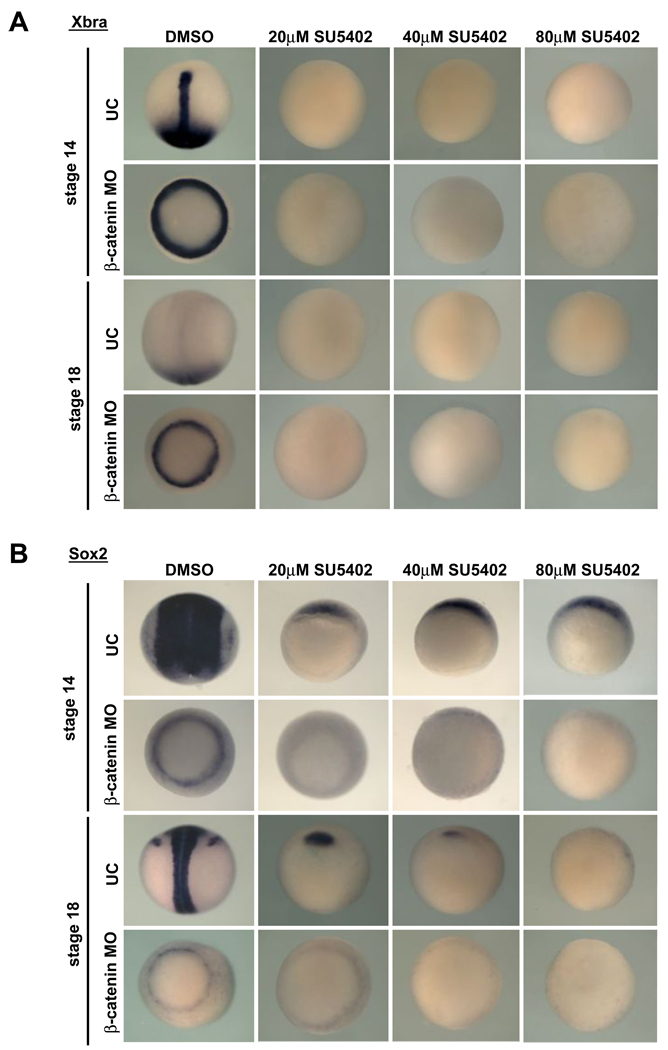
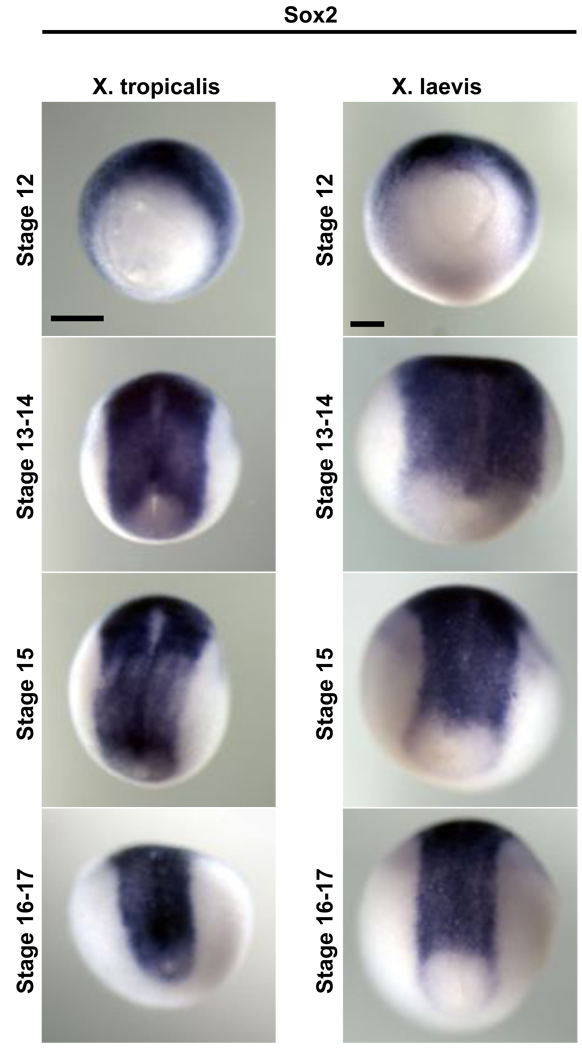
In ectodermal explants from Xenopus embryos, inhibition of BMP signaling is sufficient for neural induction, leading to the idea that neural fate is the default state in the ectoderm. Many of these experiments assayed the action of BMP antagonists on animal caps, which are relatively naïve explants of prospective ectoderm, and different results have led to debate regarding both the mechanism of neural induction and the appropriateness of animal caps as an assay system. Here we address whether BMP antagonists are only able to induce neural fates in pre-patterned explants, and the extent to which neural induction requires FGF signaling. We suggest that some discrepancies in conclusion depend on the interpretations of sox gene expression, which we show not only marks definitive neural tissue, but also tissue that is not yet committed to neural fates. Part of the early sox2 domain requires FGF signaling, but in the absence of organizer signaling, this domain reverts to epidermal fates. We also reinforce the evidence that ectodermal explants are naïve, and that explants that lack any dorsal prepattern are readily neuralized by BMP antagonists, even when FGF signaling is inhibited.
Copyright 2009 Elsevier Inc. All rights reserved.
Figures





References
-
- Bachiller D, Klingensmith J, Kemp C, Belo JA, Anderson RM, May SR, McMahon JA, McMahon AP, Harland RM, Rossant J, De Robertis EM. The organizer factors Chordin and Noggin are required for mouse forebrain development. Nature. 2000;403:658–661. - PubMed
-
- Barnett MW, Old RW, Jones EA. Neural induction and patterning by fibroblast growth factor, notochord and somite tissue in Xenopus. Dev Growth Differ. 1998;40:47–57. - PubMed
-
- Bolce ME, Hemmati-Brivanlou A, Kushner PD, Harland RM. Ventral ectoderm of Xenopus forms neural tissue, including hindbrain, in response to activin. Development. 1992;115:681–688. - PubMed
-
- Chang C, Harland RM. Neural induction requires continued suppression of both Smad1 and Smad2 signals during gastrulation. Development. 2007;134:3861–3872. - PubMed
-
- Christen B, Slack JM. FGF-8 is associated with anteroposterior patterning and limb regeneration in Xenopus. Dev Biol. 1997;192:455–466. - PubMed
Publication types
MeSH terms
Substances
Grants and funding
LinkOut - more resources
Full Text Sources
Miscellaneous
