


Mice over-expressing the myocardial creatine transporter develop progressive heart failure and show decreased glycolytic capacity
- PMID: 19913546
- PMCID: PMC2837781
- DOI: 10.1016/j.yjmcc.2009.10.033
Mice over-expressing the myocardial creatine transporter develop progressive heart failure and show decreased glycolytic capacity
Abstract
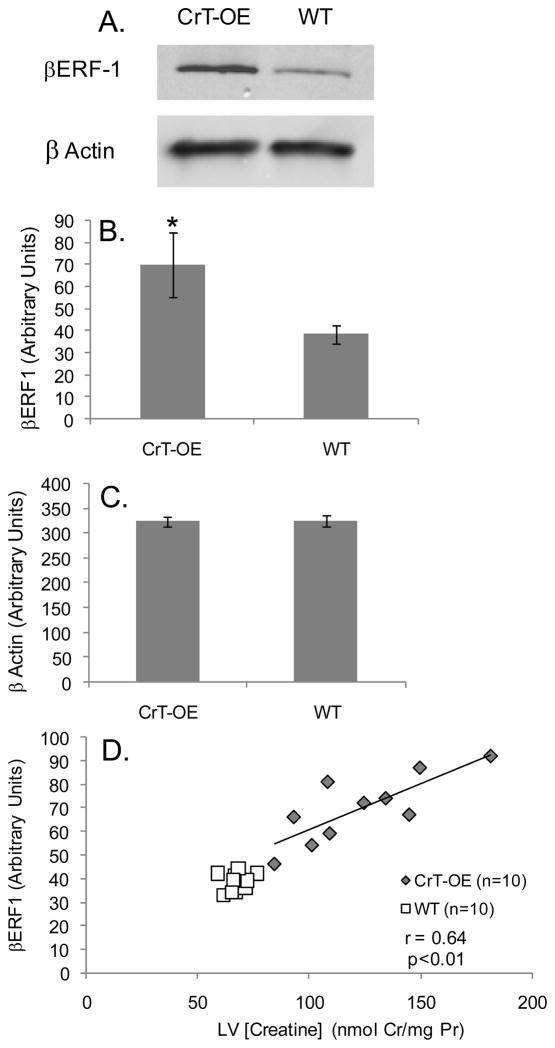
The metabolic phenotype of the failing heart includes a decrease in phosphocreatine and total creatine concentration [Cr], potentially contributing to contractile dysfunction. Surprisingly, in 32- week-old mice over-expressing the myocardial creatine transporter (CrT-OE), we previously demonstrated that elevated [Cr] correlates with left ventricular (LV) hypertrophy and failure. The aim of this study was to determine the temporal relationship between elevated [Cr] and the onset of cardiac dysfunction and to screen for potential molecular mechanisms. CrT-OE mice were compared with wild-type (WT) littermate controls longitudinally using cine-MRI to measure cardiac function and single-voxel (1)H-MRS to measure [Cr] in vivo at 6, 16, 32, and 52 weeks of age. CrT-OE mice had elevated [Cr] at 6 weeks (mean 1.9-fold), which remained constant throughout life. Despite this increased [Cr], LV dysfunction was not apparent until 16 weeks and became more pronounced with age. Additionally, LV tissue from 12 to 14 week old CrT-OE mice was compared to WT using 2D difference in-gel electrophoresis (DIGE). These analyses detected a majority of the heart's metabolic enzymes and identified seven proteins that were differentially expressed between groups. The most pronounced protein changes were related to energy metabolism: alpha- and beta-enolase were selectively decreased (p<0.05), while the remaining enzymes of glycolysis were unchanged. Consistent with a decrease in enolase content, its activity was significantly lower in CrT-OE hearts (in WT, 0.59+/-0.02 micromol ATP produced/microg protein/min; CrT-OE, 0.31+/-0.06; p<0.01). Additionally, anaerobic lactate production was decreased in CrT-OE mice (in WT, 102+/-3 micromol/g wet myocardium; CrT-OE, 78+/-13; p=0.02), consistent with decreased glycolytic capacity. Finally, we found that enolase may be regulated by increased expression of the beta-enolase repressor transcription factor, which was significantly increased in CrT-OE hearts. This study demonstrates that chronically increased myocardial [Cr] in the CrT-OE model leads to the development of progressive hypertrophy and heart failure, which may be mediated by a compromise in glycolytic capacity at the level of enolase.
Published by Elsevier Ltd.
Figures


References
-
- Hermann G, Decherd GM. The chemical nature of heart failure. Ann Intern Med. 1939;12:1233–44.
-
- Neubauer S. The failing heart--an engine out of fuel. N Engl J Med. 2007;356:1140–51. - PubMed
-
- OLSON RE, SCHWARTZ WB. Myocardial metabolism in congestive heart failure. Medicine (Baltimore) 1951;30:21–41. - PubMed
-
- Ashrafian H, Frenneaux MP, Opie LH. Metabolic mechanisms in heart failure. Circulation. 2007;116:434–48. - PubMed
-
- Ingwall JS, Weiss RG. Is the failing heart energy starved? On using chemical energy to support cardiac function. Circ Res. 2004;95:135–45. - PubMed
Publication types
MeSH terms
Substances
Grants and funding
LinkOut - more resources
Full Text Sources
Other Literature Sources
Medical
Research Materials
