


Preteen insulin levels interact with caloric intake to predict increases in obesity at ages 18 to 19 years: a 10-year prospective study of black and white girls
- PMID: 19913844
- PMCID: PMC2856778
- DOI: 10.1016/j.metabol.2009.09.016
Preteen insulin levels interact with caloric intake to predict increases in obesity at ages 18 to 19 years: a 10-year prospective study of black and white girls
Abstract
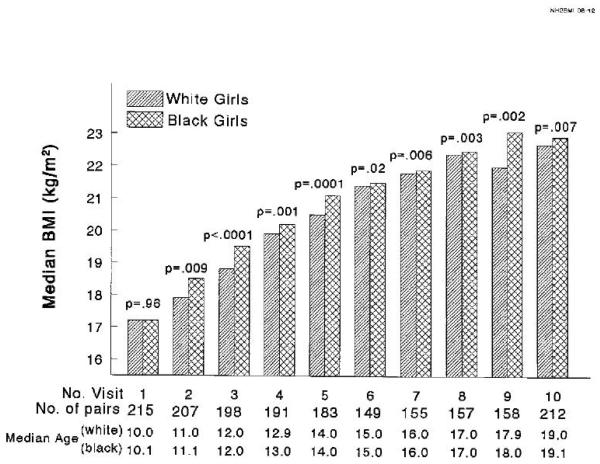
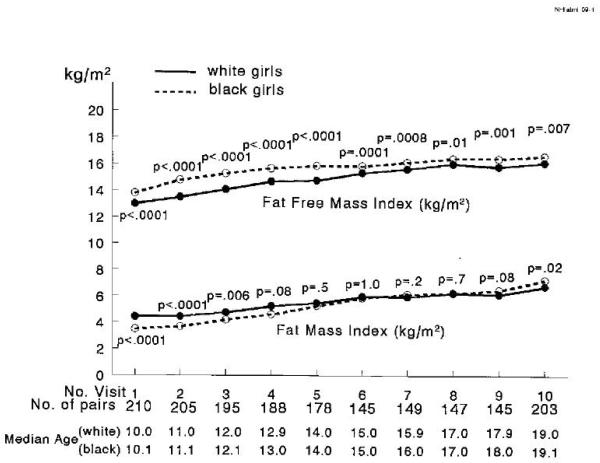
We evaluated the associations of teenage insulin and adolescent diet with 10-year weight gain in an analysis sample of black and white girls matched for pubertal stage, body mass index (BMI) (or fat mass), and insulin at ages 9 to 10 years. We hypothesized that preteen insulin and insulin resistance would interact with dietary factors to positively predict increases in BMI. Furthermore, we hypothesized that increased insulin and insulin resistance, interacting with higher caloric intake during adolescence, would lead to greater increments in BMI in black girls than in white girls. Prospective 10-year follow-up was performed on 215 pairs of black and white schoolgirls matched at baseline by BMI (or fat mass), insulin, and pubertal stage, with repeated measures of body habitus, insulin, and dietary intake. When matched for BMI, black girls had higher fat-free mass and white girls had higher fat mass at ages 9 to 10 years. Black-white differences in caloric intake were not significant at ages 9 to 10 years, but black girls consumed more calories at age 19 years. Black girls consumed a greater percentage of calories from fat throughout. At age 19 years, black girls had higher BMI, fat mass index, and insulin. When matched at ages 9 to 10 years for fat mass, black girls were heavier, had higher BMI, and had greater fat-free mass. By ages 18 to 19 years, black girls continued to have higher BMI, but had accrued higher fat mass and a higher percentage of body fat. By stepwise multiple regression, 10-year increases in BMI were predicted by ages 9 to 10 years BMI, 10-year change in insulin, and a 3-way interaction between ages 9 to 10 years insulin, adolescent caloric intake, and race (higher in black girls) (all Ps < .0001). Insulin at ages 9 to 10 years interacts with caloric intake to increase BMI by age 19 years. There appear to be intrinsic black-white metabolic differences that lead to greater gains in fat during adolescence in black girls. Evaluating BMI and insulin at ages 9 to 10 years could identify girls (particularly black) who would optimally benefit from dietary and exercise interventions to avoid obesity.
Figures


References
-
- Williamson DF, Kahn HS, Byers T. The 10-y incidence of obesity and major weight gain in black and white US women aged 30-55 y. Am J Clin Nutr. 1991;53:1515S–8S. - PubMed
-
- Troiano RP, Flegal KM, Kuczmarski RJ, Campbell SM, Johnson CL. Overweight prevalence and trends for children and adolescents. The National Health and Nutrition Examination Surveys, 1963 to 1991. Arch Pediatr Adolesc Med. 1995;149:1085–91. - PubMed
-
- Morrison JA, Sprecher DL, Barton BA, Waclawiw MA, Daniels SR. Overweight, fat patterning, and cardiovascular disease risk factors in black and white girls: The National Heart, Lung, and Blood Institute Growth and Health Study. J Pediatr. 1999;135:458–64. - PubMed
Publication types
MeSH terms
Substances
Grants and funding
LinkOut - more resources
Full Text Sources
Medical
