


E-mail in patient-provider communication: a systematic review
- PMID: 19914022
- PMCID: PMC4127895
- DOI: 10.1016/j.pec.2009.09.038
E-mail in patient-provider communication: a systematic review
Abstract
Objective: To review systematically the role of e-mails in patient-provider communication in terms of e-mail content, and perspectives of providers and patients on e-mail communication in health care.
Methods: A systematic review of studies on e-mail communication between patients and health providers in regular health care published from 2000 to 2008.
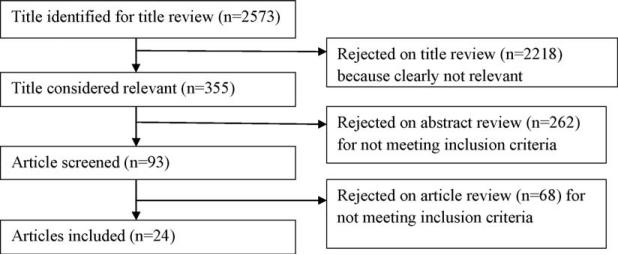
Results: A total of 24 studies were included in the review. Among these studies, 21 studies examined e-mail communication between patients and providers, and three studies examined the e-mail communication between parents of patients in pediatric primary care and pediatricians. In the content analyses of e-mail messages, topics well represented were medical information exchange, medical condition or update, medication information, and subspecialty evaluation. A number of personal and institutional features were associated with the likelihood of e-mail use between patients and providers. While benefits of e-mails in enhancing communication were recognized by both patients and providers, concerns about confidentiality and security were also expressed.
Conclusion: The e-mail is transforming the relationship between patients and providers. The rigorous exploration of pros and cons of electronic interaction in health care settings will help make e-mail communication a more powerful, mutually beneficial health care provision tool.
Practice implications: It is important to develop an electronic communication system for the clinical practice that can address a range of concerns. More efforts need to be made to educate patients and providers to appropriately and effectively use e-mail for communication.
Copyright 2009 Elsevier Ireland Ltd. All rights reserved.
Figures
Comment in
-
Patient-provider email in the "Adword" age.Patient Educ Couns. 2011 Jul;84(1):135-6. doi: 10.1016/j.pec.2010.11.015. Epub 2010 Dec 15. Patient Educ Couns. 2011. PMID: 21163606 No abstract available.
References
-
- Levinson W, Roter DL, Mullooly JP, Dull VT, Frankel RM. Physician–patient communication: the relationship with malpractice claims among primary care physicians and surgeons. J Am Med Assoc. 1997;277:553–9. - PubMed
-
- Ruiz-Moral R, Pérez Rodríguez E, Pérula de Torres LA, de la Torre J. Physician–patient communication: a study on the observed behaviours of specialty physicians and the way their patients perceive them. Patient Educ Couns. 2006;64:242–8. - PubMed
-
- Zandbelt LC, Smets EM, Oort FJ, Godfried MH, de Haes HC. Patient participation in the medical specialist encounter: does physicians’ patient-centered communication matter? Patient Educ Couns. 2007;65:396–406. - PubMed
-
- Dutta-Bergman MJ. The relation between health-orientation, provider–patient communication, and satisfaction: an individual-difference approach. Health Commun. 2005;8:291–303. - PubMed
Publication types
MeSH terms
Grants and funding
LinkOut - more resources
Full Text Sources
Medical
Miscellaneous
