


Endothelial cell responses to atheroprone flow are driven by two separate flow components: low time-average shear stress and fluid flow reversal
- PMID: 19915176
- PMCID: PMC2822569
- DOI: 10.1152/ajpheart.00565.2009
Endothelial cell responses to atheroprone flow are driven by two separate flow components: low time-average shear stress and fluid flow reversal
Abstract
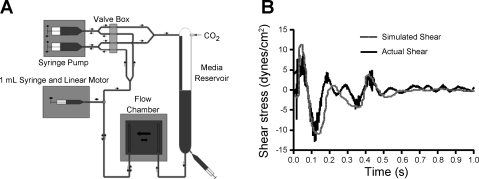
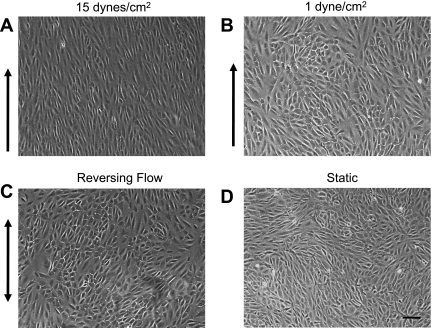
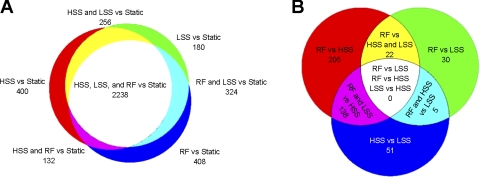
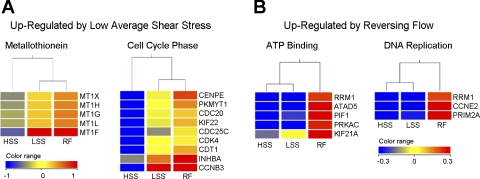
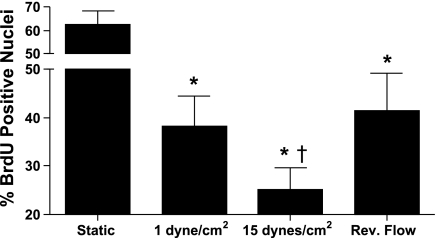
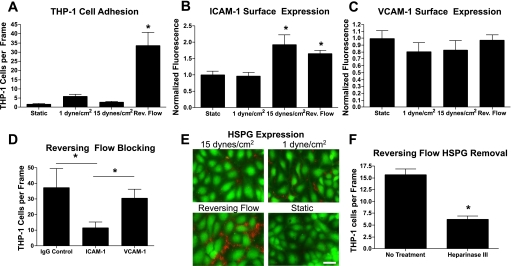
To simulate the effects of shear stress in regions of the vasculature prone to developing atherosclerosis, we subjected human umbilical vein endothelial cells to reversing shear stress to mimic the hemodynamic conditions at the wall of the carotid sinus, a site of complex, reversing blood flow and commonly observed atherosclerosis. We compared the effects of reversing shear stress (time-average: 1 dyn/cm(2), maximum: +11 dyn/cm(2), minimum: -11 dyn/cm(2), 1 Hz), arterial steady shear stress (15 dyn/cm(2)), and low steady shear stress (1 dyn/cm(2)) on gene expression, cell proliferation, and monocyte adhesiveness. Microarray analysis revealed that most differentially expressed genes were similarly regulated by all three shear stress regimens compared with static culture. Comparisons of the three shear stress regimens to each other identified 138 genes regulated by low average shear stress and 22 genes regulated by fluid reversal. Low average shear stress induced increased cell proliferation compared with high shear stress. Only reversing shear stress exposure induced monocyte adhesion. The adhesion of monocytes was partially inhibited by the incubation of endothelial cells with ICAM-1 blocking antibody. Increased heparan sulfate proteoglycan expression was observed on the surface of cells exposed to reversing shear stress. Heparinase III treatment significantly reduced monocyte adhesion. Our results suggest that low steady shear stress is the major impetus for differential gene expression and cell proliferation, whereas reversing flow regulates monocyte adhesion.
Figures
References
-
- Brooks AR, Lelkes PI, Rubanyi GM. Gene expression profiling of human aortic endothelial cells exposed to disturbed flow and steady laminar flow. Physiol Genomics 9: 27–41, 2002 - PubMed
-
- Chappell DC, Varner SE, Nerem RM, Medford RM, Alexander RW. Oscillatory shear stress stimulates adhesion molecule expression in cultured human endothelium. Circ Res 82: 532–539, 1998 - PubMed
-
- Chen BP, Li YS, Zhao Y, Chen KD, Li S, Lao J, Yuan S, Shyy JY, Chien S. DNA microarray analysis of gene expression in endothelial cells in response to 24-h shear stress. Physiol Genomics 7: 55–63, 2001 - PubMed
-
- Chow S, Rodgers P. Applet for Drawing 3 Set Area-Proportional Venn Diagrams (online). http://www.cs.kent.ac.uk/people/staff/pjr/EulerVennCircles/EulerVennAppl... [16November2009].
Publication types
MeSH terms
Substances
Grants and funding
LinkOut - more resources
Full Text Sources
Medical
Molecular Biology Databases
Miscellaneous
