. 2009 Nov 4:3:17.
doi: 10.3389/neuro.04.017.2009. eCollection 2009.

Presynaptic translation: stepping out of the postsynaptic shadow

Affiliations

Presynaptic translation: stepping out of the postsynaptic shadow

Michael R Akins et al. Front Neural Circuits. .

Abstract

The ability of the nervous system to convert transient experiences into long-lasting structural changes at the synapse relies upon protein synthesis. It has become increasingly clear that a critical subset of this synthesis occurs within the synaptic compartment. While this process has been extensively characterized in the postsynaptic compartment, the contribution of local translation to presynaptic function remains largely unexplored. However, recent evidence highlights the potential importance of translation within the presynaptic compartment. Work in cultured neurons has shown that presynaptic translation occurs specifically at synapses undergoing long-term plasticity and may contribute to the maintenance of nascent synapses. Studies from our laboratory have demonstrated that Fragile X proteins, which regulate mRNA localization and translation, are expressed at the presynaptic apparatus. Further, mRNAs encoding presynaptic proteins traffic into axons. Here we discuss recent advances in the study of presynaptic translation as well as the challenges confronting the field. Understanding the regulation of presynaptic function by local protein synthesis promises to shed new light on activity-dependent modification of synaptic architecture.

Keywords: FMRP; autism; fragile X syndrome; local translation; mRNA; mTOR; presynaptic plasticity; synaptic plasticity.


Figures
Box 1
Box 1
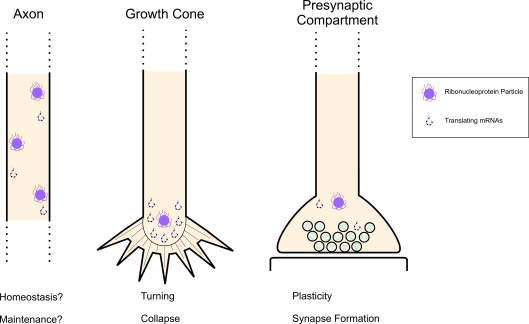
Presynaptic translation is distinct from that in axons and growth cones. Axons: Local protein synthesis has been demonstrated in axons from both invertebrates and vertebrates (reviewed in Alvarez et al., ; Wang et al., ; Lin and Holt, 2008). Messages translated include those encoding ribosomal subunits as well as heat shock, cytoskeletal and endoplasmic reticulum proteins. Gene products involved in maintaining homeostasis are also synthesized in axons. The cohort of mRNAs that localize to axons is regulated by a variety of factors including neuronal maturation, axotomy, and exposure to neurotrophins (Willis et al., , ; Taylor et al., 2009). Growth Cones: The importance of protein synthesis in growth cone turning and collapse has been shown in neurons cultured from invertebrates and vertebrates, including rodents (reviewed in Lin and Holt, 2007), but see (Roche et al., 2009). Growth cones synthesize cytoskeletal and signaling proteins and contain ultrastructurally identifiable polyribosomes (Bunge, ; Bassell et al., ; Campbell and Holt, ; Wu et al., ; Leung et al., 2006). Presynaptic compartment: Local protein synthesis has been implicated in both synapse formation and plasticity. Synapse formation in Aplysia depends on local protein production. Local presynaptic translation is required for presynaptic plasticity in Aplysia, crayfish, and Xenopus and is implicated in presynaptic plasticity in rodents. See text for references.

References

    1. Alvarez J., Giuditta A., Koenig E. (2000). Protein synthesis in axons and terminals: significance for maintenance, plasticity and regulation of phenotype: with a critique of slow transport theory. Prog. Neurobiol. 62, 1–6210.1016/S0301-0082(99)00062-3 - DOI - PubMed
    1. Aronov S., Aranda G., Behar L., Ginzburg I. (2002). Visualization of translated tau protein in the axons of neuronal P19 cells and characterization of tau RNP granules. J. Cell. Sci. 115, 3817–382710.1242/jcs.00058 - DOI - PubMed
    1. Atlas R., Behar L., Elliott E., Ginzburg I. (2004). The insulin-like growth factor mRNA binding-protein IMP-1 and the Ras-regulatory protein G3BP associate with tau mRNA and HuD protein in differentiated P19 neuronal cells. J. Neurochem. 89, 613–62610.1111/j.1471-4159.2004.02371.x - DOI - PubMed
    1. Bailey C. H., Montarolo P., Chen M., Kandel E. R., Schacher S. (1992). Inhibitors of protein and RNA synthesis block structural changes that accompany long-term heterosynaptic plasticity in Aplysia. Neuron 9, 749–75810.1016/0896-6273(92)90037-E - DOI - PubMed
    1. Bassell G. J., Zhang H., Byrd A. L., Femino A. M., Singer R. H., Taneja K. L., Lifshitz L. M., Herman I. M., Kosik K. S. (1998). Sorting of beta-actin mRNA and protein to neurites and growth cones in culture. J. Neurosci. 18, 251–265 - PMC - PubMed
