


Establishment and characterization of an osteopontin-null cutaneous squamous cell carcinoma cell line
- PMID: 19915934
- PMCID: PMC3664068
- DOI: 10.1007/s11626-009-9248-8
Establishment and characterization of an osteopontin-null cutaneous squamous cell carcinoma cell line
Abstract
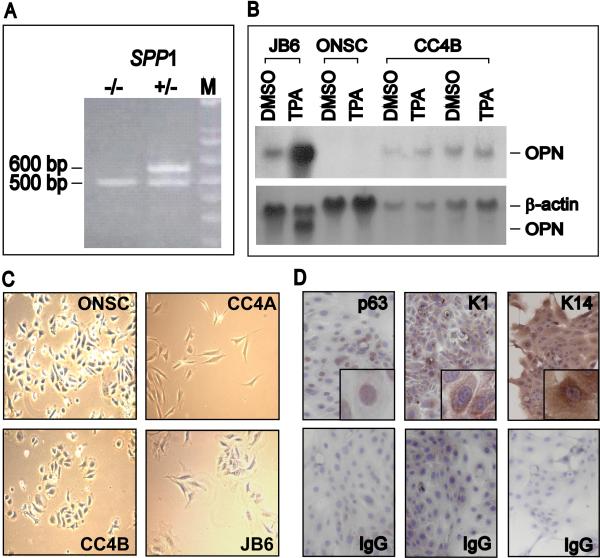
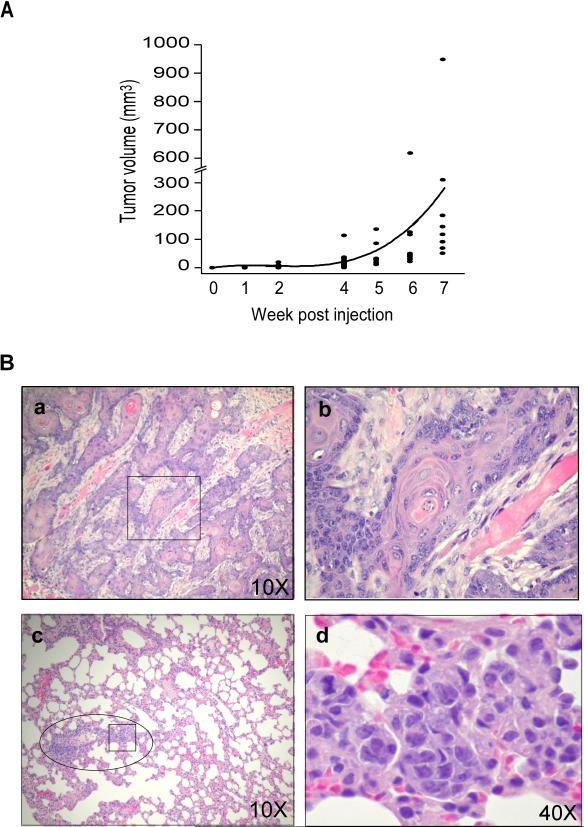
Osteopontin (OPN) is a secreted glycoprotein implicated to function in cancer development and metastasis. Although elevated expression of OPN are observed in cancer cells of various types, in some cases, only the cells in the stromal region surrounding the tumor express OPN, suggesting distinct functional roles for this protein derived from host cells and from cancer cells. To provide a model for addressing the functions and mechanisms of host-derived OPN in cancer progression and metastasis, a cutaneous squamous cell carcinoma cell line (ONSC) that lacks the OPN gene, Spp1, was established. This line of cells was derived from a squamous cell carcinoma that developed in a female, OPN-null mouse subjected to two-stage skin carcinogenesis. Morphologically, ONSC cells resemble epithelial cells, and they express the epithelial markers, K1, K14, and p63, as confirmed by immunohistochemical analyses. Genomic analyses indicate the presence of mutated H-Ras and p53 genes. ONSC cells form colonies in soft agar and, subcutaneously injected into athymic nude mice, develop into squamous cell carcinomas that metastasize to the lungs. Lacking OPN expression, these squamous cell carcinoma cells provide a model to address the function of host OPN in the context of cancer progression and metastasis.
Figures
References
-
- Chang PL, Prince CW. 1alpha,25-dihydroxyvitamin D3 stimulates synthesis and secretion of nonphosphorylated osteopontin (secreted phosphoprotein 1) in mouse JB6 epidermal cells. Cancer Res. 1991;51:2144–2150. - PubMed
-
- Chang PL, Tucker MA, Hicks PH, Prince CW. Novel protein kinase C isoforms and mitogen-activated kinase kinase mediate phorbol ester-induced osteopontin expression. Intl. J. Biochem. Cell Biol. 2002;34:1142–1151. - PubMed
-
- Colburn NH. Tumor promoter produces anchorage independence in mouse epidermal cells by an induction mechanism. Carcinogenesis. 1980;1:951–954. - PubMed
-
- Crawford HC, Matrisian LM, Liaw L. Distinct roles of osteopontin in host defense activity and tumor survival during squamous cell carcinoma progression in vivo. Cancer Res. 1998;58:5206–5215. - PubMed
Publication types
MeSH terms
Substances
Grants and funding
LinkOut - more resources
Full Text Sources
Medical
Research Materials
Miscellaneous
