Opt-out testing for stigmatized diseases: a social psychological approach to understanding the potential effect of recommendations for routine HIV testing
- PMID: 19916635
- PMCID: PMC2965185
- DOI: 10.1037/a0016395
Opt-out testing for stigmatized diseases: a social psychological approach to understanding the potential effect of recommendations for routine HIV testing
Abstract
Objective: Little research has studied experimentally whether an opt-out policy will increase testing rates or whether this strategy is especially effective in the case of stigmatized diseases such as HIV.
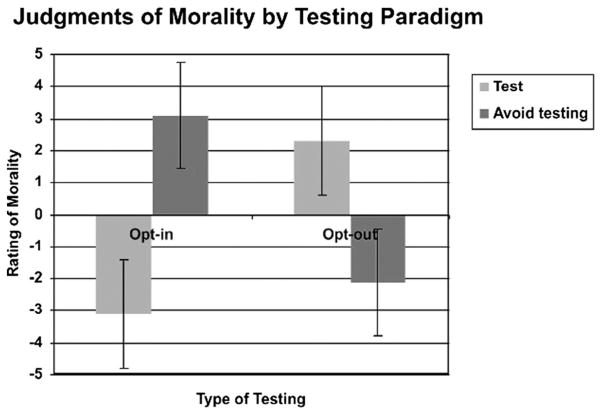
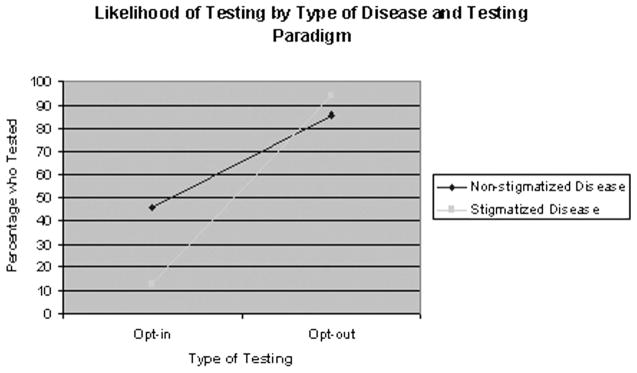
Design and main outcome measures: In Study 1, a 2 x 2 factorial design asked participants to make moral judgments about a person's decision to test for stigmatized diseases under an opt-in versus an opt-out policy. In Study 2, a 2 x 2 factorial design measuring testing rates explored whether opt-out methods reduce stigma and increase testing for stigmatized diseases.
Results: Study 1 results suggest that getting tested draws suspicion regarding moral conduct in an opt-in system, whereas not getting tested draws suspicion in an opt-out system. Study 2 results suggest that an opt-out policy may increase testing rates for stigmatized diseases and lessen the effects of stigma in people's reluctance to test.
Discussion: A social psychological approach to health services can be used to show how testing policies can influence both the stigmatization associated with testing and participation rates. An understanding of how testing policies may affect patient decision making and behavior is imperative for creating effective testing policies.
PsycINFO Database Record (c) 2009 APA, all rights reserved.
Figures
References
-
- Berrios D, Hearst N, Coates T, Stall R, Hudes E, Turner H, et al. HIV antibody testing among those at risk for HIV infection: The National AIDS Behavior Survey (NABC) JAMA. 1993 October 6;270:1576–1580. - PubMed
-
- Branson BM, Handsfield HH, Lampe MA, Janssen RS, Taylor AW, Lyss SB, et al. Revised recommendations for HIV testing of adults, adolescents, and pregnant women in health-care settings. MMWR Recomm Rep. 2006;22:1–17. - PubMed
-
- Centers for Disease Control and Prevention. Technical guidance on HIV counseling. MMWR. 1993. pp. 11–16. Accessed September 2007, from http://www.cdc.gov/mmwr/preview/mmwrhtml/00020645.htm. - PubMed
-
- Centers for Disease Control and Prevention. HIV counseling and testing in publicly funded sites. 1996. Retrieved September 2007 from http://www.cdc.gov/hiv/pubs/cts96.pdf.