


Temporal trends in the incidence of Staphylococcus aureus bacteremia in Olmsted County, Minnesota, 1998 to 2005: a population-based study
- PMID: 19916797
- PMCID: PMC3050712
- DOI: 10.1086/648442
Temporal trends in the incidence of Staphylococcus aureus bacteremia in Olmsted County, Minnesota, 1998 to 2005: a population-based study
Abstract
Background: There is a paucity of population-based studies on Staphylococcus aureus bacteremia (SAB) in the United States. We determined the incidence of and trends in SAB in Olmsted County, Minnesota, over an 8-year period.
Methods: A retrospective, population-based, cohort study was done to evaluate the initial episodes of SAB occurring in adult residents of Olmsted County, Minnesota, from 1 January 1998 through 31 December 2005, using the microbiology databases at Mayo Clinic and Olmsted Medical Center in Rochester, Minnesota.
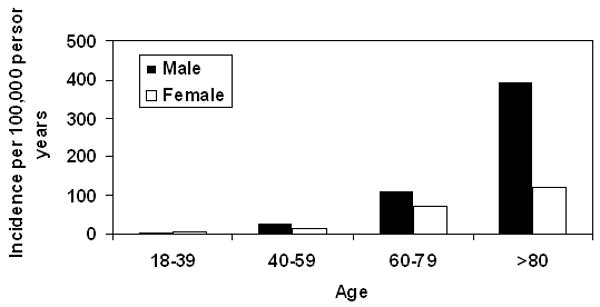
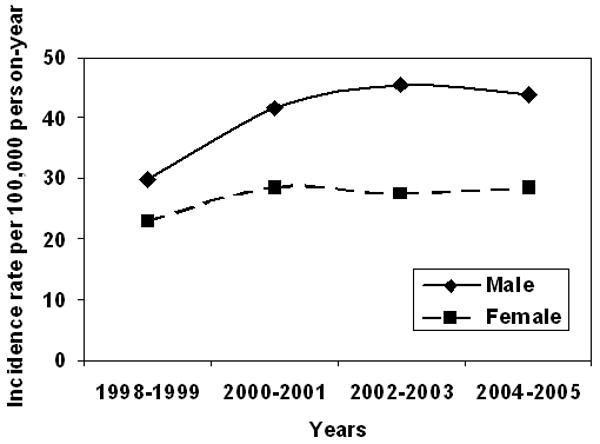
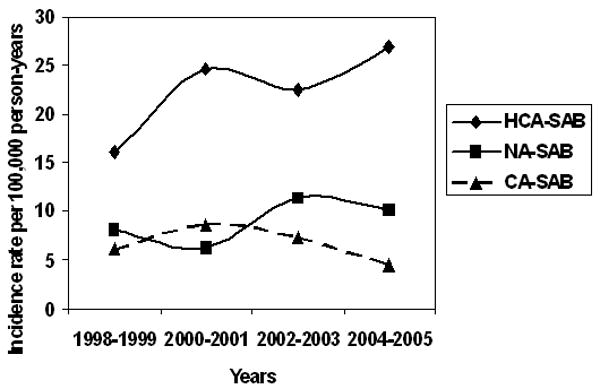
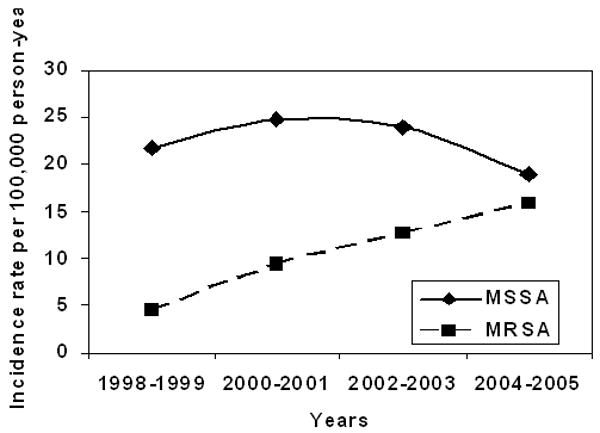
Results: Of 247 evaluable adult patients with SAB who were included in the incidence calculation, 143 (57.9%) were males, and the median age was 72.1 years (range, 19.5-98.5 years). Episodes of bacteremia were classified according to acquisition type: 58 (23.5%) were nosocomial (N-SAB), 145 (58.7%) were healthcare-associated (HCA-SAB), and 44 (17.8%) were community-acquired (CA-SAB). Methicillin-resistant S. aureus (MRSA) constituted 31.6% of the cases. No community-acquired MRSA bacteremia was noted. The age-adjusted incidence of SAB was 28.3 episodes/100,000 person-years for females and 53.5 episodes/100,000 person-years for males, with an age- and sex-adjusted rate of 38.2 episodes/100,000 person-years. The age- and sex-adjusted incidence of N-SAB, HCA-SAB, and CA-SAB was 9.0, 22.6, and 6.6 episodes/100,000 person-years, respectively. The age- and sex-adjusted incidence of methicillin-susceptible S. aureus was 25.4 episodes/100,000 person-years, and that of MRSA was 12.4 episodes/100,000 person-years. Overall, the incidence rate increased with age but not over the calendar year. The exception was MRSA bacteremia, which increased at a rate of 19.8% (standard error, +/-5.5%) per year during the study.
Conclusions: The incidence of SAB in adults remained stable in Olmsted County, Minnesota, from 1998 to 2005, but the proportion of episodes due to MRSA significantly increased over the 8-year period.
Conflict of interest statement
The authors report no potential conflicts of interest.
Figures
References
-
- Petti CA, Fowler VG., Jr Staphylococcus aureus bacteremia and endocarditis. Infect Dis Clin N Am. 2002;16:413–435. - PubMed
-
- Banerjee SN, Emori TG, Culver DH, et al. Secular trends in nosocomial primary bloodstream infections in the United States, 1980-1989. Am J Med. 1991;91(suppl 3B):86S–9S. - PubMed
-
- Wisplinghoff H, Bischoff T, Tallent SM, Seifert H, Wenzel RP, Edmond MB. Nosocomial bloodstream infections in US hospitals: analysis of 24,179 cases from a prospective nationwide surveillance study. Clin Infect Dis. 2004;39:309–17. - PubMed
-
- Uslan DZ, Crane SJ, Steckelberg JM, et al. Age- and sex-associated trends in bloodstream infection: a population-based study in Olmsted County, Minnesota. Arch Intern Med. 2007;167:834–9. - PubMed
-
- Crane SJ, Uslan DZ, Baddour LM. Bloodstream infections in a geriatric cohort: a population-based study. Am J Med. 2007;120:1078–1083. - PubMed
Publication types
MeSH terms
Grants and funding
LinkOut - more resources
Full Text Sources
Medical
