


[6S]-5-methyltetrahydrofolate increases plasma folate more effectively than folic acid in women with the homozygous or wild-type 677C-->T polymorphism of methylenetetrahydrofolate reductase
- PMID: 19917061
- PMCID: PMC2807663
- DOI: 10.1111/j.1476-5381.2009.00492.x
[6S]-5-methyltetrahydrofolate increases plasma folate more effectively than folic acid in women with the homozygous or wild-type 677C-->T polymorphism of methylenetetrahydrofolate reductase
Abstract
Background and purpose: 5,10-Methylenetetrahydrofolate reductase (MTHFR) is responsible for the synthesis of 5-methyltetrahydrofolate (5-MTHF). The 677C-->T mutation of MTHFR reduces the activity of this enzyme. The aim of this study was, first, to compare pharmacokinetic parameters of [6S]-5-MTHF and folic acid (FA) in women with the homozygous (TT) and wild-type (CC) 677C-->T mutation, and second, to explore genotype differences. The metabolism of [6S]-5-MTHF and FA was evaluated by measuring plasma folate derivatives.
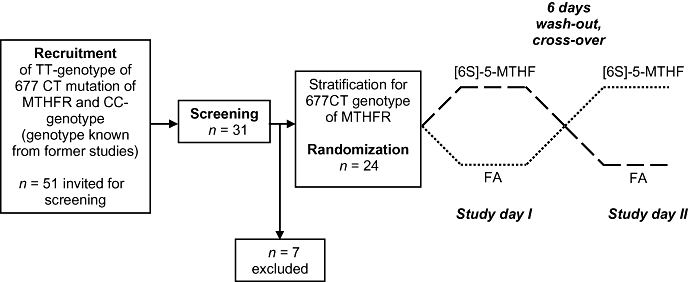
Experimental approach: Healthy females (TT, n= 16; CC, n= 8) received a single oral dose of FA (400 microg) and [6S]-5-MTHF (416 microg) in a randomized crossover design. Plasma folate was measured up to 8 h after supplementation. Concentration-time-profile [area under the curve of the plasma folate concentration vs. time (AUC)], maximum concentration (C(max)) and time-to-reach-maximum (t(max)) were calculated.
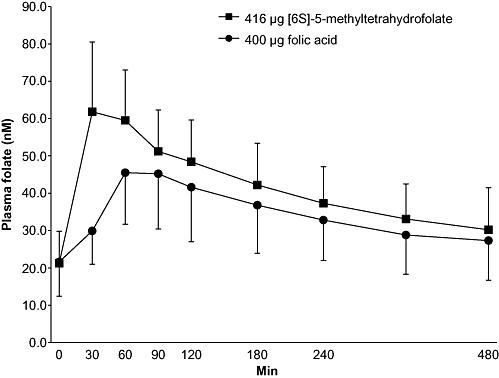
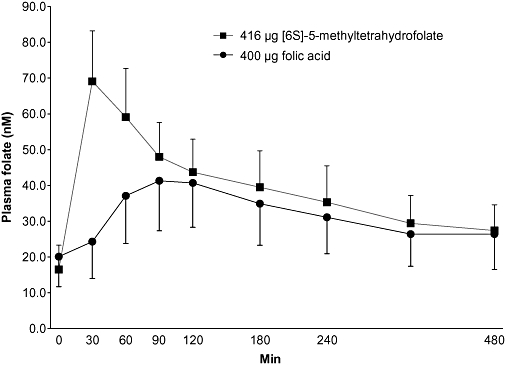
Key results: AUC and C(max) were significantly higher, and t(max) significantly shorter for [6S]-5-MTHF compared with FA in both genotypes. A significant difference between the genotypes was observed for t(max) after FA only (P < 0.05). Plasma folate consisted essentially of 5-MTHF irrespective of the folate form given. Unmetabolized FA in plasma occurs regularly following FA supplementation, but rarely with [6S]-5-MTHF.
Conclusions and implications: These data suggest that [6S]-5-MTHF increases plasma folate more effectively than FA irrespective of the 677C-->T mutation of the MTHFR. This natural form of folate could be an alternative to FA supplementation or fortification.
Figures
References
-
- Brattström L, Wilcken DE, Ohrvik J, Brudin L. Common methylenetetrahydrofolate reductase gene mutation leads to hyperhomocysteinemia but not to vascular disease: the result of a meta-analysis. Circulation. 1998;98:2520–2526. - PubMed
-
- de Bree A, Verschuren WM, Bjorke-Monsen AL, van der Put NM, Heil SG, Trijbels FJ, et al. Effect of the methylenetetrahydrofolate reductase 677C→T mutation on the relations among folate intake and plasma folate and homocysteine concentrations in a general population sample. Am J Clin Nutr. 2003;77:687–693. - PubMed
-
- CDC (Centers of Disease Control) Recommendations for the use of folic acid to reduce the number of cases of spina bifida and other neural tube defects. Morb Mortal Wkly Rep. 1992;41:2–8.
-
- Christensen B, Arbour L, Tran P, Leclerc D, Sabbaghian N, Platt R, et al. Genetic polymorphisms in methylenetetrahydrofolate reductase and methionine synthase, folate levels in red blood cells, and risk of neural tube defects. Am J Med Genet. 1999;84:151–157. - PubMed
-
- Commission of the European Communities. Reports of the Scientific Committees for Food: 31st series. Luxembourg: 1993. Nutrient and energy intakes for the European Community. Office for the Official Publications of the European Communities.
Publication types
MeSH terms
Substances
Grants and funding
LinkOut - more resources
Full Text Sources
Other Literature Sources
Medical
