Comparative Study
. 2009 Nov 16:8:255.
doi: 10.1186/1475-2875-8-255.

Is flow cytometry better in counting malaria pigment-containing leukocytes compared to microscopy?

Affiliations
Comparative Study

Is flow cytometry better in counting malaria pigment-containing leukocytes compared to microscopy?

Thomas Hänscheid et al. Malar J. .

Abstract

Background: Detection of malaria pigment (or haemozoin; Hz)-containing leukocytes may have prognostic relevance in malaria; however, studies reported conflicting results, with microscopic counts suggestive of being inaccurate and imprecise.

Methods: Numbers of Hz-containing leukocytes from a malaria patient obtained with a flow cytometer counting 50.000 gated events were compared with thin film microscopy as applied under field conditions.

Results: Flow cytometry identified 5.8% Hz-containing monocytes and 1.8% Hz-containing neutrophils. The microscopic examination yielded 10% and 13% of Hz-containing monocytes, as well as 0% and 0.5% of Hz-containing neutrophils for observers one and two, respectively.

Conclusion: Novel, robust and affordable cytometric methods should be evaluated in the field as they may assist in utilizing Hz-containing cells as clinically useful parameter.


Figures
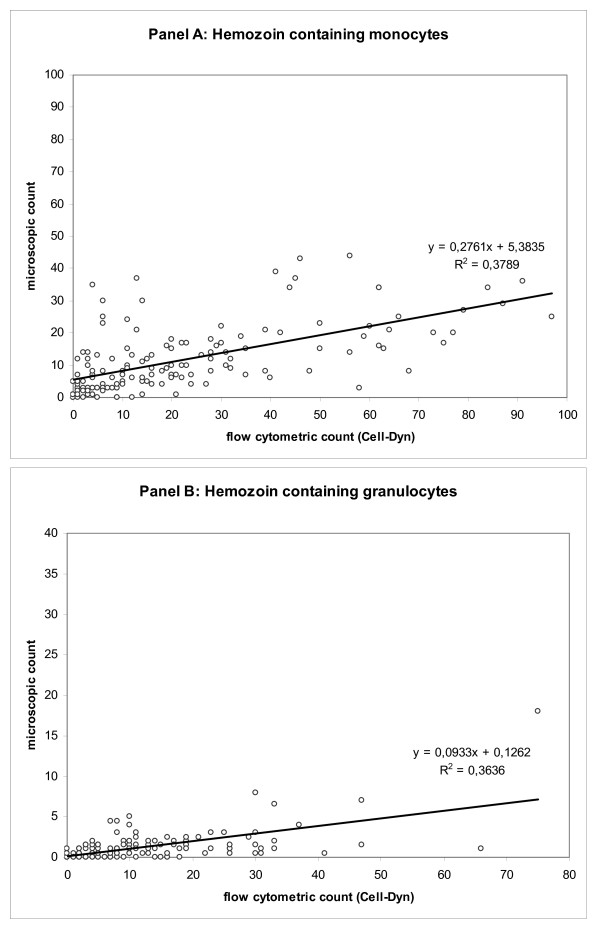
Figure 1
Figure 1
Comparison of flow cytometric and microscopic determination of Hz-containing leukocytes (panel A, monocytes; panel B, granulocytes). 152 samples from malarious patients were used as part of a study on flow cytometric detection of Hz-containing leukocytes [5]. Hz-containing leukocytes were determined by counting 100 monocytes and 200 granulocytes in a thick film, and by image analysis of screenshot from a Cell-Dyn® haematology analyser, as described elsewhere [5]. To allow better scaling in panel A, four outliers were excluded with 173/30, 167/53, 128/33 and 111/50 flow cytometric/microscopic monocyte counts, respectively.

References

    1. Metzger WG, Mordmüller BG, Kremsner PG. Malaria pigment in leucocytes. Trans R Soc Trop Med Hyg. 1995;89:637–638. doi: 10.1016/0035-9203(95)90423-9. - DOI - PubMed
    1. Day NP, Pham TD, Phan TL, Dinh XS, Pham PL, Ly VC, Tran TH, Nguyen TH, Bethell DB, Nguyan HP, Tran TH, White NJ. Clearance kinetics of parasites and pigment-containing leukocytes in severe malaria. Blood. 1996;88:4694–4700. - PubMed
    1. Luty AJ, Perkins DJ, Lell B, Schmidt-Ott R, Lehman LG, Luckner D, Greve B, Matousek P, Herbich K, Schmid D, Weinberg JB, Kremsner PG. Low interleukin-12 activity in severe Plasmodium falciparum malaria. Infect Immun. 2000;68:3909–3915. doi: 10.1128/IAI.68.7.3909-3915.2000. - DOI - PMC - PubMed
    1. Hänscheid T, Längin M, Lell B, Pötschke M, Oyakhirome S, Kremsner PG, Grobusch MP. Full blood count and haemozoin-containing leukocytes in children with malaria: diagnostic value and association with disease severity. Malar J. 2008;7:109. doi: 10.1186/1475-2875-7-109. - DOI - PMC - PubMed
    1. Hänscheid T, Egan TJ, Grobusch MP. Haemozoin: from melatonin pigment to drug target, diagnostic tool, and immune modulator. Lancet Infect Dis. 2007;7:675–685. doi: 10.1016/S1473-3099(07)70238-4. - DOI - PubMed

Publication types
