


Household surveillance of severe neonatal illness by community health workers in Mirzapur, Bangladesh: coverage and compliance with referral
- PMID: 19917652
- PMCID: PMC2912547
- DOI: 10.1093/heapol/czp048
Household surveillance of severe neonatal illness by community health workers in Mirzapur, Bangladesh: coverage and compliance with referral
Abstract
Background: Effective and scalable community-based strategies are needed for identification and management of serious neonatal illness.
Methods: As part of a community-based, cluster-randomized controlled trial of the impact of a package of maternal-neonatal health care, community health workers (CHWs) were trained to conduct household surveillance and to identify and refer sick newborns according to a clinical algorithm. Assessments of newborns by CHWs at home were linked to hospital-based assessments by physicians, and factors impacting referral, referral compliance and outcome were evaluated.
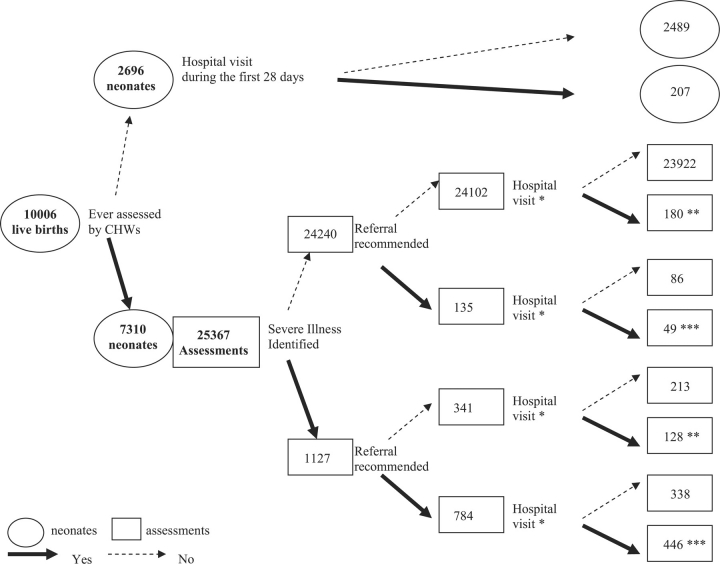
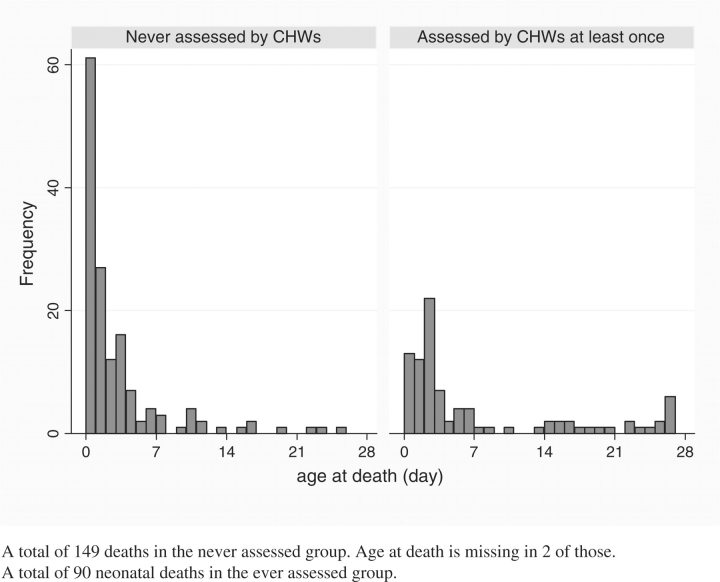
Results: Seventy-three per cent (7310/10,006) of live-born neonates enrolled in the study were assessed by CHWs at least once; 54% were assessed within 2 days of birth, but only 15% were attended at delivery. Among assessments for which referral was recommended, compliance was verified in 54% (495/919). Referrals recommended to young neonates 0-6 days old were 30% less likely to be complied with compared to older neonates. Compliance was positively associated with having very severe disease and selected clinical signs, including respiratory rate > or = 70/minute; weak, abnormal or absent cry; lethargic or less than normal movement; and feeding problem. Among 239 neonates who died, only 38% were assessed by a CHW before death.
Conclusions: Despite rigorous programmatic effort, reaching neonates within the first 2 days after birth remained a challenge, and parental compliance with referral recommendation was limited, particularly among young neonates. To optimize potential impact, community postnatal surveillance must be coupled with skilled attendance at delivery, and/or a worker skilled in recognition of neonatal illness must be placed in close proximity to the community to allow for rapid case management to avert early deaths.
Figures
References
-
- Bakry N, Laabid A, De Brouwere V, Dujardin B. [Why patients do not comply with reference decision made by general practitioners?] Revue d'Épidémiologie et de Santé Publique. 1999;47(Suppl. 2):2S65–2S74. - PubMed
-
- Bang AT, Bang RA, Baitule SB, Reddy MH, Deshmukh MD. Effect of home-based neonatal care and management of sepsis on neonatal mortality: field trial in rural India. The Lancet. 1999;354:1955–61. - PubMed
-
- Bang AT, Bang RA, Baitule SB, Reddy HM, Deshmukh MD. Management of birth asphyxia in home deliveries in rural Gadchiroli: the effect of two types of birth attendants and of resuscitating with mouth-to-mouth, tube-mask or bag-mask. Journal of Perinatology. 2005a;25(Suppl. 1):S82–S91. - PubMed
-
- Bang AT, Bang RA, Stoll BJ, Baitule SB, Reddy HM, Deshmukh MD. Is home-based diagnosis and treatment of neonatal sepsis feasible and effective? Seven years of intervention in the Gadchiroli field trial (1996 to 2003) Journal of Perinatology. 2005b;25(Suppl. 1):S62–S71. - PubMed
-
- Bang AT, Reddy HM, Deshmukh MD, Baitule SB, Bang RA. Neonatal and infant mortality in the ten years (1993 to 2003) of the Gadchiroli field trial: effect of home-based neonatal care. Journal of Perinatology. 2005c;25(Suppl. 1):S92–107. - PubMed
Publication types
MeSH terms
Grants and funding
LinkOut - more resources
Full Text Sources
Medical
