Masked hypertension associates with left ventricular hypertrophy in children with CKD
- PMID: 19917781
- PMCID: PMC2799282
- DOI: 10.1681/ASN.2009060609
Masked hypertension associates with left ventricular hypertrophy in children with CKD
Abstract
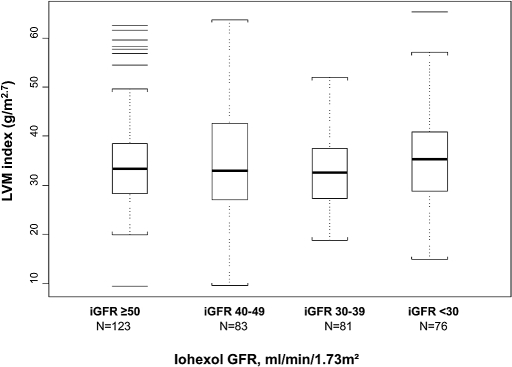
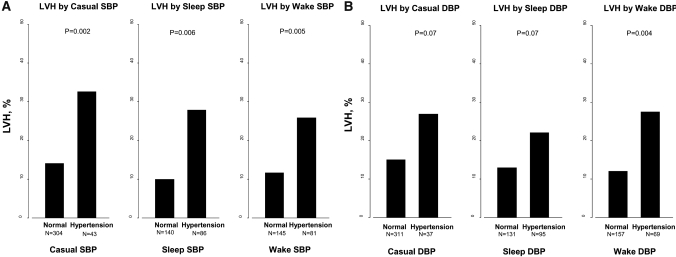
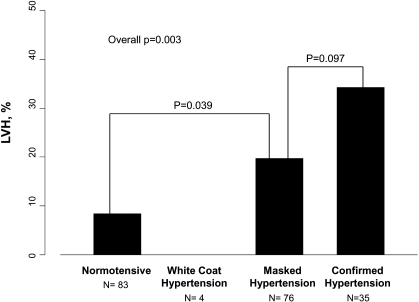
Left ventricular hypertrophy (LVH) associates with increased risk for cardiovascular disease. Hypertension leads to LVH in adults, but its role in the pathogenesis of LVH in children is not as well established. To examine left ventricular mass and evaluate factors associated with LVH in children with stages 2 through 4 chronic kidney disease (CKD), we analyzed cross-sectional data from children who had baseline echocardiography (n = 366) and underwent ambulatory BP monitoring (n = 226) as a part of the observational Chronic Kidney Disease in Children (CKiD) cohort study. At baseline, 17% of children had LVH (11% eccentric and 6% concentric) and 9% had concentric remodeling of the left ventricle. On the basis of a combination of ambulatory and casual BP assessment (n = 198), 38% of children had masked hypertension (normal casual but elevated ambulatory BP) and 18% had confirmed hypertension (both elevated casual and ambulatory BP). There was no significant association between LVH and kidney function. LVH was more common in children with either confirmed (34%) or masked (20%) hypertension compared with children with normal casual and ambulatory BP (8%). In multivariable analysis, masked (odds ratio 4.1) and confirmed (odds ratio 4.3) hypertension were the strongest independent predictors of LVH. In conclusion, casual BP measurements alone are insufficient to predict the presence of LVH in children with CKD. The high prevalence of masked hypertension and its association with LVH supports early echocardiography and ambulatory BP monitoring to evaluate cardiovascular risk in children with CKD.
Figures
References
-
- K/DOQI clinical practice guidelines for cardiovascular disease in dialysis patients. Am J Kidney Dis 45[Suppl 3]: S1–S153, 2005 - PubMed
-
- Johnstone LM, Jones CL, Grigg LE, Wilkinson JL, Walker RG, Powell HR: Left ventricular abnormalities in children, adolescents and young adults with renal disease. Kidney Int 50: 998–1006, 1996 - PubMed
-
- Mitsnefes MM, Kimball TR, Witt SA, Glascock BJ, Khoury PR, Daniels SR: Left ventricular mass and systolic performance in pediatric patients with chronic renal failure. Circulation 107: 864–868, 2003 - PubMed
-
- Matteucci MC, Wuhl E, Picca S, Mastrostefano A, Rinelli G, Romano C, Rizzoni G, Mehls O, de Simone G, Schaefer FESCAPE Trial Group: Left ventricular geometry in children with mild to moderate chronic renal insufficiency. J Am Soc Nephrol 17: 218–226, 2006 - PubMed
-
- Mitsnefes MM, Kimball TR, Kartal J, Witt SA, Glascock BJ, Khoury PR, Daniels SR: Progression of left ventricular hypertrophy in children with early chronic kidney disease: 2-Year follow-up study. J Pediatr 149: 671–675, 2006 - PubMed
Publication types
MeSH terms
Grants and funding
LinkOut - more resources
Full Text Sources
Other Literature Sources
Medical