


Late-occurring neurologic sequelae in adult survivors of childhood acute lymphoblastic leukemia: a report from the Childhood Cancer Survivor Study
- PMID: 19917844
- PMCID: PMC2815720
- DOI: 10.1200/JCO.2009.22.5060
Late-occurring neurologic sequelae in adult survivors of childhood acute lymphoblastic leukemia: a report from the Childhood Cancer Survivor Study
Abstract
Purpose: Children with acute lymphoblastic leukemia (ALL) are often cured, but the therapies they receive may be neurotoxic. Little is known about the incidence and severity of late-occurring neurologic sequelae in ALL survivors. Data were analyzed to determine the incidence of adverse long-term neurologic outcomes and treatment-related risk factors.
Patients and methods: We analyzed adverse neurologic outcomes that occurred after diagnosis in 4,151 adult survivors of childhood ALL who participated in the Childhood Cancer Survivor Study (CCSS), a retrospective cohort of 5-year survivors of childhood cancer diagnosed between 1970 and 1986. A randomly selected cohort of the survivors' siblings served as a comparison group. Self-reported auditory-vestibular-visual sensory deficits, focal neurologic dysfunction, seizures, and serious headaches were assessed.
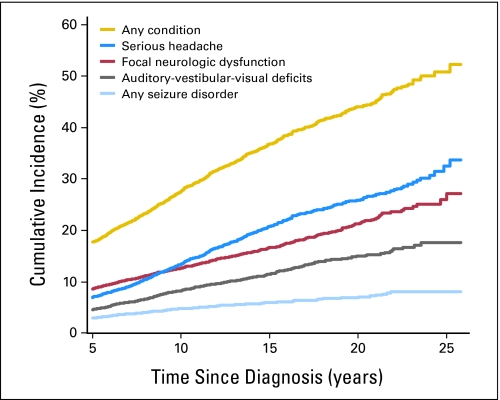
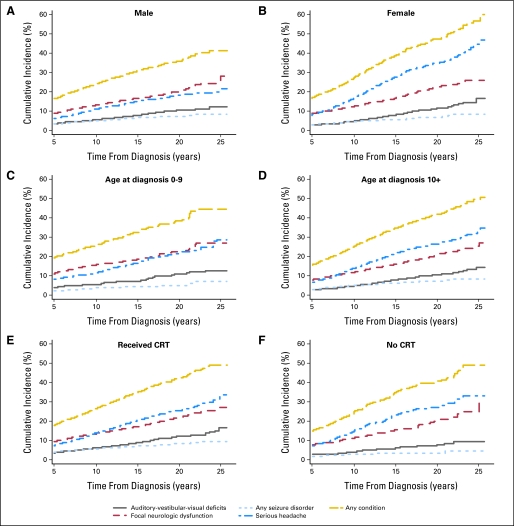
Results: The median age at outcome assessment was 20.2 years for survivors. The median follow-up time to death or last survey since ALL diagnosis was 14.1 years. Of the survivors, 64.5% received cranial radiation and 94% received intrathecal chemotherapy. Compared with the sibling cohort, survivors were at elevated risk for late-onset auditory-vestibular-visual sensory deficits (rate ratio [RR], 1.8; 95% CI, 1.5 to 2.2), coordination problems (RR, 4.1; 95% CI, 3.1 to 5.3), motor problems (RR, 5.0; 95% CI, 3.8 to 6.7), seizures (RR, 4.6; 95% CI, 3.4 to 6.2), and headaches (RR, 1.6; 95% CI, 1.4 to 1.7). In multivariable analysis, relapse was the most influential factor that increased risk of late neurologic complications.
Conclusion: Children treated with regimens that include cranial radiation for ALL and those who suffer a relapse are at increased risk for late-onset neurologic sequelae.
Conflict of interest statement
Authors' disclosures of potential conflicts of interest and author contributions are found at the end of this article.
Figures
References
-
- Pui CH, Robison LL, Look AT. Acute lymphoblastic leukaemia. Lancet. 2008;371:1030–1043. - PubMed
-
- Rivera GK, Pinkel D, Simone JV, et al. Treatment of acute lymphoblastic leukemia: 30 years' experience at St. Jude Children's Research Hospital. N Engl J Med. 1993;329:1289–1295. - PubMed
-
- Cousens P, Waters B, Said J, et al. Cognitive effects of cranial irradiation in leukaemia: A survey and meta-analysis. J Child Psychol Psychiatry. 1988;29:839–852. - PubMed
-
- Meadows AT, Gordon J, Massari DJ, et al. Declines in IQ scores and cognitive dysfunctions in children with acute lymphocytic leukaemia treated with cranial irradiation. Lancet. 1981;2:1015–1018. - PubMed
-
- Kuskonmaz B, Unal S, Gumruk F, et al. The neurologic complications in pediatric acute lymphoblastic leukemia patients excluding leukemic infiltration. Leuk Res. 2006;30:537–541. - PubMed
Publication types
MeSH terms
Grants and funding
LinkOut - more resources
Full Text Sources
Medical
