


Metabolic evolution of energy-conserving pathways for succinate production in Escherichia coli
- PMID: 19918073
- PMCID: PMC2777959
- DOI: 10.1073/pnas.0905396106
Metabolic evolution of energy-conserving pathways for succinate production in Escherichia coli
Abstract
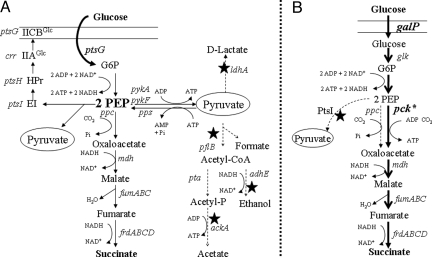
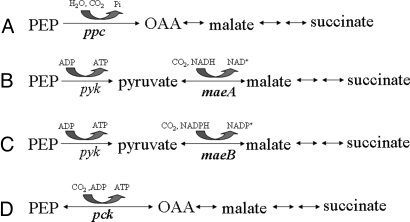
During metabolic evolution to improve succinate production in Escherichia coli strains, significant changes in cellular metabolism were acquired that increased energy efficiency in two respects. The energy-conserving phosphoenolpyruvate (PEP) carboxykinase (pck), which normally functions in the reverse direction (gluconeogenesis; glucose repressed) during the oxidative metabolism of organic acids, evolved to become the major carboxylation pathway for succinate production. Both PCK enzyme activity and gene expression levels increased significantly in two stages because of several mutations during the metabolic evolution process. High-level expression of this enzyme-dominated CO(2) fixation and increased ATP yield (1 ATP per oxaloacetate). In addition, the native PEP-dependent phosphotransferase system for glucose uptake was inactivated by a mutation in ptsI. This glucose transport function was replaced by increased expression of the GalP permease (galP) and glucokinase (glk). Results of deleting individual transport genes confirmed that GalP served as the dominant glucose transporter in evolved strains. Using this alternative transport system would increase the pool of PEP available for redox balance. This change would also increase energy efficiency by eliminating the need to produce additional PEP from pyruvate, a reaction that requires two ATP equivalents. Together, these changes converted the wild-type E. coli fermentation pathway for succinate into a functional equivalent of the native pathway that nature evolved in succinate-producing rumen bacteria.
Conflict of interest statement
Conflict of interest statement: L.O.I. is a consultant (Chief Science Officer) and minor shareholder in Myriant Technologies (formerly BioEnergy International), licensee of this technology from the University of Florida. Other authors declare no conflict of interest.
Figures
References
-
- Zeikus JG, Jain MK, Elankovan P. Biotechnology of succinic acid production and markets for derived industrial products. Appl Microbiol Biotechnol. 1999;51:545–552.
-
- McKinlay JB, Vieille C, Zeikus JG. Prospects for a bio-based succinate industry. Appl Microbiol Biotechnol. 2007;76:727–740. - PubMed
-
- Jantama K, et al. Combining metabolic engineering and metabolic evolution to develop nonrecombinant strains of Escherichia coli C that produce succinate and malate. Biotechnol Bioeng. 2008;99:1140–1153. - PubMed
-
- VanderWerf MJ, Guettler MV, Jain MK, Zeikus JG. Environmental and physiological factors affecting the succinate product ratio during carbohydrate fermentation by Actinobacillus sp. 130Z. Arch Microbiol. 1997;167:332–342. - PubMed
Publication types
MeSH terms
Substances
LinkOut - more resources
Full Text Sources
Other Literature Sources
Molecular Biology Databases
Miscellaneous
