


Telephone-delivered collaborative care for treating post-CABG depression: a randomized controlled trial
- PMID: 19918088
- PMCID: PMC3010227
- DOI: 10.1001/jama.2009.1670
Telephone-delivered collaborative care for treating post-CABG depression: a randomized controlled trial
Abstract
Context: Depressive symptoms commonly follow coronary artery bypass graft (CABG) surgery and are associated with less positive clinical outcomes.
Objective: To test the effectiveness of telephone-delivered collaborative care for post-CABG depression vs usual physician care.
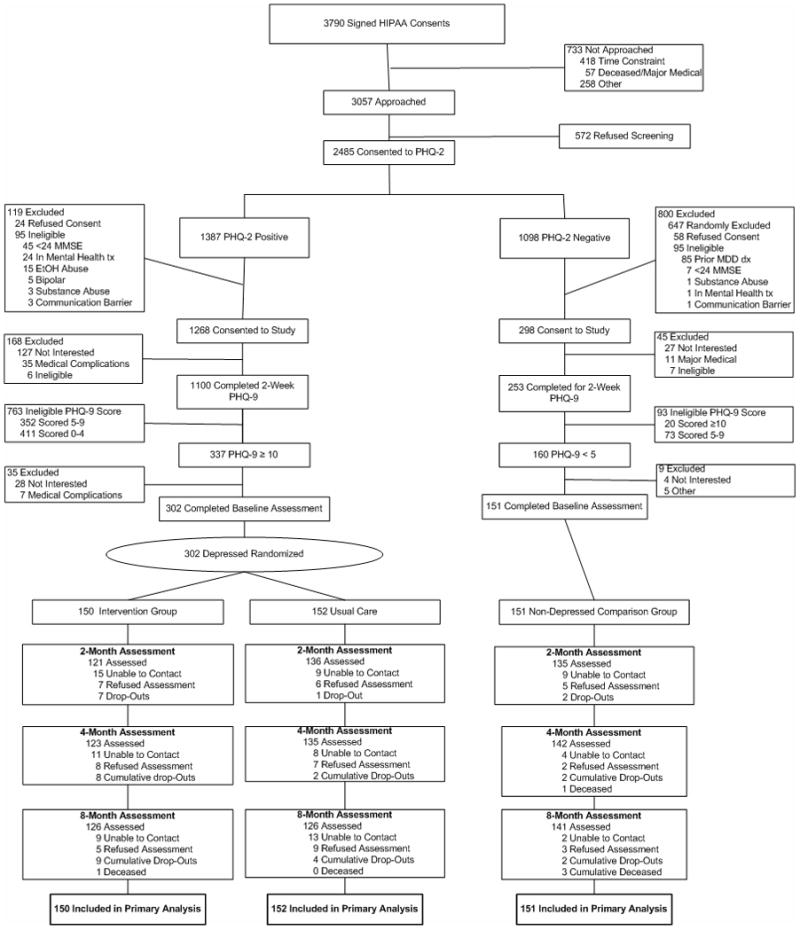
Design, setting, and participants: Single-blind effectiveness trial at 7 university-based and community hospitals in or near Pittsburgh, Pennsylvania. Participants were 302 post-CABG patients with depression (150, intervention; 152, usual care) and a comparison group of 151 randomly sampled post-CABG patients without depression recruited between March 2004 and September 2007 and observed as outpatients until June 2008.
Intervention: Eight months of telephone-delivered collaborative care provided by nurses working with patients' primary care physicians and supervised by a psychiatrist and primary care physician from this study.
Main outcome measures: Mental health-related quality of life (HRQL) measured by the Short Form-36 Mental Component Summary (SF-36 MCS) at 8-month follow-up; secondary outcome measures included assessment of mood symptoms (Hamilton Rating Scale for Depression [HRS-D]), physical HRQL (SF-36 PCS), and functional status (Duke Activity Status Index [DASI]); and hospital readmissions.
Results: The intervention patients reported greater improvements in mental HRQL (all P < or = .02) (SF-36 MCS: Delta, 3.2 points; 95% confidence interval [CI], 0.5-6.0), physical functioning (DASI: Delta, 4.6 points; 95% CI, 1.9-7.3), and mood symptoms (HRS-D: Delta, 3.1 points; 95% CI, 1.3-4.9); and were more likely to report a 50% or greater decline in HRS-D score from baseline (50.0% vs 29.6%; number needed to treat, 4.9 [95% CI, 3.2-10.4]) than usual care patients (P < .001). Men with depression were particularly likely to benefit from the intervention (SF-36 MCS: Delta, 5.7 points; 95% CI, 2.2-9.2; P = .001). However, the mean HRQL and physical functioning of intervention patients did not reach that of the nondepressed comparison group.
Conclusion: Compared with usual care, telephone-delivered collaborative care for treatment of post-CABG depression resulted in improved HRQL, physical functioning, and mood symptoms at 8-month follow-up.
Trial registration: clinicaltrials.gov Identifier: NCT00091962.
Figures
Comment in
-
Collaborative care for post-CABG depression.JAMA. 2010 Apr 7;303(13):1252; author reply 1252-3. doi: 10.1001/jama.2010.362. JAMA. 2010. PMID: 20371779 No abstract available.
-
Randomised controlled trial: Telephone-delivered collaborative care for post-CABG depression is more effective than usual care for improving mental-health-related quality of life.Evid Based Med. 2010 Apr;15(2):57-8. doi: 10.1136/ebm1059. Evid Based Med. 2010. PMID: 20436129 No abstract available.
-
Telephone-delivered collaborative care for post-CABG depression is more effective than usual care for improving quality of life related to mental health.Evid Based Nurs. 2010 Apr;13(2):37. doi: 10.1136/ebn1050. Evid Based Nurs. 2010. PMID: 20436137 No abstract available.
References
-
- Lloyd-Jones D, Adams R, et al. Heart Disease and Stroke Statistics--2009 Update: A Report From the American Heart Association Statistics Committee and Stroke Statistics Subcommittee. Circulation. 2009;119(3):e21–181. - PubMed
-
- Eagle KA, Guyton RA, Davidoff R, et al. ACC/AHA 2004 guideline update for coronary artery bypass graft surgery: a report of the American College of Cardiology/American Heart Association Task Force on Practice Guidelines. Circulation. 2004;110(14):e340–437. - PubMed
-
- Pignay-Demaria V, Lesperance F, Demaria RG, Frasure-Smith N, Perrault LP. Depression and Anxiety and Outcomes of Coronary Artery Bypass Surgery. Ann Thorac Surg. 2003;75:314–321. - PubMed
-
- Goyal TM, Idler EL, Krause TJ, Contrada RJ. Quality of life following cardiac surgery: impact of the severity and course of depressive symptoms. Psychosomatic Med. 2005;67(5):759–765. - PubMed
-
- Mallik S, Krumholz HM, Lin ZQ, et al. Patients with depressive symptoms have lower health status benefits after coronary artery bypass surgery. Circulation. 2005;111(3):271–277. - PubMed
Publication types
MeSH terms
Substances
Associated data
Grants and funding
LinkOut - more resources
Full Text Sources
Other Literature Sources
Medical
