. 2009;14(7):891-8.
doi: 10.3851/IMP1420.

Efficacy of the novel parainfluenza virus haemagglutinin-neuraminidase inhibitor BCX 2798 in mice - further evaluation

Affiliations

Efficacy of the novel parainfluenza virus haemagglutinin-neuraminidase inhibitor BCX 2798 in mice - further evaluation

Irina V Alymova et al. Antivir Ther. 2009.

Abstract

Background: Human parainfluenza virus type 1 (hPIV-1) causes serious respiratory tract infections, especially in children. This study investigated the efficacy of the novel haemagglutinin-neuraminidase (HN) inhibitor BCX 2798 in the prophylaxis of lethal and the treatment of non-lethal parainfluenza virus infection in mice.

Methods: In the prophylaxis model, 129x1/SvJ mice were inoculated with a 90% lethal dose of a recombinant Sendai virus, in which the HN gene was replaced with that of hPIV-1 (rSeV[hPIV-1HN]). The mice were intranasally treated either once or for 5 days with 1 or 10 mg/kg/day of BCX 2798, starting 4 h before infection. In the therapeutic model, mice were infected with 100 plaque-forming units of rSeV(hPIV-1HN) per mouse and treated intranasally with 0.1, 1 or 10 mg/kg/day of BCX 2798 for 5 days, starting 24 or 48 h after infection, or for 4 days starting 72 h after infection.

Results: Similar to multiple dosing, a single intranasal prophylaxis with 1 or 10 mg/kg of BCX 2798 protected approximately 40% or 90%, respectively, of mice from death by rSeV(hPIV-1HN) infection. BCX 2798 also significantly reduced virus lung titres (in a dose- and time-dependent manner) and reduced histopathological changes in the airways of non-lethally infected mice at multiple intranasal dosages in the therapeutic model, with the lowest effective dosage being 0.1 mg/kg/day administered 24 h after infection.

Conclusions: BCX 2798 was effective in the prophylaxis of lethal and in the therapy of non-lethal parainfluenza virus infection in mice, suggesting further consideration of BCX 2798 for clinical trials.


Conflict of interest statement

Conflict of interest

We do not have any conflicts of interest to disclose.

Figures
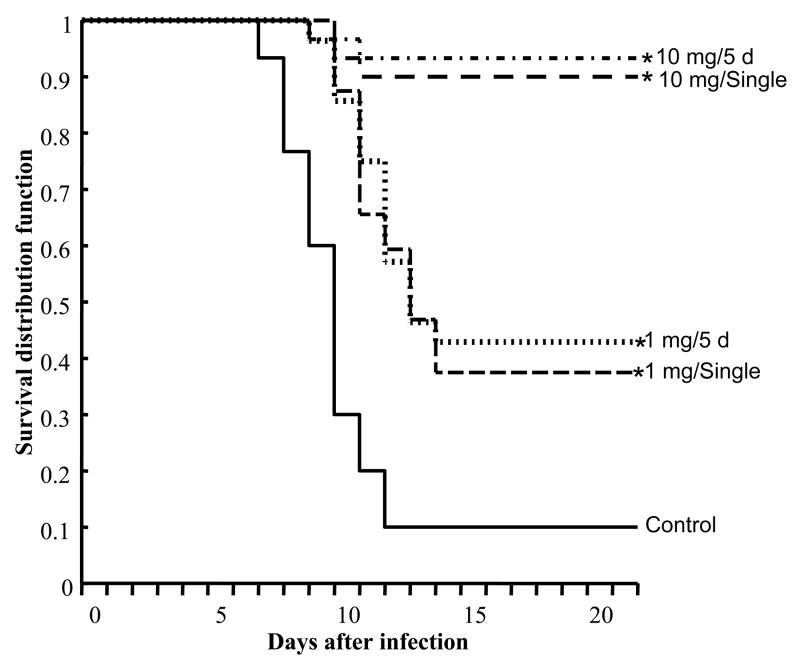
FIG. 1
FIG. 1
Effect of a single intranasal prophylactic dose of BCX 2798 on survival of mice inoculated with a 90% lethal dose of rSeV(hPIV-1HN). 129x1/SvJ mice were administered 1 or 10 mg/kg/d of BCX 2798 in single or multiple (twice daily for five consecutive days) regimens starting 4 h before lethal infection with 4.2 × 10⁷ PFU of virus per mouse. Control infected mice were treated with PBS alone. The Kaplan-Meier method was used to estimate the probability of survival, which is expressed as survival distribution function. A value of 1 corresponds to 100% survival. *P<0.05 compared with the control group.
FIG. 2
FIG. 2
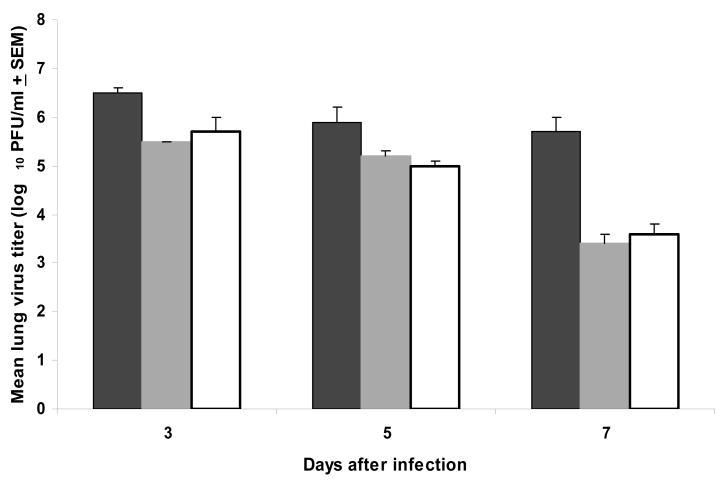
Effect of a single intranasal prophylactic dose of BCX 2798 on virus titers in the lungs of mice infected with a 90% lethal dose of rSeV(hPIV-1HN). Mice were treated with 10 mg/kg/d of BCX 2798 in multiple (twice daily for five consecutive days; gray box) or single (white box) regimens starting 4 h before inoculation of 4.2 × 10⁷ PFU of virus per mouse. Control infected mice were treated only with PBS (black box). Each data point represents the mean virus titer of three mice plotted with error bars indicating the SEM. Virus lung titers in both treatment groups differed significantly from those in the control group in a one-way ANOVA model (P<0.05).
FIG. 3
FIG. 3
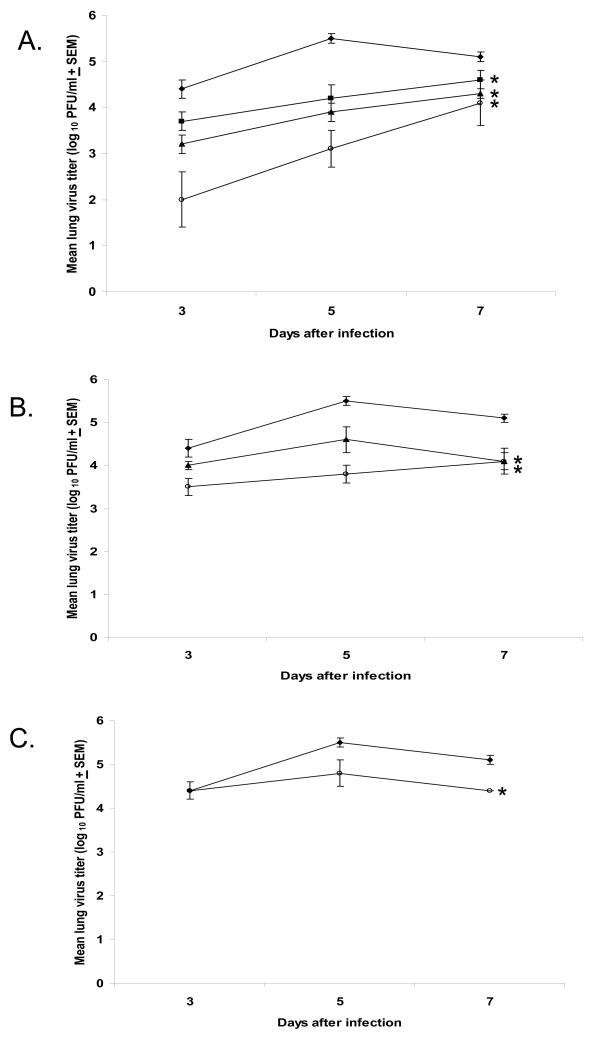
Effect of treatment with BCX 2798 on virus titers in mice infected with 100 PFU of rSeV(hPIV-1HN). BCX 2798 at dosages of 0.1 (-■-), 1 (-▲-) and 10 (-○-) mg/kg/d was administered intranasally to 129x1/SvJ mice starting at either 24 h (A) or 48 h (B) after infection (treatment for five consecutive days) or 72 h (C) after infection (treatment for four consecutive days). Control infected mice were treated with PBS alone (- ◆ -). The mean virus lung titers from six to nine mice from at least two independent in vivo experiments are presented. The averages for each group are plotted with error bars indicating the SEM. *P<0.05 compared with the control group; one-way ANOVA model.
FIG. 4
FIG. 4
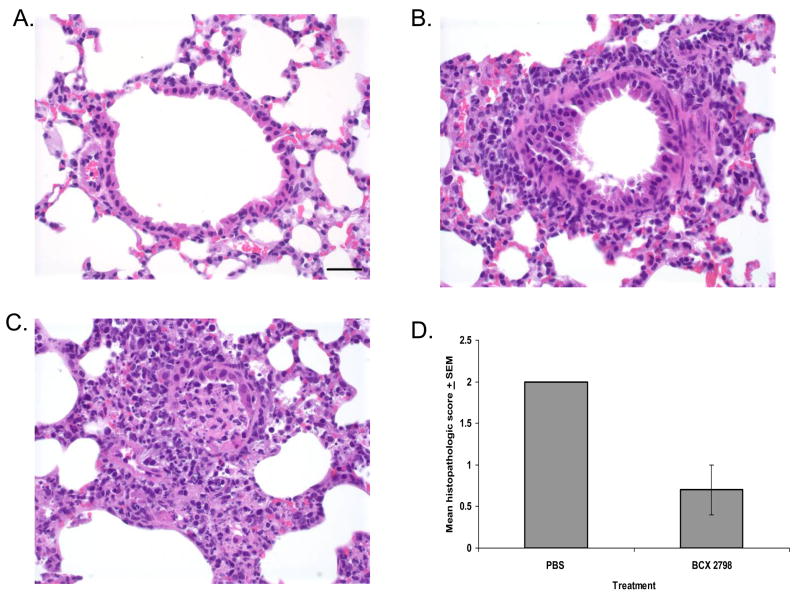
Effect of treatment with BCX 2798 on histopathologic changes in lungs of mice infected with 100 PFU of rSeV(hPIV-1HN). Infected mice (three per group) were intranasally treated with 10 mg/kg/d of compound or PBS for 5 d starting 24 h after infection. Lungs were removed 8 d after infection. The sections were stained with hematoxylin and eosin and examined microscopically. High-power view (400×) of the stained section is shown. Bar = 30 μm. (A) Uninfected mice treated with PBS; (B) Infected mice treated with BCX 2798 (note the mild peribronchiolar infiltrates of lymphocytes, plasma cells and neutrophils and absence of airway epithelial necrosis); (C) Infected mice treated with PBS (note a peribronchiolar cuffing of the distal airway by inflammatory cells; the airway lumen is plugged by a mixture of sloughed necrotic epithelial cells and inflammatory cells, and there is local extension of the inflammation and necrosis into the alveoli); (D) Histopathologic scoring of infected mouse lungs. The degree of histopathologic changes was graded on a scale of 0 (no change) to 4 (severe pneumonia). The averages for each group are plotted with error bars indicating the SEM.

References

    1. Karron RA, Collins PL. Parainfluenza Viruses. In: Knipe DM, Howley PM, editors. Fields Virology. 5. Lippincott/The Williams & Wilkins Co., a Wolters Kluwer Business; Philadelphia, Pa: 2007. pp. 1497–1526.
    1. Counihan ME, Shay DK, Holman RC, Lowther SA, Anderson LJ. Human parainfluenza virus-associated hospitalizations among children less than five years of age in the United States. Pediatr Infect Dis. 2001;20:646–653. - PubMed
    1. Marx A, Torok TJ, Holman RC, Clarke MJ, Anderson LJ. Pediatric hospitalizations for croup (laryngotracheobronchitis): biennial increases associated with human parainfluenza virus 1 epidemics. J Infect Dis. 1997;176:1423–1427. - PubMed
    1. Stone-Hulslander J, Morrison TG. Detection of an interaction between the HN and F proteins in Newcastle disease virus-infected cells. J Virol. 1997;71:6287–6295. - PMC - PubMed
    1. Yao Q, Hu X, Compans RW. Association of the parainfluenza virus fusion and hemagglutinin-neuraminidase glycoproteins on cell surfaces. J Virol. 1997;71:650–656. - PMC - PubMed

Publication types

MeSH terms

Substances

LinkOut - more resources