


Tamoxifen-poly(ethylene glycol)-thiol gold nanoparticle conjugates: enhanced potency and selective delivery for breast cancer treatment
- PMID: 19919059
- PMCID: PMC2839930
- DOI: 10.1021/bc9002212
Tamoxifen-poly(ethylene glycol)-thiol gold nanoparticle conjugates: enhanced potency and selective delivery for breast cancer treatment
Abstract
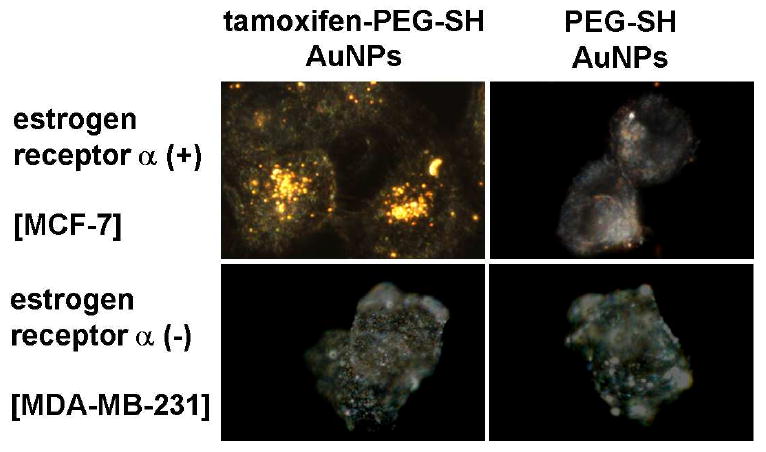
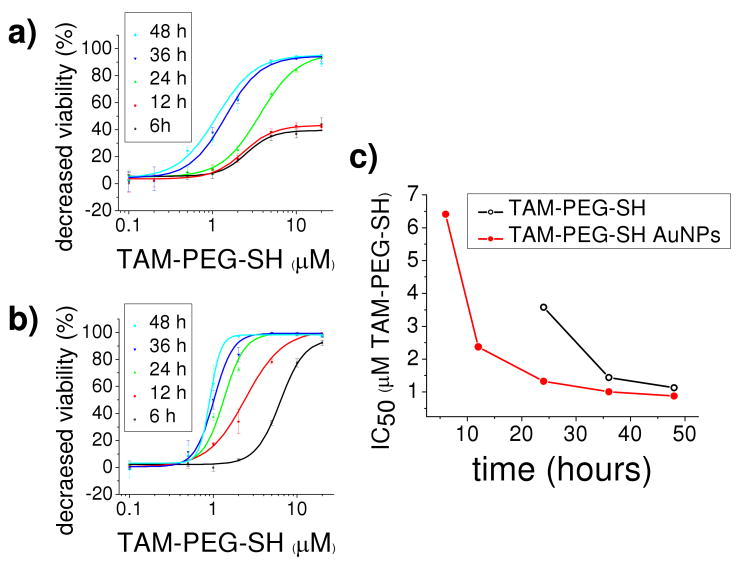
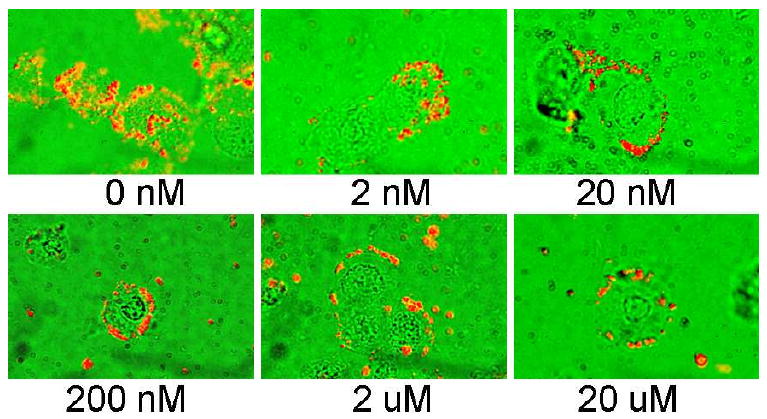
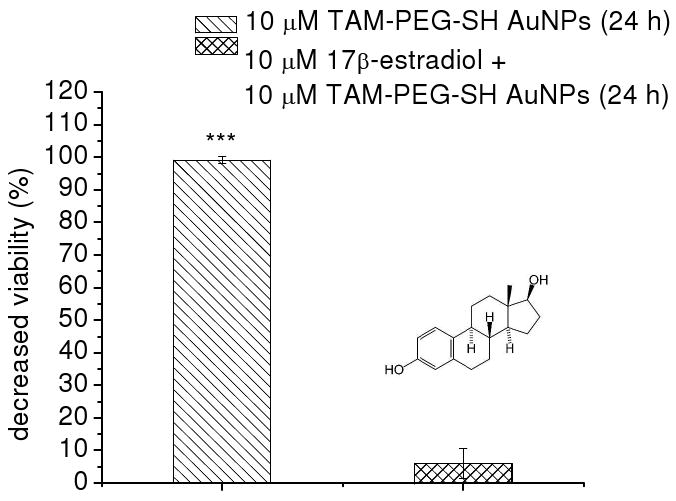
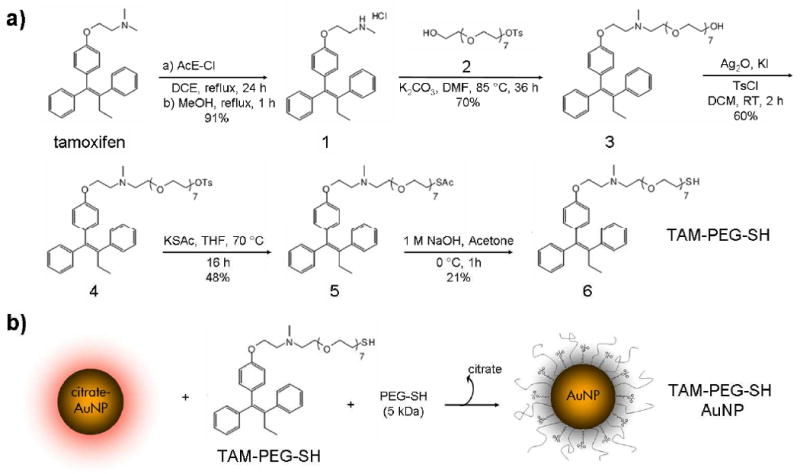
The breast cancer treatment drug tamoxifen has been widely administered for more than three decades. This small molecule competes with 17beta-estradiol for binding to estrogen receptor, a hormone receptor upregulated in a majority of breast cancers, subsequently initiating programmed cell death. We have synthesized a thiol-PEGylated tamoxifen derivative that can be used to selectively target and deliver plasmonic gold nanoparticles to estrogen receptor positive breast cancer cells with up to 2.7-fold enhanced drug potency in vitro. Optical microscopy/spectroscopy, time-dependent dose-response data, and estrogen competition studies indicate that augmented activity is due to increased rates of intracellular tamoxifen transport by nanoparticle endocytosis, rather than by passive diffusion of the free drug. Both ligand- and receptor-dependent intracellular delivery of gold nanoparticles suggest that plasma membrane localized estrogen receptor alpha may facilitate selective uptake and retention of this and other therapeutic nanoparticle conjugates. Combined targeting selectivity and enhanced potency provides opportunities for both multimodal endocrine treatment strategies and adjunctive laser photothermal therapy.
Figures
References
-
- Obrero M, Yu DV, Shapiro DJ. Estrogen receptor-dependent and estrogen receptor-independent pathways for tamoxifen and 4-hydroxytamoxifen-induced programmed cell death. J Biol Chem. 2002;277:45695–45703. - PubMed
-
- Bates SE, Davidson NE, Valverius EM, Freter CE, Dickson RB, Tam JP, Kudlow JE, Lippman ME, Salomon DS. Expression of Transforming Growth Factor-Alpha and Its Messenger Ribonucleic-Acid in Human-Breast Cancer - Its Regulation by Estrogen and Its Possible Functional-Significance. Mol Endocrinol. 1988;2:543–555. - PubMed
-
- Dubik D, Dembinski TC, Shiu RPC. Stimulation of c-Myc Oncogene Expression Associated With Estrogen-Induced Proliferation of Human-Breast Cancer-Cells. Cancer Res. 1987;47:6517–6521. - PubMed
-
- Krishnan V, Wang XH, Safe S. Estrogen Receptor-SP1 Complexes Mediate Estrogen-Induced Cathepsin-D Gene-Expression in MCF-7 Human Breast-Cancer Cells. J Biol Chem. 1994;269:15912–15917. - PubMed
-
- Cleator S, Heller W, Coombes RC. Triple-negative breast cancer: therapeutic options. Lancet Oncol. 2007;8:235–244. - PubMed
Publication types
MeSH terms
Substances
Grants and funding
LinkOut - more resources
Full Text Sources
Other Literature Sources
Medical
