


Hyperuricemia and incident heart failure
- PMID: 19919980
- PMCID: PMC2801811
- DOI: 10.1161/CIRCHEARTFAILURE.108.797662
Hyperuricemia and incident heart failure
Abstract
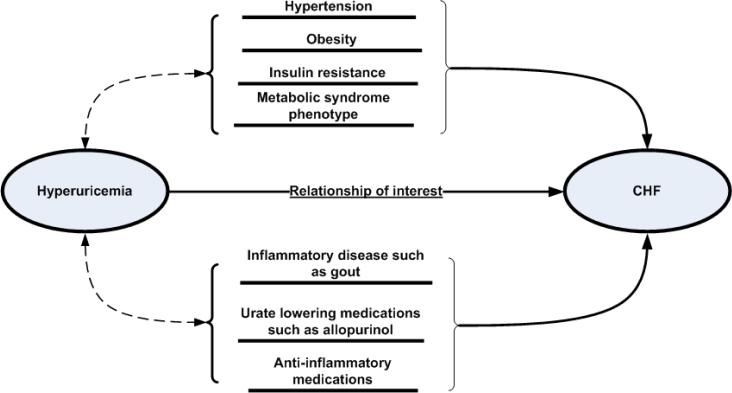
Background: Hyperuricemia, a known correlate of oxidative stress, is a marker for adverse prognosis among individuals with heart failure. However, the relationship between hyperuricemia and the risk for incidence of heart failure in a community-based population has not been studied.
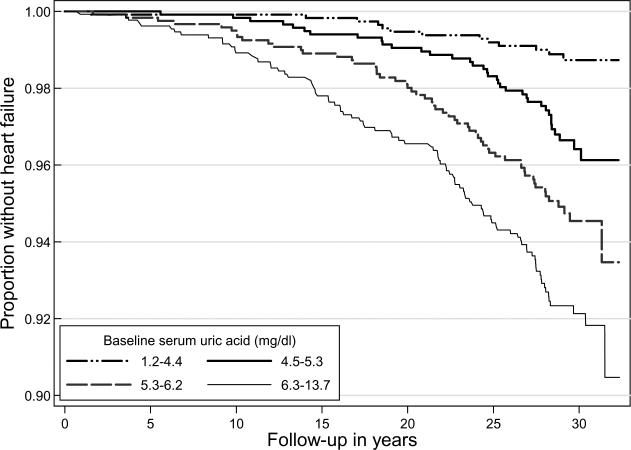
Methods and results: We prospectively analyzed the relationship between serum uric acid concentration at baseline and subsequent heart failure among the participants of the Framingham Offspring cohort (n=4912; mean baseline age, 36 years; 52% women). By using Cox regressions, we calculated the risk of heart failure with increasing serum uric acid after adjusting for sex, age, smoking, body mass index, renal dysfunction, diuretics, systolic blood pressure, valvular heart disease, diabetes, alcohol, and use of antihypertensive medications. The incidence rates of heart failure were approximately 6-fold higher among those at the highest quartile of serum uric acid (>6.3 mg/dL) compared with those at the lowest quartile (<3.4 mg/dL). The adjusted hazard ratio for the highest quartile of serum uric acid compared with the lowest was 2.1 (1.04 to 4.22). The relationship between hyperuricemia and heart failure was found in participants without metabolic syndrome and other subgroups as well.
Conclusions: Hyperuricemia is a novel, independent risk factor for heart failure in a group of young general community dwellers. This has implications for development of preventive strategies for heart failure.
Figures
References
-
- Heart disease and stroke statistics-2006 update. American Heart Association; Dallas, TX: 2006. - PubMed
-
- Gwadry-Sridhar FH, Flintoft V, Lee DS, Lee H, Guyatt GH. A systematic review and meta-analysis of studies comparing readmission rates and mortality rates in patients with heart failure. Arch Intern Med. 2004;164:2315–2320. - PubMed
-
- Kenchaiah S, Narula J, Vasan RS. Risk factors for heart failure. Med Clin North Am. 2004;88:1145–1172. - PubMed
-
- Leyva F, Anker S, Swan JW, Godsland IF, Wingrove CS, Chua TP, Stevenson JC, Coats AJ. Serum uric acid as an index of impaired oxidative metabolism in chronic heart failure. Eur Heart J. 1997;18:858–865. - PubMed
Publication types
MeSH terms
Substances
Grants and funding
LinkOut - more resources
Full Text Sources
Other Literature Sources
Medical
