. 2009 Dec 1;106(48):20464-9.
doi: 10.1073/pnas.0907508106. Epub 2009 Nov 17.

Fusion of epithelial cells by Epstein-Barr virus proteins is triggered by binding of viral glycoproteins gHgL to integrins alphavbeta6 or alphavbeta8

Affiliations

Fusion of epithelial cells by Epstein-Barr virus proteins is triggered by binding of viral glycoproteins gHgL to integrins alphavbeta6 or alphavbeta8

Liudmila S Chesnokova et al. Proc Natl Acad Sci U S A. .

Erratum in

  • Proc Natl Acad Sci U S A. 2010 Feb 16;107(7):3275

Abstract

Epstein-Barr virus (EBV) is a ubiquitous human herpesvirus that is causally implicated in the development of lymphoid and epithelial tumors. Entry of virus requires fusion of virus envelopes and cell membranes. Fusion with B lymphocytes requires virus glycoprotein gB and a 3-part complex of glycoproteins, gHgLgp42. It is triggered by interactions between glycoprotein 42 (gp42) and HLA class II. However, fusion with epithelial cells is impeded by gp42 and instead is triggered by interactions between an unknown epithelial protein and a 2-part complex of gHgL. We report here that gHgL binds with high affinity to epithelial cells and that affinity of binding is increased by 3 orders of magnitude in the presence of Mn(2+). Binding and infection can be reduced by fibronectin and vitronectin, by down-regulation of integrin alphav, or by a peptide corresponding to 13 aa of gH which include a KGDE motif. Fusion of cells expressing gB and gHgL can be blocked by vitronectin or triggered by addition of soluble truncated integrins alphavbeta6 and alphavbeta8. We conclude that the direct interaction between EBV gHgL and integrins alphavbeta6 and alphavbeta8 can provide the trigger for fusion of EBV with an epithelial cell.


Conflict of interest statement

The authors declare no conflict of interest.

Figures
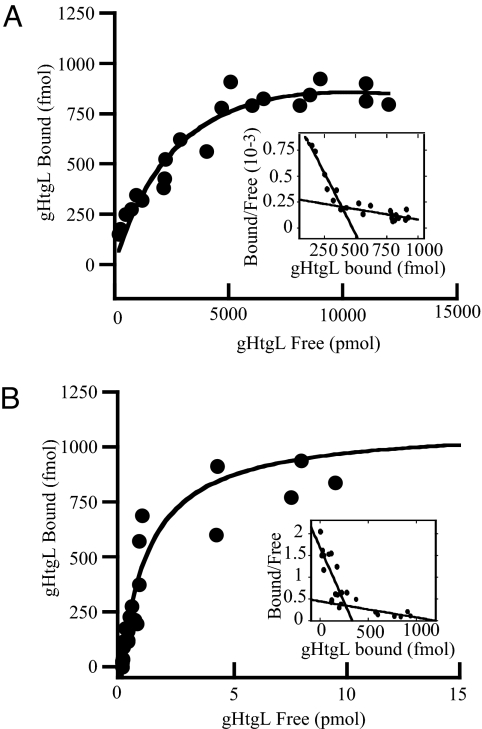
Fig. 1.
Fig. 1.
Manganese increases the affinity of gHtgL binding to AGS cells without affecting the number of binding sites. Scatchard analysis of 125I-labeled gHtgL binding to AGS cells in the absence (A) or presence (B) of 200 μM MnCl2.
Fig. 2.
Fig. 2.
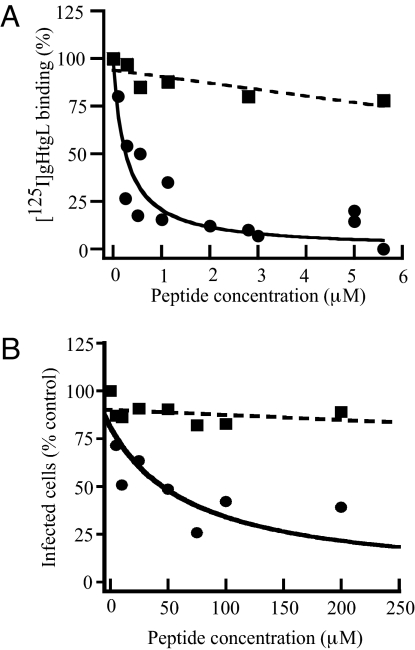
A peptide corresponding to residues 184–196 of gH blocks gHtgL binding to and infection of SVKCR2 cells, but a scrambled peptide does not. (A) Binding of 125I-labeled gHtgL to cells preincubated with increasing concentrations of cognate peptide including the KGD motif (solid line) or a scrambled form of the same residues (dotted line). The data were fit using Kaleida Graph (Synergy Software). The plot of the scrambled peptide obeys a linear equation (r = 0.82), and that for the cognate peptide obeys an equation for competitive inhibition of binding (r = 0.91). Initial slopes of the 2 conditions are significantly different (P < 0.0001). (B) Infection of cells preincubated with the indicated amounts of the cognate KGD peptide (solid line) or a scrambled form of the same peptide (dotted line). The plot of the scrambled peptide obeys a linear equation (r = 0.73), and that for the cognate peptide obeys an equation for competitive inhibition of binding (r = 0.63). Initial slopes of the 2 conditions are significantly different (P = 0.0003). Plots in both panels are the averages of 3 independent experiments.
Fig. 3.
Fig. 3.
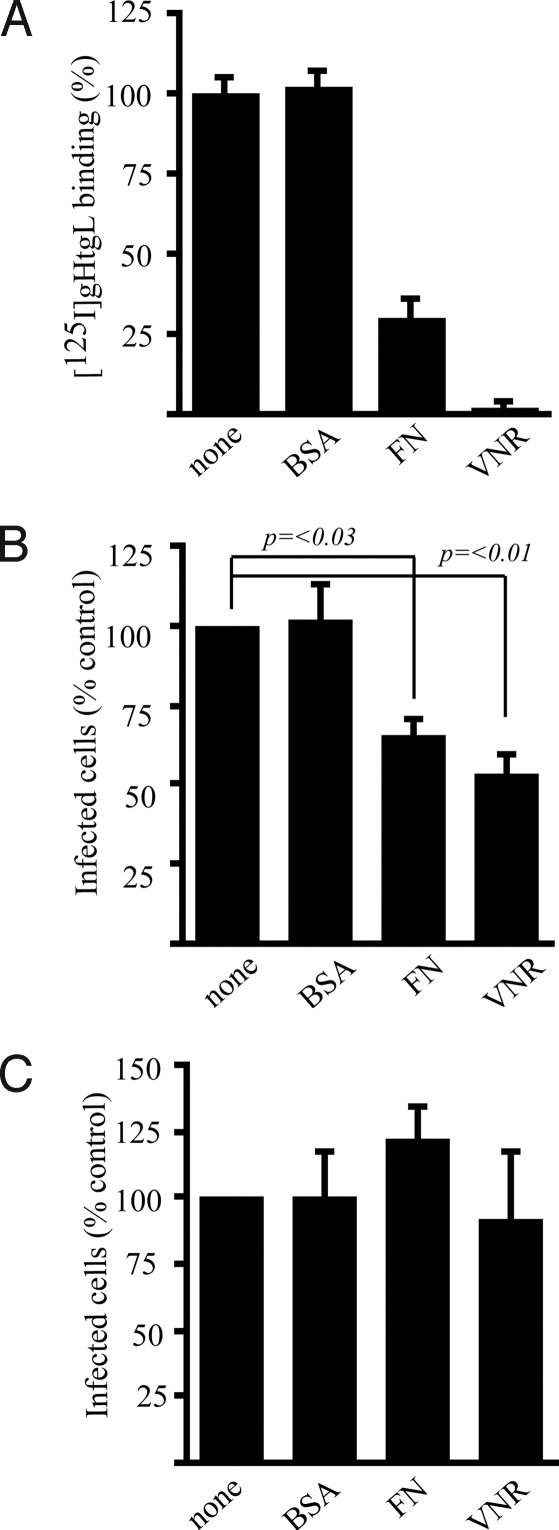
Fibronectin and vitronectin block gHtgL binding and infection. (A) Binding of 125I-labeled gHtgL to AGS cells in medium alone (none) or in the presence of 40 μg/mL of BSA (BSA), fibronectin (FN), or vitronectin (VNR). (B) Infection of SVKCR2 cells in the presence of medium alone or 40 μg/mL BSA, fibronectin, or vitronectin. (C) Infection of EBV-negative Akata B cells in the presence of medium alone or 40 μg/mL BSA, fibronectin, or vitronectin. Error bars indicate SD of 3 infections and duplicate binding assays.
Fig. 4.
Fig. 4.
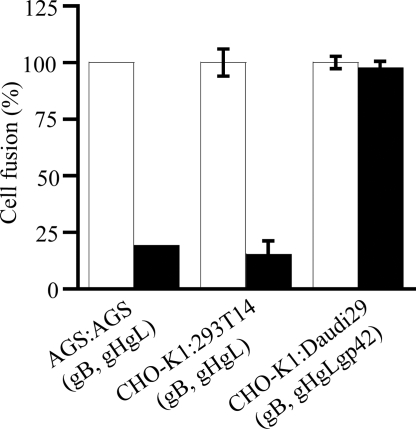
Vitronectin blocks fusion of epithelial cells but not of B cells. Vitronectin was added immediately after transfection of AGS cells with gB and gHgL (AGS:AGS), after transfection of CHO-K1 cells with gB, gHgL, and a luciferase construct and subsequently overlaid with 293T14 cells (CHO:293T14), or after transfection of CHO-K1 cells with gB, gHgL, gp42, and a luciferase construct, subsequently overlaid with Daudi29 cells (CHO:Daudi29) (black bars). Fusion is expressed as a percentage of that occurring in the absence of vitronectin (white bars). Error bars indicate SD of 3 experiments; the SD of AGS :AGS fusion in the presence of vitronectin is too small to visualize.
Fig. 5.
Fig. 5.
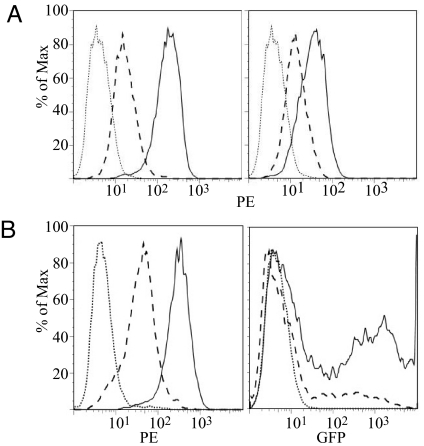
gHtgL binding and infection are reduced by siRNA to αv. (A) SVKCR2 cells were nucleoporated with siRNA to αv (dashed line) or with control siRNA (solid line), and expression of αv (Left) or binding of gHtgL (Right) was measured by flow cytometry. The isotype controls are shown as dotted lines. (B) SVKCR2 cells were transfected with siRNA to αv (dashed line) or control siRNA (solid line), and expression of αv (Left) or infection (Right) was measured by flow cytometry. Isotype controls or uninfected cells are shown as dotted lines. Experiments are representative of 3 different nucleoporations/transfections.
Fig. 6.
Fig. 6.
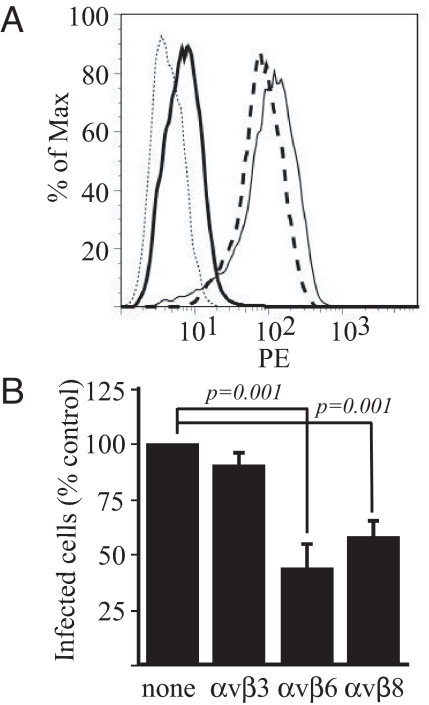
gHtgL binding and infection are reduced by media containing soluble integrins. (A) Flow cytometric analysis of gHtgL binding to SVKCR2 cells in the presence of fresh tissue culture media (light solid line), concentrated spent tissue culture media from CHO-K1 cells (dashed line), or CHO-C5 cells secreting soluble human αvβ6 (heavy solid line). Cells were preincubated with supernatants before addition of gHtgL. The isotype control is shown as a dotted line. (B) Infection of SVKCR2 cells with virus preincubated with soluble αvβ3, αvβ6, or αvβ8. Error bars indicated the SD of triplicate infections.
Fig. 7.
Fig. 7.
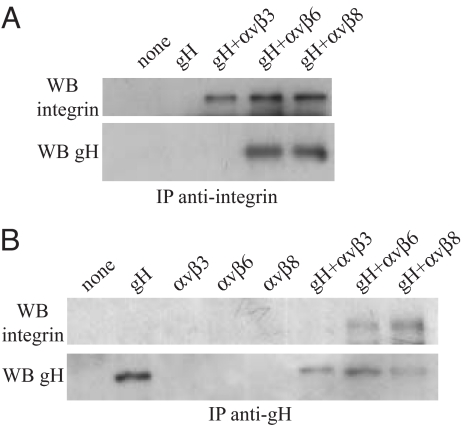
gHtgL is reciprocally precipitated with αvβ6 and αvβ8 but not with αvβ3. Integrins or gHtgL were immunoprecipitated (IP) individually or together as indicated, with antibody to the alkaline phosphatase fused to the carboxy termini of each integrin (A) or with antibody to gH (B) and were Western blotted (WB) with antibody to αv (Upper) or gH (Lower).
Fig. 8.
Fig. 8.
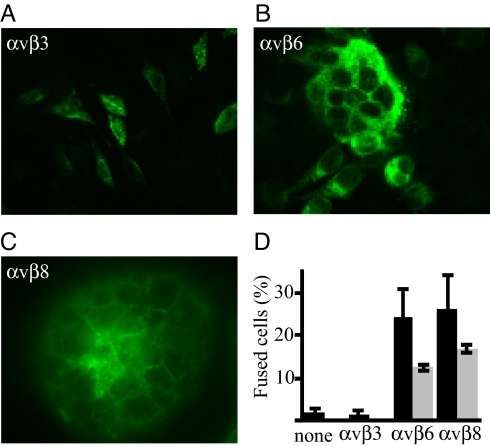
Soluble αvβ6 and αvβ8 trigger fusion of CHO-K1 cells transfected with gB and gHgL but solubleαvβ3 does not. Cells were transfected with gB and gHgL, overlaid with integrins, and 20 h later were fixed and stained with monoclonal antibody to gB. (A) Cells overlaid with αvβ3. (B) Cells overlaid with αvβ6. (C) Cells overlaid with αvβ8. (D) Percentage of cells expressing gB that contained 4 or more nuclei (% fusion) after overlay with integrins (black bars) or integrins preincubated with cognate blocking antibody (gray bars). Error bars indicate SD of 5 experiments without antibody and 2 experiments with antibody.

References

    1. Rickinson AB, Kieff E. In: Fields Virology. Knipe DM, Howley PM, editors. Vol 2. Philadelphia: Lippincott Williams & Wilkins; 2007. pp. 2655–2700.
    1. Hutt-Fletcher LM. Epstein–Barr virus entry. J Virol. 2007;81:7825–7832. - PMC - PubMed
    1. Spear PG, Longnecker R. Herpesvirus entry: An update. J Virol. 2003;77:10179–10185. - PMC - PubMed
    1. Borza CM, Morgan AJ, Turk SM, Hutt-Fletcher LM. Use of gHgL for attachment of Epstein–Barr virus to epithelial cells compromises infection. J Virol. 2004;78:5007–5014. - PMC - PubMed
    1. Molesworth SJ, Lake CM, Borza CM, Turk SM, Hutt-Fletcher LM. Epstein–Barr virus gH is essential for penetration of B cell but also plays a role in attachment of virus to epithelial cells. J Virol. 2000;74:6324–6332. - PMC - PubMed

Publication types

MeSH terms