


Aggression and Violence in Households of Crack Sellers/Abusers
- PMID: 19920879
- PMCID: PMC2777729
- DOI: 10.1016/S1068-8595(96)80024-9
Aggression and Violence in Households of Crack Sellers/Abusers
Abstract
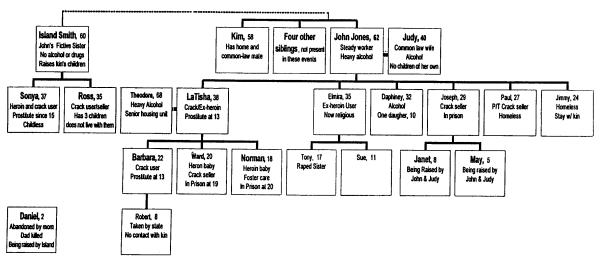
While the consequences of aggression and violence in family settings have been extensively documented, the intergenerational processes by which such behaviors are modeled, learned, and practiced have not been firmly established. This research was derived from a larger ethnographic study of crack sellers and their family systems and provides a case study of one kin network in Harlem where many adults were actively involved in alcohol and hard drug use and sales. "Illuminating episodes" suggest the various processes by which aggression and violence were directly modeled by adults and observed and learned by children.Aggression and violent behavior were entrenched in the Jones and Smith family, as was drug consumption and sales. Adults often fought over drugs or money and feuded while under the influence of crack and alcohol. They used aggression and violence against family members as retribution or punishment for previous aggressive and violent acts. Aggressive language and excessive profanity were routine adult behaviors and a major means of communication; jokes and insults led to arguments, often followed by fights. Most adults who were abused physically or sexually as children did the same to their own as when one mother was knifed by her daughter. Children rarely obtained special attention and support and had almost no opportunity to learn nonaggressive patterns. Rather, youths learned to model adult behaviors, such that the intergenerational transmission of aggression and violence was well established in this kin network.
References
-
- Aschenbrenner J. Lifelines: Black families in Chicago. Waveland Press; Prospect Heights, IL: 1975.
-
- Bandura A. Aggression: A social learning approach. Prentice Hall; Englewood Cliffs, NJ: 1973.
-
- Bandura A, Ross D, Ross S. Transmission of aggression through imitation of aggresive models. Journal of Abnormal Sociology and Psychology. 1961;63:575–582. - PubMed
-
- Biringen Z, Robinson J. Emotional availability in mother-child interactions: A reconceptualization for research. American Journal of Orthopsychiatry. 1991;61(2):258–271. - PubMed
-
- Bourgois P, Dunlap E. Exorcising sex-for-crack: An ethnographic perspective from Harlem. In: Ratner M, editor. Crack pipe as pimp: An eight-city study of the sex-for-crack phenomenon. Lexington Books; New York: 1993. pp. 97–132.
Grants and funding
LinkOut - more resources
Full Text Sources