


Comparative in vivo bioequivalence and in vitro dissolution of two valproic acid sustained-release formulations
- PMID: 19920901
- PMCID: PMC2761171
- DOI: 10.2147/dddt.s3556
Comparative in vivo bioequivalence and in vitro dissolution of two valproic acid sustained-release formulations
Abstract
Objective: A study was conducted to establish the bioequivalence between different sustained-release formulations of valproic acid (Depakene R and Selenica R), which were developed in Japan.
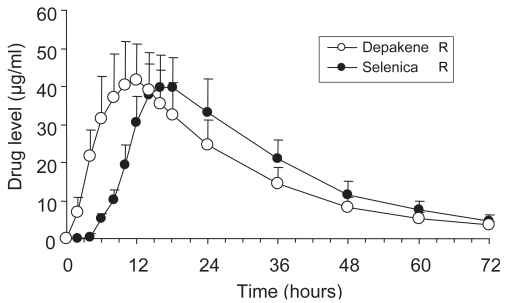
Materials and methods: The clinical investigation was designed in a randomized, crossover fashion with a single dose given to 12 healthy subjects. The subjects were administered a single 600 mg dose of valproic acid in one of two formulations. Serial venous blood samples were obtained over 72 hours after each administration to measure valproic acid in serum by enzyme immunoassay (EIA). In addition, a dissolution test was performed. Each sample was analyzed by an high-performance liquid chromatography to determine the dissolution rate of valproic acid.
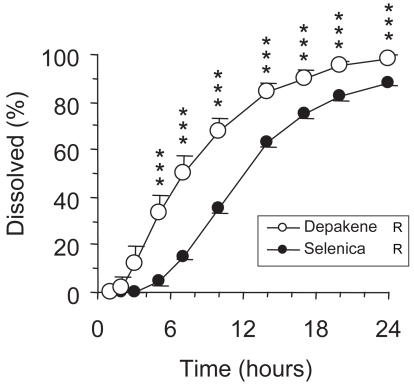
Results: No difference in maximum concentration or area under the curve was found between the two formulations. The time to maximum concentration of the new formation was significantly delayed compared with the conventional formulation (10.8 +/- 1.7 versus 17.6 +/- 1.8 hours, p < 0.001). Apparent clearance or elimination half-life did not differ between the two formulations. An in vitro dissolution study showed that Depakene R was significantly more dissoluble than Selenica R.
Conclusion: Based on the results, the present study demonstrated a significant difference between the two sustained-release formulations in the absorption profile, and also demonstrated that the bioavailability of valproic acid in the two formulations was similar but absorption speed (lag time) was very different.
Keywords: Depakene R; Selenica R; bioequivalence; sustained-release; valproic acid.
Figures
References
-
- Bialer M. Pharmacokinetic evaluation of sustained release formulations of antiepileptic drugs. Clinical implications. Clin Pharmacokinet. 1992;22:11–21. - PubMed
-
- Bowden CL, Singh V. Valproate in bipolar disorder: 2000 onwards. Acta Psychiatr Scand Suppl. 2005;426:13–20. - PubMed
-
- Buck D, Jacoby A, Baker GA, et al. Factors influencing compliance with antiepileptic drug regimes. Seizure. 1997;6:87–93. - PubMed
-
- Cramer J, Vachon L, Desforges C, et al. Dose frequency and dose interval compliance with multiple antiepileptic medications during a controlled clinical trial. Epilepsia. 1995;36:1111–7. - PubMed
-
- Doughty J, Baker GA, Jacoby A, et al. Compliance and satisfaction with switching from an immediate-release to sustained-release formulation of valproate in people with epilepsy. Epilepsy Behav. 2003;4:710–6. - PubMed
LinkOut - more resources
Full Text Sources
Medical
