


doi: 10.1007/s12192-009-0155-4.
Epub 2009 Nov 18.
Why proteins without an alpha-crystallin domain should not be included in the human small heat shock protein family HSPB
Affiliations
- PMID: 19921466
- PMCID: PMC3082639
- DOI: 10.1007/s12192-009-0155-4
Item in Clipboard
Why proteins without an alpha-crystallin domain should not be included in the human small heat shock protein family HSPB
Cell Stress Chaperones.
2010 Jul.
Abstract
The presence of an alpha-crystallin domain documents the evolutionary relatedness of the ubiquitous family of small heat shock proteins. Sequence and three-dimensional structure provide no evidence for the presence of such a domain in HSPC034, recently proposed as the 11th member of the human HSPB family. Also, phylogenetic analyses detect no relationship between HSPC034 and the human HSPB1-10 sequences. Arguments are provided as to why inclusion in the HSPB family of proteins like HSPC034, which resemble small heat shock proteins in being heat-inducible and having chaperone-like properties and a low monomeric mass, but are evolutionarily unrelated, is misleading and confusing.
Figures

Alignment and secondary structure elements of sHSP and HSPC034 sequences. Human HSPB1–10 are aligned with wheat Tae Hsp16.9 and the archaeal Methanococcus jannasschii Mj Hsp16.5 because of the latters’ known crystal structures. HSPC034 sequences are from human (Hs), mouse (Mm), chicken (Gg), amphioxus (Bf), Trichoplax adhaerens, a placozoan, the lowest metazoans (Tad), and T. vaginalis, a unicellular eukaryote (Tv). No prokaryotic homologs of HSPC034 could be retrieved. For accession numbers, see the legends of Supplementary Fig. S1. This set of sequences is taken without change from the larger alignment in Supplementary Fig. S1, which was used for the construction of the cladogram in Fig. 2, and also includes mouse and chicken HSPB1–10. Alignment was obtained with ClustalW v1.83 at default settings, without manual editing, to avoid any subjective influences. White letters on dark gray background: >80% identity or similarity in the six HSPC034 sequences; black letters on light gray background: >80% identity or similarity in the 12 sHSP sequences; white letters on black background: >80% identity or similarity both in HSPC034 and sHSP sequences. Similarity groups are: D/N, V/L/I/M, F/Y/W, K/R, E/D, and Q/E. To make the alignment more compact, the C-terminal tails of most sHSPs are not shown (slashes) and an internal sequence of 20 residues is deleted from Hs HspB10 (number sign at position 97). The demarcations of the discoidin domain in human HSPC034 (positions 39–171) and the ACD in human HSPB5 (positions 94–191) are indicated. Asterisks at positions 117 and 119 indicate the F and P residues that are diagnostic for metazoan sHSPs (de Jong et al. ; Bagnéris et al. 2009). The positions of experimentally determined β-strands and α-helices in human αB-crystallin (Hs HspB5; Bagnéris et al. ; Jehle et al. 2009), rat Hsp20 (Rn HspB6; Bagnéris et al. 2009), wheat Tae Hsp16.9 (van Montfort et al. 2001), M. jannasschii Mj Hsp16.5 (Kim et al. 1998), and human HSPC034 (Ramelot et al. 2009) are shown below the alignment; for Hs_HspB5 and rat Rn_HspB6, only the structures of the ACDs are known. The remarkable interruptions in the β2 strands of HspB5, Hsp16.9, and Hsp16.5 would normally have been corrected by manual editing
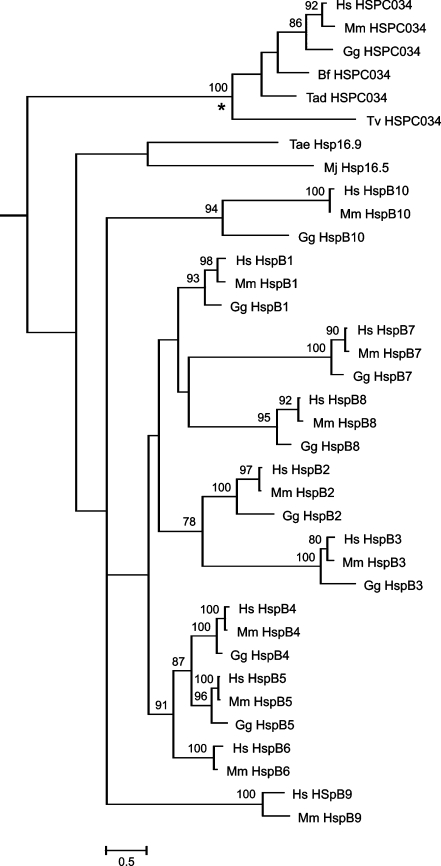
Cladogram resulting from a maximum likelihood analysis of the aligned complete sHSP and HSPC034 sequences as present in Supplementary Fig. S1. These are the same as in Fig. 1, plus the mouse (Mm) and chicken (Gg) orthologs of human (Hs) HSPB1–10. The analysis was performed with PhyML v3.0 at http://www.atgc-montpellier.fr/phyml/ using the WAG substitution model, a fixed proportion of invariable sites, four substitution rate categories, and estimated gamma shape parameter. Nodal support was estimated by bootstrap analysis with 100 replicates. Bootstrap values above 70 are shown. The asterisk indicates the oldest divergence in the HSPC034 clade, between the protist T. vaginalis and the metazoa
References
-
- Bellyei S, Szigeti A, Boronkai A, Pozsgai E, Gomori E, Melegh B, Janaky T, Bognar Z, Hocsak E, Sumegi B, Gallyas F., Jr Inhibition of cell death by a novel 16.2 kD heat shock protein predominantly via Hsp90 mediated lipid rafts stabilization and Akt activation pathway. Apoptosis. 2007;12:97–112. doi: 10.1007/s10495-006-0486-x. - DOI - PubMed
MeSH terms
Substances
LinkOut - more resources
Full Text Sources
Molecular Biology Databases
Research Materials
Miscellaneous
