


HIV prevention cost-effectiveness: a systematic review
- PMID: 19922689
- PMCID: PMC2779507
- DOI: 10.1186/1471-2458-9-S1-S5
HIV prevention cost-effectiveness: a systematic review
Abstract
Background: After more than 25 years, public health programs have not been able to sufficiently reduce the number of new HIV infections. Over 7,000 people become infected with HIV every day. Lack of convincing evidence of cost-effectiveness (CE) may be one of the reasons why implementation of effective programs is not occurring at sufficient scale. This paper identifies, summarizes and critiques the CE literature related to HIV-prevention interventions in low- and middle-income countries during 2005-2008.
Methods: Systematic identification of publications was conducted through several methods: electronic databases, internet search of international organizations and major funding/implementing agencies, and journal browsing. Inclusion criteria included: HIV prevention intervention, year for publication (2005-2008), setting (low- and middle-income countries), and CE estimation (empirical or modeling) using outcomes in terms of cost per HIV infection averted and/or cost per disability-adjusted life year (DALY) or quality-adjusted life year (QALY).
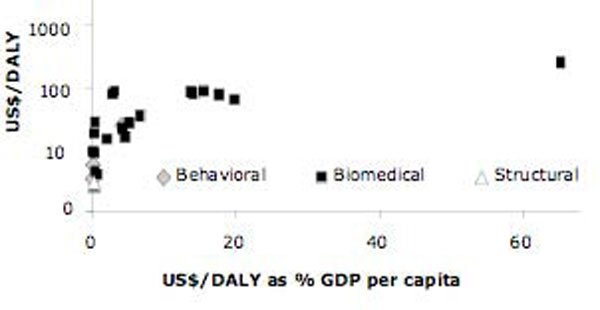
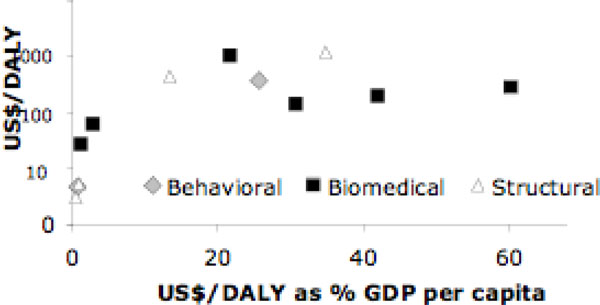
Results: We found 21 distinct studies analyzing the CE of HIV-prevention interventions published in the past four years (2005-2008). Seventeen CE studies analyzed biomedical interventions; only a few dealt with behavioral and environmental/structural interventions. Sixteen studies focused on sub-Saharan Africa, and only a handful on Asia, Latin America and Eastern Europe. Many HIV-prevention interventions are very cost effective in absolute terms (using costs per DALY averted), and also in country-specific relative terms (in cost per DALY measured as percentage of GDP per capita).
Conclusion: There are several types of interventions for which CE studies are still not available or insufficient, including surveillance, abstinence, school-based education, universal precautions, prevention for positives and most structural interventions. The sparse CE evidence available is not easily comparable; thus, not very useful for decision making. More than 25 years into the AIDS epidemic and billions of dollars of spending later, there is still much work to be done both on costs and effectiveness to adequately inform HIV prevention planning.
Figures
References
-
- UNAIDS. Report on the Global AIDS Epidemic: 2008. Geneva: Joint United Nations Program on HIV/AIDS (UNAIDS); World Health Organization (WHO); 2008.
-
- Bertozzi SM, Padian NS, Wegbreit J, DeMaria LM, Feldman B, Gayle H, Gold J, Grant R, Isbell MT. In: Disease control priorities in developing countries. Jamison DT, Breman JG, Measham AR, Alleyne G, Claeson M, Evans DB, Jha P, Mills A, Musgrove P, editor. Vol. 2. New York; Washington, DC: Oxford University Press; World Bank; 2006. HIV/AIDS Prevention and Treatment; pp. 331–370. - PubMed
-
- Gold MR, Siegel JE, Russel LB, Weinstein MC. Cost-effectiveness in health and medicine. New York: Oxford University Press; 1996.
-
- Drummond M, O'Brien BJ, Stoddart GL, Torrance G. Methods for the economic evaluation of health care programmes. Oxford: Oxford University Press; 1997.
Publication types
MeSH terms
Grants and funding
LinkOut - more resources
Full Text Sources
Medical
Miscellaneous
