Reflux related hospital admissions after fundoplication in children with neurological impairment: retrospective cohort study
- PMID: 19923145
- PMCID: PMC2779335
- DOI: 10.1136/bmj.b4411
Reflux related hospital admissions after fundoplication in children with neurological impairment: retrospective cohort study
Abstract
Objective: To examine the impact of fundoplication on reflux related hospital admissions for children with neurological impairment.
Design: Retrospective, observational cohort study. Setting 42 children's hospitals in the United States.
Participants: 3721 children with neurological impairment born between 2000 and 2005 who had at least one hospital admission at a study hospital before their fundoplication.
Intervention: Fundoplication.
Main outcome measures: Incident rate ratio for reflux related hospital admissions, defined as the post-fundoplication admission rate divided by the pre-fundoplication admission rate.
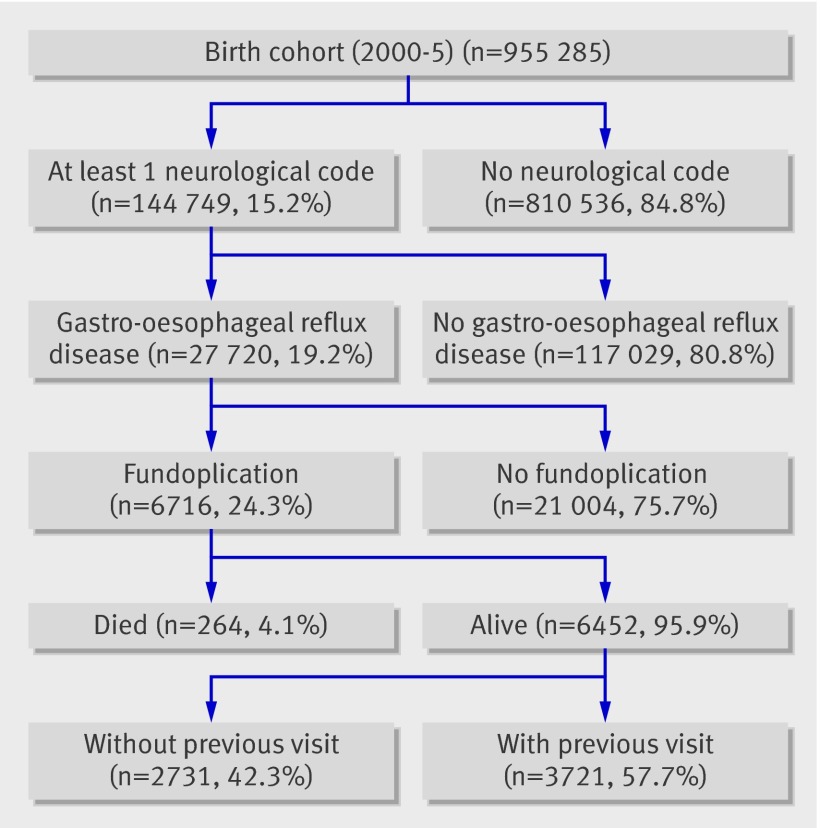
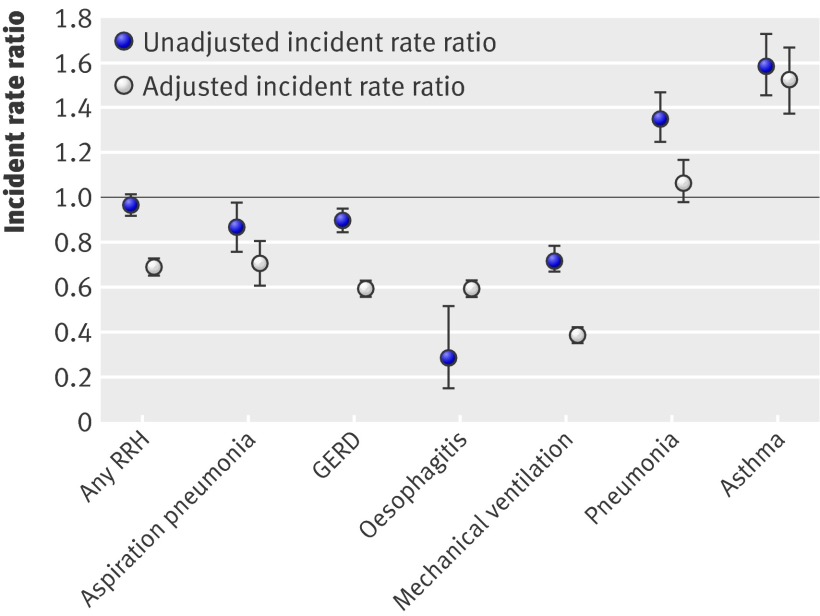
Results: Of the 955 285 children born during the study period, 144,749 (15%) had neurological impairment. Of these, 27,720 (19%) were diagnosed as having gastro-oesophageal reflux disease, of whom 6716 (24%) had a fundoplication. Of these, 3721 (55%) had at least one previous hospital admission and were included in the study cohort. After fundoplication, hospital admissions decreased for any reflux related cause (incident rate ratio 0.69, 95% confidence interval 0.67 to 0.72; P<0.01), aspiration pneumonia (0.71, 0.62 to 0.81; P<0.01), gastro-oesophageal reflux disease (0.60, 0.57 to 0.63; P<0.01), and mechanical ventilation (0.40, 0.37 to 0.43; P<0.01), after adjustment for other patient and hospital related factors that may influence reflux related hospital admissions. Hospital admissions increased for asthma (incident rate ratio 1.52, 1.38 to 1.67; P<0.01) and remained constant for pneumonia (1.07, 0.98 to 1.17; P=0.16). Conclusions Children with neurological impairment who have fundoplication had reduced short term reflux related hospital admissions for aspiration pneumonia, gastro-oesophageal reflux disease, and mechanical ventilation. However, admissions for pneumonia remained constant and those for asthma increased after fundoplication. Comparative effectiveness data for other treatments (such as gastrojejunal feeding tubes) are unknown.
Conflict of interest statement
Competing interests: None declared.
Figures
References
-
- Chaney RH, Eyman RK, Miller CR. Comparison of respiratory mortality in the profoundly mentally retarded and in the less retarded. J Ment Defic Res 1979;23:1-7. - PubMed
-
- Plioplys AV, Kasnicka I, Lewis S, Moller D. Survival rates among children with severe neurologic disabilities. South Med J 1998;91:161-72. - PubMed
-
- Marik PE. Aspiration pneumonitis and aspiration pneumonia. N Engl J Med 2001;344:665-71. - PubMed
-
- Sondheimer JM, Morris BA. Gastroesophageal reflux among severely retarded children. J Pediatr 1979;94:710-4. - PubMed
Publication types
MeSH terms
Grants and funding
LinkOut - more resources
Full Text Sources
Medical