


Review
doi: 10.1128/JVI.01334-09.
Epub 2009 Nov 18.
Early events in Kaposi's sarcoma-associated herpesvirus infection of target cells
Affiliations
- PMID: 19923183
- PMCID: PMC2820927
- DOI: 10.1128/JVI.01334-09
Item in Clipboard
Review
Early events in Kaposi's sarcoma-associated herpesvirus infection of target cells
J Virol.
2010 Mar.
Abstract
Kaposi's sarcoma-associated herpesvirus (KSHV), the most recently identified member of the herpesvirus family, infects a variety of target cells in vitro and in vivo. This minireview surveys current information on the early events of KSHV infection, including virus-receptor interactions, involved envelope glycoproteins, mode of entry, intracellular trafficking, and initial viral and host gene expression programs. We describe data supporting the hypothesis that KSHV manipulates preexisting host cell signaling pathways to allow successful infection. The various signaling events triggered by infection, and their potential roles in the different stages of infection and disease pathogenesis, are summarized.
Figures
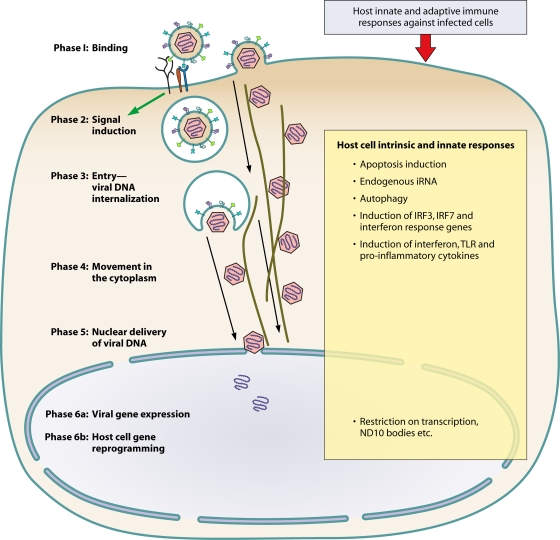
Model illustrating the different phases of early events of KSHV infection of target cells and the obstacles encountered by the virus. iRNA, interfering RNA.
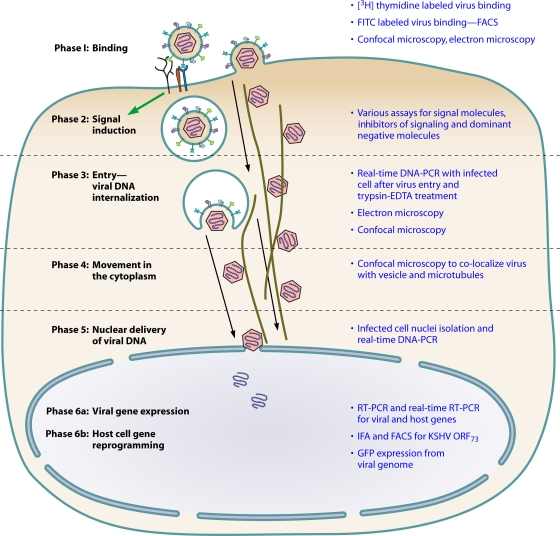
Model illustrating the various methods used to analyze the different phases of early events of KSHV infection of in vitro target cells. FITC, fluorescein isothiocyanate; FACS, fluorescence-activated cell sorter; IFA, immunofluorescence assay.
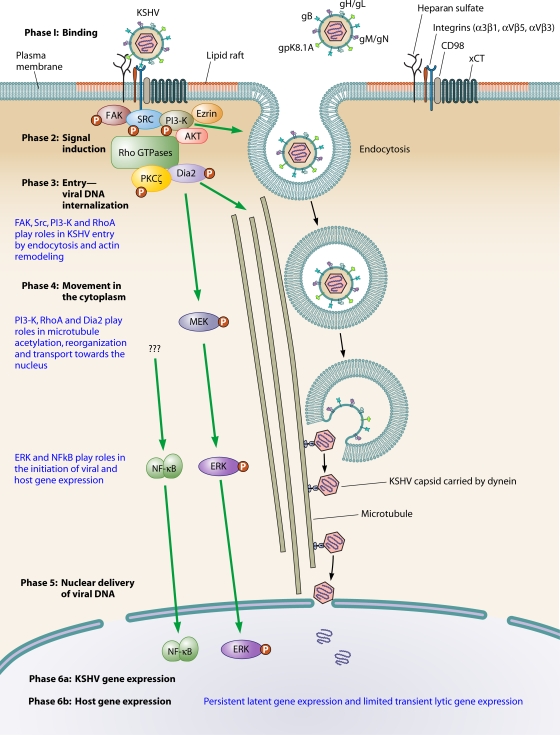
Model illustrating the dynamic overlapping phases of early events of KSHV infection in endothelial and fibroblast cells and KSHV-induced signal pathways and their role in infection. In phase 1, KSHV infection is initiated by binding to the cell surface via interactions with heparan sulfate (HS) followed by temporal interactions with αVβ5, α3β1, and αVβ3 integrins and xCT (CD98) molecules which overlap with the induction of host cell preexisting signal molecules (phase 2) that play roles in actin remodeling, the formation of endocytic vesicles, virus entry, movement in the cytoplasm, delivery into the nucleus, and viral and host gene expression. KSHV interactions with cell surface integrins leads to autophosphorylation of FAK at tyrosine 397, which creates a binding site for the SH2 domain of Src family kinases and leads to the subsequent phosphorylation of PI3-K and Rho GTPases. FAK, Src, PI-3K, and Rho GTPases play roles in KSHV entry. In the absence of FAK, Pyk2 is induced to compensate for the function of FAK. In phase 3, overlapping with phase 2, the virus enters the cells by endocytosis, and in phase 4, viral capsid/tegument moves in the cytoplasm. RhoA activates Dia2, which in turn augments Src activation, all of which are probably essential for the formation of endocytic vesicles and their movement in the cytoplasm. Capsid is released from the endocytic vesicles via fusion of the viral envelope with the endocytic vesicles. The role of signal pathways in the acidification of endosomes and changes in viral envelope architecture are poorly understood. RhoA GTPase facilitates the transport of capsid toward the nucleus by inducing MT stabilization and regulating MT dynamics via Dia2. The endocytic vesicles with virus or released capsid/tegument complexes bind to dynein motor components, transported along the MT to reach the nuclear vicinity, and deliver the viral DNA into the nucleus. RhoA GTPases facilitate the transport of the capsid toward the nucleus by inducing microtubule stabilization and regulating microtubule dynamics. KSHV-induced ERK and NF-κB play roles in the modulation of both viral and host gene expression and to overcome the host restriction on transcription. Nuclear delivery of the KSHV genome into the infected cell nucleus is followed by simultaneous induction of viral gene expression (phase 6a) and host gene expression (phase 6b). The overlapping viral gene-induced host cell gene expression may exert an influence on subsequent viral and host gene expression. These studies demonstrate that KSHV interactions with host cell receptors play vital roles in manipulating the host cell signaling pathway to create a conducive intracellular environment for the establishment of a successful infection. The arrows indicate the stage of KSHV infection in which the induced signal pathways are shown to play roles.
References
-
- Akula, S. M., P. P. Naranatt, F. Z. Wang, and B. Chandran. 2001. Human herpesvirus envelope-associated glycoprotein B interacts with heparan sulfate-like moieties. Virology 284:235-249. - PubMed
-
- Akula, S. M., F. Z. Wang, J. Vieira, and B. Chandran. 2001. Human herpesvirus 8 interaction with target cells involves heparan sulfate. Virology 282:245-255. - PubMed
-
- Akula, S. M., P. P. Naranatt, F. Z. Wang, and B. Chandran. 2002. Integrin α3β1 (CD49c/29) is a cellular receptor for Kaposi's sarcoma-associated herpesvirus (KSHV/HHV8) entry into target cells. Cell 108:407-419. - PubMed
-
- Baghian, A., M. Luftig, J. B. Black, Y. X. Meng, C. P. Pau, T. Voss, P. E. Pellett, and K. G. Kousoulas. 2000. Glycoprotein B of human herpesvirus 8 is a component of the virion in a cleaved form composed of amino- and carboxyl-terminal fragments. Virology 269:18-25. - PubMed
Publication types
MeSH terms
Substances
Grants and funding
LinkOut - more resources
Full Text Sources
Other Literature Sources
