Comparative Study
. 2009 Nov 18;29(46):14383-93.
doi: 10.1523/JNEUROSCI.3583-09.2009.

Timing in the absence of supraspinal input II: regularly spaced stimulation induces a lasting alteration in spinal function that depends on the NMDA receptor, BDNF release, and protein synthesis

Affiliations
Comparative Study

Timing in the absence of supraspinal input II: regularly spaced stimulation induces a lasting alteration in spinal function that depends on the NMDA receptor, BDNF release, and protein synthesis

Kyle M Baumbauer et al. J Neurosci. .

Abstract

The detection of temporal regularity allows organisms to predict the occurrence of future events. When events occur in an irregular manner, uncertainty is increased, and negative outcomes can ensue (e.g., stress). The present study shows that spinal neurons can discriminate between variable- and fixed-spaced stimulation and that the detection of regularity requires training and engages a form of NMDA receptor-mediated plasticity. The impact of stimulus exposure was assessed using a spinally mediated instrumental response, wherein spinally transected rats are given legshock whenever one hindlimb is extended. Over time, they learn to maintain the leg in a flexed position that minimizes net shock exposure. Prior exposure to 180-900 tailshocks given in a variable (unpredictable) manner inhibited this learning. A learning deficit was not observed when 900 tailshocks were applied using a fixed (predictable) spacing. Fixed-spaced stimulation did not have a divergent effect when fewer (180) shocks were presented, implying that the abstraction of temporal regularity required repeated exposure (training). Moreover, fixed-spaced stimulation both prevented and reversed the learning deficit. The protective effect of fixed-spaced shock lasted 48 h, and was prevented by pretreatment with the NMDA receptor antagonist MK-801. Administration of the protein synthesis inhibitor cycloheximide after training blocked the long-term effect. Inhibiting BDNF function, using TrkB-IgG, also eliminated the beneficial effect of fixed-spaced stimulation. The results suggest that spinal systems can detect regularity and that this type of stimulation promotes adaptive plasticity, which may foster recovery after spinal injury.


Figures
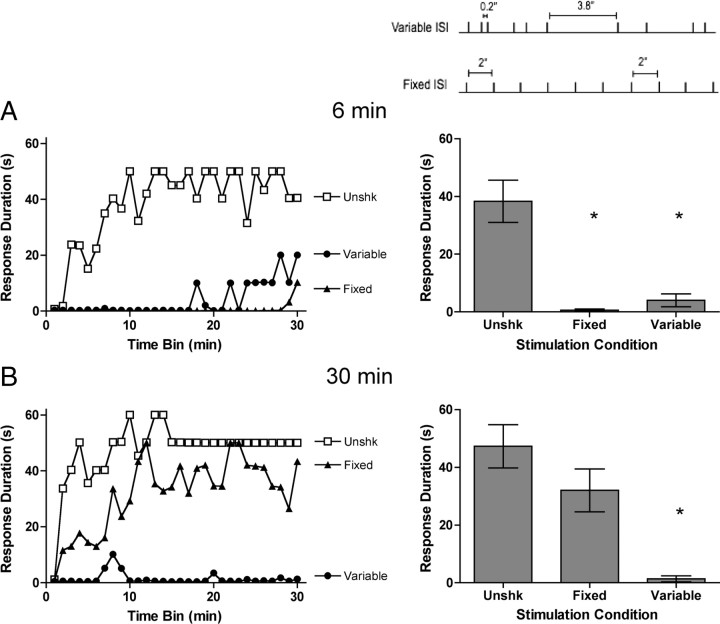
Figure 1.
Figure 1.
The effect of training with 6 or 30 min of fixed or variable-spaced stimulation on performance. Subjects received 6 or 30 min of tailshock on a variable or fixed spacing before testing. The upper panels (A) represent data from subjects that received 6 min of tailshock and the lower panels (B) depict data from subjects that received 30 min of shock [open squares = unshocked controls (Unshk), closed circles = variable spaced (Variable), closed triangles = fixed spaced (Fixed)]. Panels on the left depict response durations across time and the panels on the right show the average response duration collapsed across trials. Asterisks indicate groups that were significantly different from the unshocked controls (p < 0.05), and error bars indicate ±SE. The inset illustrates variable (range = 0.2–3.8 s, mean = 2 s) versus fixed-spaced (2 s) stimulation.
Figure 2.
Figure 2.
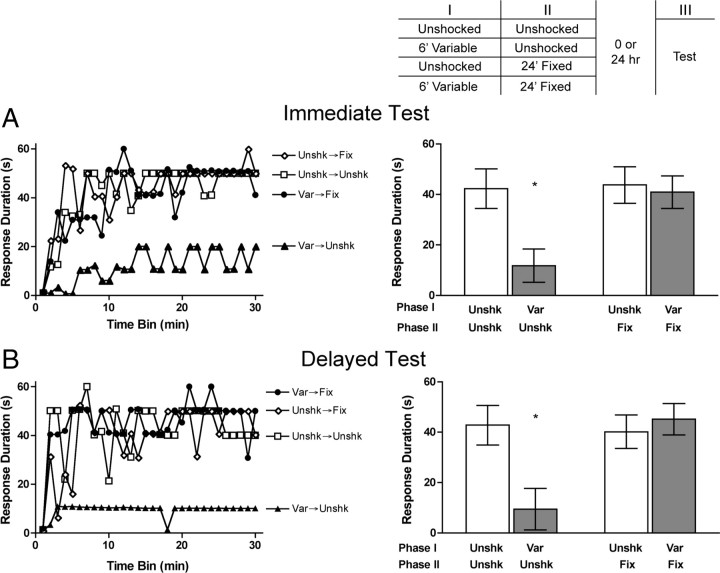
Fixed-spaced stimulation reverses the learning deficit produced by variable shock. Subjects received 0 or 6 min of variable-spaced tailshock followed by 0 or 24 min of fixed-spaced shock (see inset). Testing occurred 0 (top panels; A) or 24 h (lower panels; B) after tailshock. The panels on the left depict response durations across time for subjects that received no shock (open squares; Unshk→Unshk), 6 min of variable stimulation followed by no shock (closed triangles; Var→Unshk), no shock followed by 24 min of fixed stimulation (open diamonds; Unshk→Fix), or 6 min of variable shock followed by 24 min of fixed shock (closed circles; Var→Fix). The panels on the right show subjects' average response durations collapsed across time. Asterisks indicate groups that were significantly different from subjects that received no shock (p < 0.05), and error bars represent ±SE.
Figure 3.
Figure 3.
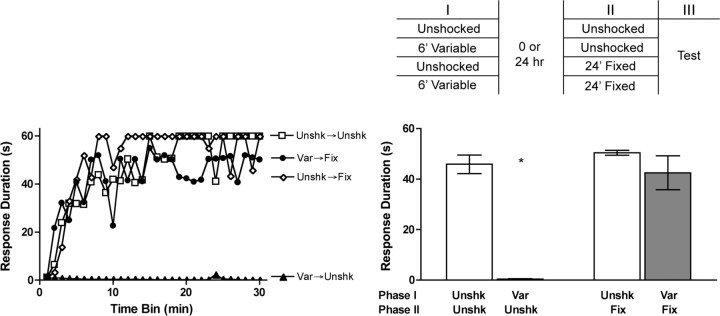
Fixed-spaced stimulation reverses the learning deficit when administered 24 h following variable shock. Subjects received 0 or 6 min of variable-spaced tailshock 24 h before treatment with 0 or 24 min of fixed stimulation (see inset). Testing occurred immediately following fixed-spaced shock. The left panel shows response durations over time for subjects that received no shock (open squares; Unshk→Unshk), 6 min of variable stimulation followed by no shock (closed triangles; Var→Unshk), no shock followed by 24 min of fixed stimulation (open diamonds; Unshk→Fix), or 6 min of variable shock followed by 24 min of fixed shock (closed circles; Var→Fix). The panel on the right shows subjects' average response durations collapsed across time. Asterisks indicate groups that were significantly different from subjects that received no shock (p < 0.05), and error bars represent ±SE.
Figure 4.
Figure 4.
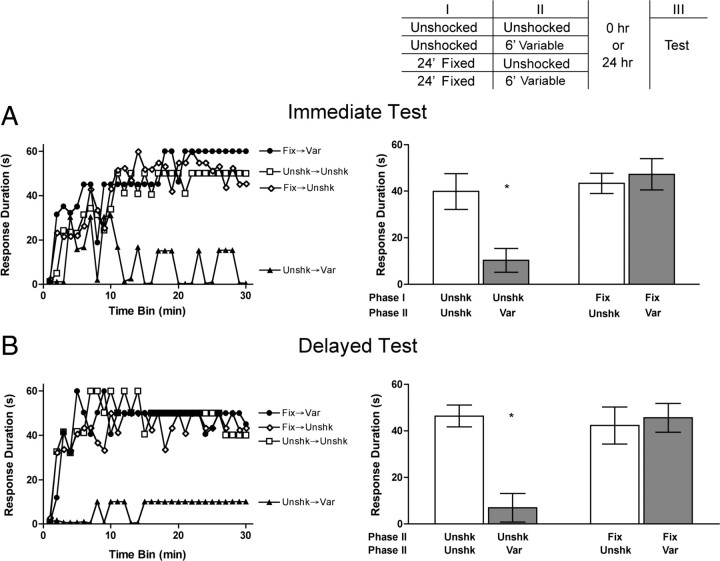
Fixed-spaced stimulation protects against deficit induction. Subjects received 0 or 24 min of fixed-spaced tailshock followed by 0 or 6 min of variable-spaced shock (see inset). Testing occurred 0 (top panels; A) or 24 h (lower panels; B) following tailshock treatment. The panels on the left depict response durations across time for subjects that received no shock (open squares; Unshk→Unshk), no shock followed by 6 min of fixed stimulation (closed triangles; Unshk→Var), 24 min of fixed stimulation followed by no shock (open diamonds; Fix→Unshk), or 24 min of fixed shock followed by 6 min of variable shock (closed circles; Fix→Var). The panels on the right show subjects' average response durations collapsed across time. Asterisks indicate groups that were significantly different from subjects that received no shock (p < 0.05), and error bars represent ±SE.
Figure 5.
Figure 5.
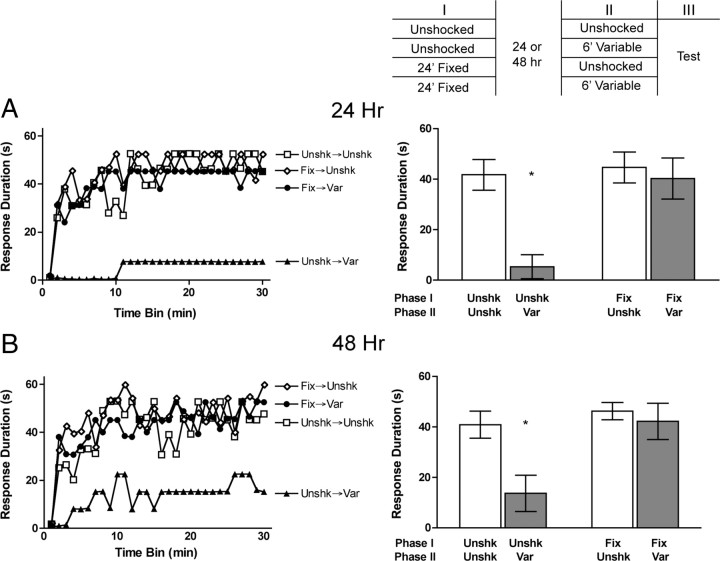
The protective effect of fixed-spaced stimulation persists for 24–48 h. Subjects received 0 or 24 min of fixed-spaced tailshock followed 24 (top panels; A) or 48 h (bottom panels; B) later by 0 or 6 min of variable-spaced shock (see inset). Testing occurred immediately following variable stimulation. The panels on the left depict response durations across time for subjects that received no shock (open squares; Unshk→Unshk), no shock followed by 6 min of fixed stimulation (closed triangles; Unshk→Var), 24 min of fixed stimulation followed by no shock (open diamonds; Fix→Unshk), or 24 min of fixed shock followed by 6 min of variable shock (closed circles; Fix→Var). The panels on the right show subjects' average response durations collapsed across time. Asterisks indicate groups that were significantly different from subjects that received no shock (p < 0.05), and error bars represent ±SE.
Figure 6.
Figure 6.
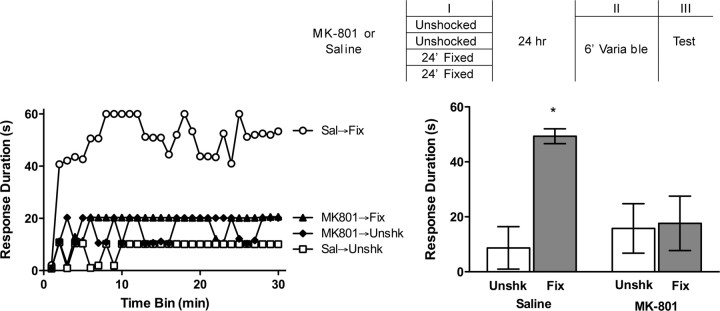
The protective effect of fixed-spaced stimulation is NMDAR dependent. Subjects received 10 nmol of MK-801 or saline before application of 0 or 24 min of fixed-spaced tailshock (see inset). Twenty-four hours later, subjects were given 6 min of variable-spaced shock immediately followed by instrumental test. Data are depicted for subjects that received saline before 0 min of fixed stimulation (open squares; Sal→Unshk), saline before 24 min of fixed stimulation (open circles; Sal→Fix), MK-801 before 0 min of fixed stimulation (closed diamonds; MK801→Unshk), or MK-801 before 24 min of fixed stimulation (closed triangles; MK801→Fix). The panel on the left depicts response durations across time, while the panel on the right shows subjects' average response durations collapsed across trials. Asterisks indicate groups that were significantly different from subjects that received saline and 0 min of fixed stimulation (p < 0.05), and error bars represent ±SE.
Figure 7.
Figure 7.
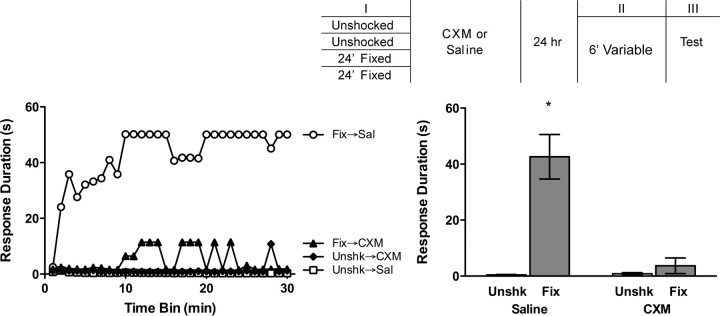
The protective effect of fixed-spaced stimulation requires protein synthesis. Subjects received 0 or 24 min of fixed-spaced tailshock followed by intrathecal administration of cycloheximide (10 nmol) or saline (see inset). Twenty-four hours later, subjects were given 6 min of variable-spaced shock immediately followed by instrumental test. Data are shown for subjects that received 0 min of fixed stimulation before saline (open squares; Unshk→Sal), 24 min of fixed stimulation before saline (open circles; Fix→Sal), 0 min of fixed stimulation before cycloheximide (closed diamonds; Unshk→CXM), or 24 min of fixed stimulation before cycloheximide (closed triangles; Fix→CXM). The panel on the left depicts response durations across time, while the panel on the right shows subjects' average response durations collapsed across trials. Asterisks indicate groups that were significantly different from subjects that received 0 min of fixed stimulation and saline (p < 0.05), and error bars represent ±SE.
Figure 8.
Figure 8.
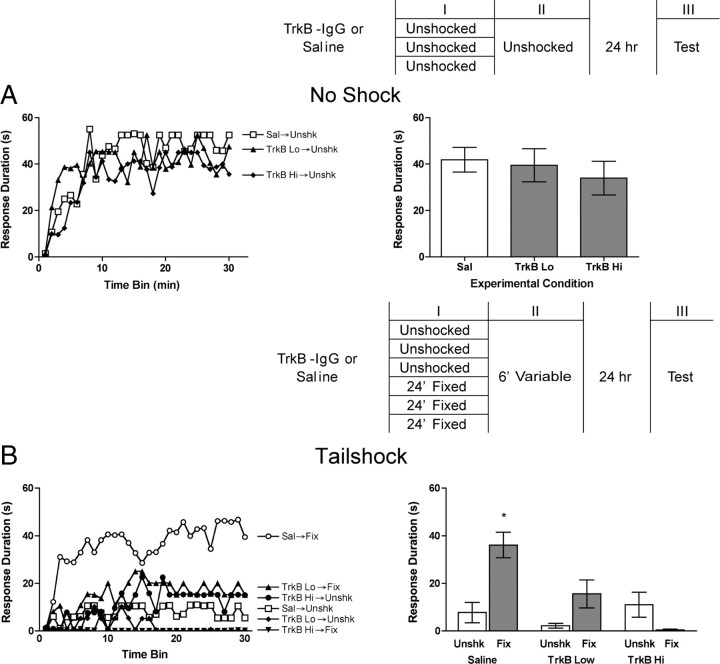
Sequestering BDNF eliminates the protective effect of fixed stimulation. Subjects received 0, 4.5, or 9.0 pmol of TrkB-IgG before application of 0 or 24 min of fixed-spaced tailshock (see inset). Immediately following fixed stimulation rats were administered 6 min of variable-spaced shock. Testing occurred 24 h later. The upper panels (A) depict data for unshocked controls that received saline (open squares; Sal→Unshk), 4.5 pmol of TrkB-IgG (closed triangles; TrkB Lo→Unshk), or 9.0 pmol of TrkB-IgG (closed diamonds; TrkB Hi→Unshk). The lower panels (B) show data for subjects that received saline before 0 min of fixed stimulation (open squares; Sal→Unshk), saline before 24 min of fixed stimulation (open circles; Sal→Fix), 4.5 pmol of TrkB-IgG before 0 min of fixed stimulation (closed diamonds; TrkB Lo→Unshk), 9.0 pmol of TrkB-IgG before 0 min of fixed stimulation (closed circles; TrkB Hi→Unshk), 4.5 pmol of TrkB-IgG before 24 min of fixed stimulation (closed upward triangles; TrkB Lo→Fix), or 9.0 pmol of TrkB-IgG before 24 min of fixed stimulation (closed downward triangles; TrkB Hi→Unshk). The panels on the left depict response durations across time, while the panels on the right show subjects' average response durations collapsed across trials. Asterisks indicate groups that were significantly different from subjects that received saline and 0 min of fixed stimulation (p < 0.05), and error bars represent ±SE.

References

    1. Abidin I, Köhler T, Weiler E, Zoidl G, Eysel UT, Lessmann V, Mittmann T. Reduced presynaptic efficiency of excitatory synaptic transmission impairs LTP in the visual cortex of BDNF-heterozygous mice. Eur J Neurosci. 2006;24:3519–3531. - PubMed
    1. Aicardi G, Argilli E, Cappello S, Santi S, Riccio M, Thoenen H, Canossa M. Induction of long-term potentiation and depression is reflected by corresponding changes in secretion of endogenous brain-derived neurotrophin factor. Proc Natl Acad Sci U S A. 2004;101:15788–15792. - PMC - PubMed
    1. Amat J, Matus-Amat P, Watkins LR, Maier SF. Escapable and inescapable stress differentially alter extracellular levels of 5-HT in the basolateral amygdala of the rat. Brain Res. 1998;812:113–120. - PubMed
    1. Amat J, Paul E, Watkins LR, Maier SF. Activation of the ventral medial prefrontal cortex during an uncontrollable stressor reproduces both the immediate and long-term protective effects of behavioral control. Neuroscience. 2008;154:1178–1186. - PMC - PubMed
    1. Baumbauer KM, Young EE, Hoy KC, Jr, France JL, Joynes RL. Intrathecal infusions of anisomycin impact the learning deficit but not the learning effect observed in spinal rats that have received instrumental training. Behav Brain Res. 2006;173:299–309. - PubMed

Publication types

MeSH terms

Substances