


The evolutionary history of the extinct ratite moa and New Zealand Neogene paleogeography
- PMID: 19923428
- PMCID: PMC2791642
- DOI: 10.1073/pnas.0906660106
The evolutionary history of the extinct ratite moa and New Zealand Neogene paleogeography
Abstract
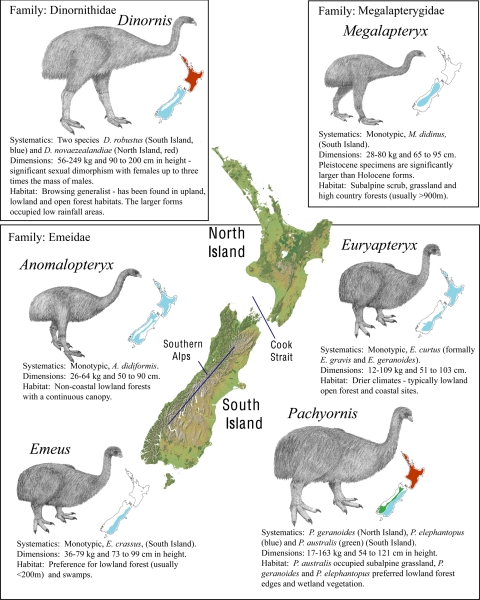
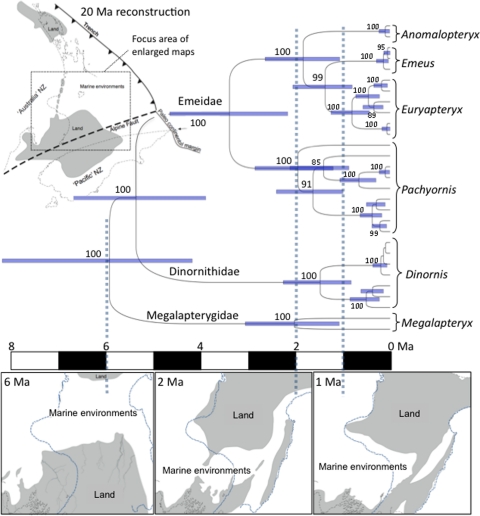
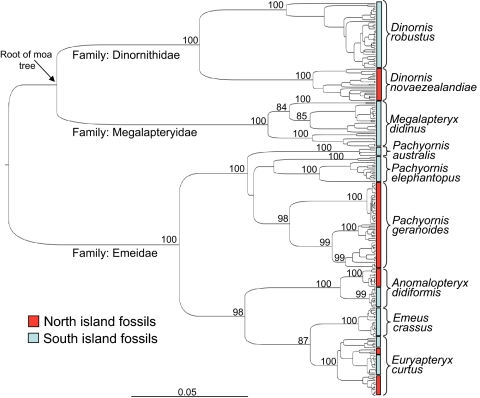
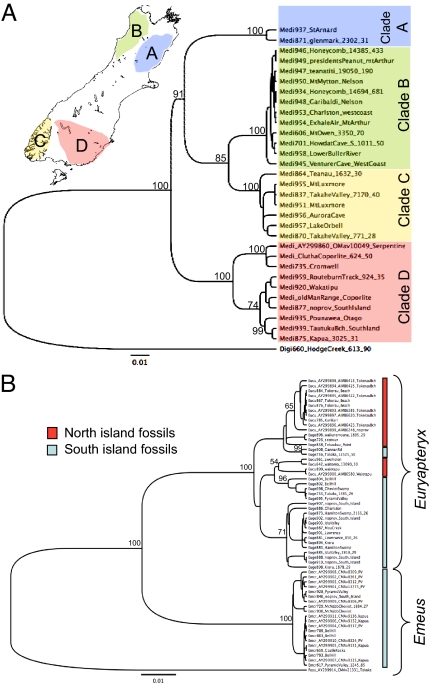
The ratite moa (Aves: Dinornithiformes) were a speciose group of massive graviportal avian herbivores that dominated the New Zealand (NZ) ecosystem until their extinction approximately 600 years ago. The phylogeny and evolutionary history of this morphologically diverse order has remained controversial since their initial description in 1839. We synthesize mitochondrial phylogenetic information from 263 subfossil moa specimens from across NZ with morphological, ecological, and new geological data to create the first comprehensive phylogeny, taxonomy, and evolutionary timeframe for all of the species of an extinct order. We also present an important new geological/paleogeographical model of late Cenozoic NZ, which suggests that terrestrial biota on the North and South Island landmasses were isolated for most of the past 20-30 Ma. The data reveal that the patterns of genetic diversity within and between different moa clades reflect a complex history following a major marine transgression in the Oligocene, affected by marine barriers, tectonic activity, and glacial cycles. Surprisingly, the remarkable morphological radiation of moa appears to have occurred much more recently than previous early Miocene (ca. 15 Ma) estimates, and was coincident with the accelerated uplift of the Southern Alps just ca. 5-8.5 Ma. Together with recent fossil evidence, these data suggest that the recent evolutionary history of nearly all of the iconic NZ terrestrial biota occurred principally on just the South Island.
Conflict of interest statement
The authors declare no conflict of interest.
Figures
References
-
- Worthy TH, Holdaway RN. The Lost World of the Moa. Bloomington, IN: Indiana Univ Press; 2002. p. 718.
-
- Cracraft J. Continental drift and vertebrate distribution. Ann Rev Ecol Syst. 1974;5:189–205.
-
- Owen R. On the bone of an unknown struthious bird from New Zealand, meeting of November 12, 1839. Proc. Zool. Soc. Lon. for 1839 Part VII. 1840:169–171. (no. 1xxxiii)
-
- Archey G. The Moa: A study of the Dinornithiformes. 1941:116–121. Bulletin of the Auckland Institute and Museum No. 1.
Publication types
MeSH terms
Substances
Associated data
- Actions
- Actions
- Actions
- Actions
- Actions
- Actions
- Actions
- Actions
- Actions
- Actions
- Actions
- Actions
- Actions
- Actions
- Actions
- Actions
- Actions
- Actions
- Actions
- Actions
- Actions
- Actions
- Actions
- Actions
- Actions
- Actions
- Actions
- Actions
- Actions
- Actions
- Actions
- Actions
- Actions
- Actions
- Actions
- Actions
- Actions
- Actions
- Actions
- Actions
- Actions
- Actions
- Actions
- Actions
- Actions
- Actions
- Actions
- Actions
- Actions
- Actions
- Actions
- Actions
- Actions
- Actions
- Actions
- Actions
- Actions
- Actions
- Actions
- Actions
- Actions
- Actions
- Actions
- Actions
- Actions
- Actions
- Actions
- Actions
- Actions
- Actions
- Actions
- Actions
- Actions
- Actions
- Actions
- Actions
- Actions
- Actions
- Actions
- Actions
- Actions
- Actions
- Actions
- Actions
- Actions
- Actions
- Actions
- Actions
- Actions
- Actions
- Actions
- Actions
- Actions
- Actions
- Actions
- Actions
- Actions
- Actions
- Actions
- Actions
- Actions
- Actions
- Actions
- Actions
- Actions
- Actions
- Actions
- Actions
- Actions
- Actions
- Actions
- Actions
- Actions
- Actions
- Actions
- Actions
- Actions
- Actions
- Actions
- Actions
- Actions
Grants and funding
LinkOut - more resources
Full Text Sources
Miscellaneous
