Comparative Study
. 2010 Jan;48(1):258-67.
doi: 10.1128/JCM.01725-09. Epub 2009 Nov 18.

Rapid universal identification of bacterial pathogens from clinical cultures by using a novel sloppy molecular beacon melting temperature signature technique

Affiliations
Comparative Study

Rapid universal identification of bacterial pathogens from clinical cultures by using a novel sloppy molecular beacon melting temperature signature technique

Soumitesh Chakravorty et al. J Clin Microbiol. 2010 Jan.

Abstract

A real-time PCR assay with the ability to rapidly identify all pathogenic bacteria would have widespread medical utility. Current real-time PCR technologies cannot accomplish this task due to severe limitations in multiplexing ability. To this end, we developed a new assay system which supports very high degrees of multiplexing. We developed a new class of mismatch-tolerant "sloppy" molecular beacons, modified them to provide an extended hybridization range, and developed a multiprobe, multimelting temperature (T(m)) signature approach to bacterial species identification. Sloppy molecular beacons were exceptionally versatile, and they were able to generate specific T(m) values for DNA sequences that differed by as little as one nucleotide to as many as 23 polymorphisms. Combining the T(m) values generated by several probe-target hybrids resulted in T(m) signatures that served as highly accurate sequence identifiers. Using this method, PCR assays with as few as six sloppy molecular beacons targeting bacterial 16S rRNA gene segments could reproducibly classify 119 different sequence types of pathogenic and commensal bacteria, representing 64 genera, into 111 T(m) signature types. Blinded studies using the assay to identify the bacteria present in 270 patient-derived clinical cultures including 106 patient blood cultures showed a 95 to 97% concordance with conventional methods. Importantly, no bacteria were misidentified; rather, the few species that could not be identified were classified as "indeterminate," resulting in an assay specificity of 100%. This approach enables highly multiplexed target detection using a simple PCR format that can transform infectious disease diagnostics and improve patient outcomes.


Figures
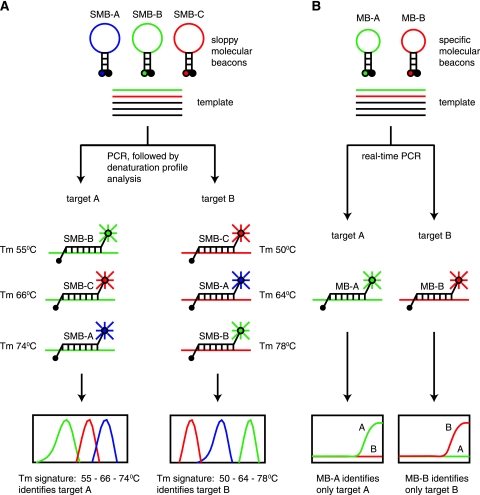
FIG. 1.
FIG. 1.
Two paradigms of target identification. (A) Sloppy molecular beacon approach. Three sloppy molecular beacons with different semispecific probe regions are placed in a PCR with an unknown target. Each probe is distinguished by a unique fluorophore. Asymmetrical PCR is performed, and the Tm of each probe target-hybrid is measured. Each probe generates a Tm that is specific for a limited number of targets such that probe A, probe B, and probe C generate Tm values of 55°C, 66°C, and 74°C, respectively, with target A and Tm values of 64°C, 78°C, and 50°C, respectively, with target B. All three Tm values are combined into a single species-specific signature that identifies the unknown target. Hundreds of different targets can theoretically be identified and distinguished with the same three probes in this manner. (B) Conventional approach. Two molecular beacons with probe regions that are specific for a single target sequence are placed in a PCR with an unknown target. Each molecular beacon is distinguished by a unique fluorophore or reaction well. PCR is performed, and the presence or absence of each molecular beacon signal is assessed. The unknown target is identified by determining which of the molecular beacons in a reaction produces a positive signal. The number of different target sequences that can be identified is limited to the number of different molecular beacons that are used in the assay.
FIG. 2.
FIG. 2.
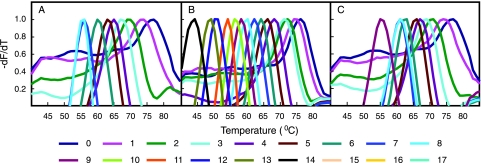
Effect of probe-target mismatches on sloppy molecular beacon hybridization. The first derivatives of normalized melting plots are shown for two different sloppy molecular beacons in the presence of different oligonucleotide targets. The Tm value for each hybridization is indicated by the peak of each curve. (A) SMB45 in the presence of targets that do not contain an anchor sequence. (B) V6P3 in the presence of targets that do not contain an anchor sequence. (C) SMB45 in the presence of targets that contain a 15-nucleotide-long anchor sequence at their 3′ ends. Numbers indicate mismatches between the target and probe sequences.
FIG. 3.
FIG. 3.
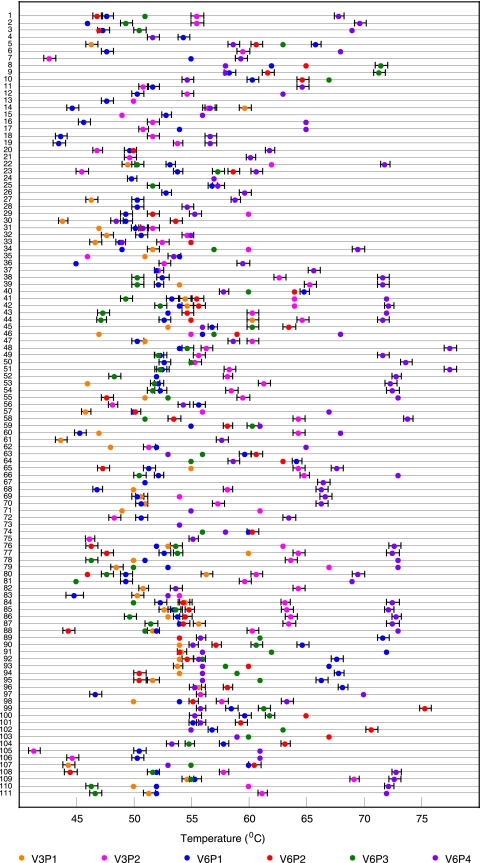
Distribution of Tm signatures among 111 Tm signature types. Each line represents one of 111 Tm signature types. The colored dots along each line correspond to the mean Tm values (from six independent measurements) generated by each of the six sloppy molecular beacon probes in the presence of that sequence type. Error bars show ±1 standard deviation from the mean values. The absence of a dot indicates that the corresponding probe did not generate a Tm value for that particular bacterial DNA. The numbers indicate the Tm profile of the species (species groups) as outlined in Table S6 in the supplemental material.
FIG. 4.
FIG. 4.
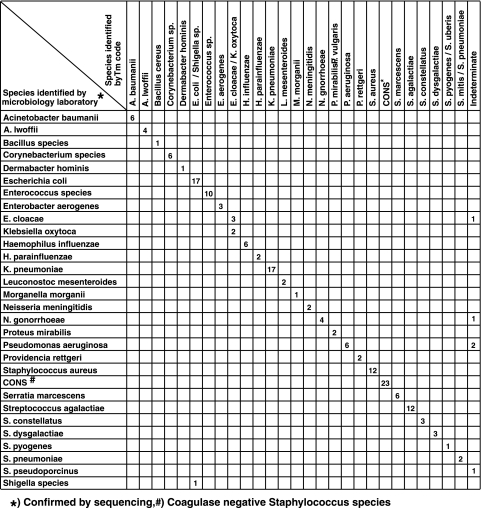
Assay performance on cultured clinical isolates. The results of the sloppy molecular beacon assay are compared to a gold standard of microbiology species identification confirmed by 16S rRNA sequencing. Due to space limitations Corynebacterium species represent C. jeikeium, C. diphtheriae, C. xerosis, and C. amycolatum, which were all identified to the species level by our assay; Enterococcus species represent E. faecalis, E. faecium, E. gallinarum, and E. avium; the coagulase-negative staphylococcal species represent S. epidermidis, S. haemolyticus, S. lugdunensis, S. capitis, S. hominis, S. sciuri, and S. cohnii. Two Shigella isolates were not identifiable to the species level and are listed as Shigella species.
FIG. 5.
FIG. 5.
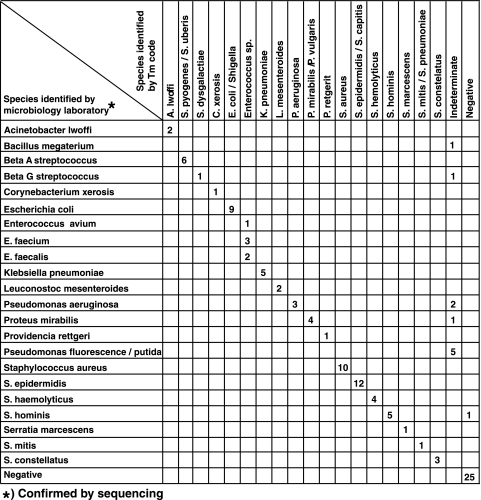
Assay performance in tests of clinical blood cultures. The results of the sloppy molecular beacon assay are compared to a gold standard of microbiology species identification confirmed by 16S rRNA sequencing.

References

    1. Baldwin, C. D., G. B. Howe, R. Sampath, L. B. Blyn, H. Matthews, V. Harpin, T. A. Hall, J. J. Drader, S. A. Hofstadler, M. W. Eshoo, K. Rudnick, K. Studarus, D. Moore, S. Abbott, J. M. Janda, and C. A. Whitehouse. 2009. Usefulness of multilocus polymerase chain reaction followed by electrospray ionization mass spectrometry to identify a diverse panel of bacterial isolates. Diagn. Microbiol. Infect. Dis. 63:403-408. - PubMed
    1. Bosshard, P. P., R. Zbinden, S. Abels, B. Boddinghaus, M. Altwegg, and E. C. Bottger. 2006. 16S rRNA gene sequencing versus the API 20 NE system and the VITEK 2 ID-GNB card for identification of nonfermenting Gram-negative bacteria in the clinical laboratory. J. Clin. Microbiol. 44:1359-1366. - PMC - PubMed
    1. Chakravorty, S., D. Helb, M. Burday, N. Connell, and D. Alland. 2007. A detailed analysis of 16S ribosomal RNA gene segments for the diagnosis of pathogenic bacteria. J. Microbiol. Methods 69:330-339. - PMC - PubMed
    1. Claesson, M. J., O. O'Sullivan, Q. Wang, J. Nikkila, J. R. Marchesi, H. Smidt, W. M. de Vos, R. P. Ross, and P. W. O'Toole. 2009. Comparative analysis of pyrosequencing and a phylogenetic microarray for exploring microbial community structures in the human distal intestine. PLoS One 4:e6669. - PMC - PubMed
    1. d'Azevedo, P. A., C. A. Dias, A. L. Goncalves, F. Rowe, and L. M. Teixeira. 2001. Evaluation of an automated system for the identification and antimicrobial susceptibility testing of enterococci. Diagn. Microbiol. Infect. Dis. 40:157-161. - PubMed

Publication types

MeSH terms