. 2010 Mar;17(3):812-20.
doi: 10.1245/s10434-009-0827-4.

A critical appraisal of circumferential resection margins in esophageal carcinoma

Affiliations

A critical appraisal of circumferential resection margins in esophageal carcinoma

Bareld B Pultrum et al. Ann Surg Oncol. 2010 Mar.

Abstract

Background: In esophageal cancer, circumferential resection margins (CRMs) are considered to be of relevant prognostic value, but a reliable definition of tumor-free CRM is still unclear. The aim of this study was to appraise the clinical prognostic value of microscopic CRM involvement and to determine the optimal limit of CRM.

Methods: To define the optimal tumor-free CRM we included 98 consecutive patients who underwent extended esophagectomy with microscopic tumor-free resection margins (R0) between 1997 and 2006. CRMs were measured in tenths of millimeters with inked lateral margins. Outcome of patients with CRM involvement was compared with a statistically comparable control group of 21 patients with microscopic positive resection margins (R1).

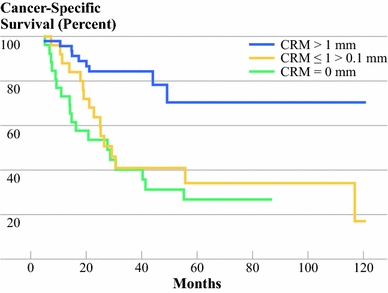
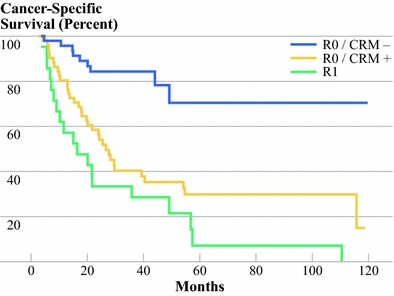
Results: A cutoff point of CRM at < or = 1.0 mm and > 1.0 mm appeared to be an adequate marker for survival and prognosis (both P < 0.001). The outcome in patients with CRMs < or = 1.0 and > 0 mm was equal to that in patients with CRM of 0 mm (P = 0.43). CRM involvement was an independent prognostic factor for both recurrent disease (P = 0.001) and survival (P < 0.001). Survival of patients with positive CRMs (< or = 1 mm) did not significantly differ from patients with an R1 resection (P = 0.12).

Conclusion: Involvement of the circumferential resection margins is an independent prognostic factor for recurrent disease and survival in esophageal cancer. The optimal limit for a positive CRM is < or = 1 mm and for a free CRM is >1.0 mm. Patients with unfavorable CRM should be approached as patients with R1 resection with corresponding outcome.


Figures
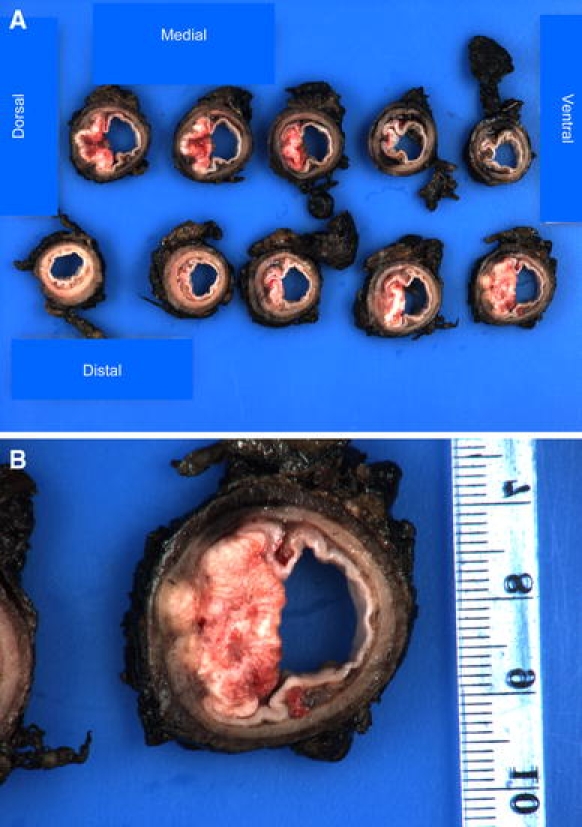
Fig. 1
Fig. 1
a Cross-sections of a specimen through the tumor with 0.5-cm-wide slices. b Cross-section with macroscopically minimal distance between the tumor and the nearest inked margin
Fig. 2
Fig. 2
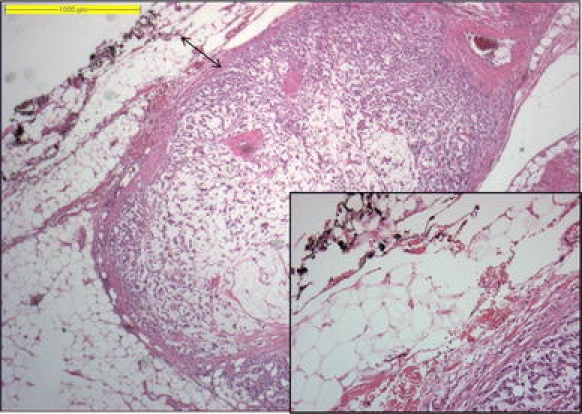
Microscopic example of CRM measurement, from most lateral tumor cells to the inked outer margins; an enlargement of the margin is shown in the inset
Fig. 3
Fig. 3
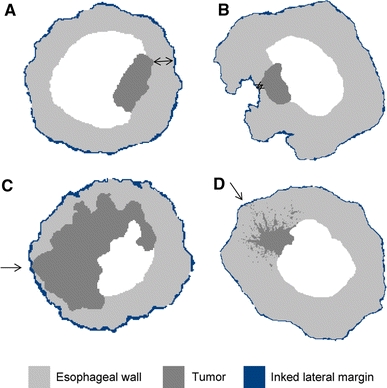
Schematic representation of four possible microscopic circumferential resection margins (CRM) measurements in different esophageal cross-sections: a tumor with free CRM, measurement performed in tenths of millimeters; b small tumor with narrow free CRM, damage to the esophageal wall caused by surgical manipulation; c large tumor, directly growing into the CRM; d tumor with satellite (spray) growth into the CRM with few malignant cells
Fig. 4
Fig. 4
Cancer-specific survival by CRM in three categories: CRMs with tumor ingrowth (0 mm) had similar outcome to CRMs ≤1 mm and >0 mm (P = 0.43); both had significantly worse outcome compared with CRM >1 mm (P < 0.001 and P = 0.004, respectively)
Fig. 5
Fig. 5
Equal cancer-specific survival of positive CRMs and R1 resections. Kaplan–Meier survival curve of patients with positive resection margins (R1) of the control group (n = 21) and patients of the study group with positive CRM ≤1 mm (CRM+) (n = 51, 52%) and free CRM >1 mm (CRM−) (n = 47, 48%). There was no significant difference in survival between CRM+ and R1 (P = 0.12); significant differences were found between CRM− with CRM+ and R1 (both P < 0.001)

References

    1. Powell J. Continuing rising trend in oesophageal adenocarcinoma. Int J Cancer. 2002;102:422–427. doi: 10.1002/ijc.10721. - DOI - PubMed
    1. Plukker JT, van Westreenen HL. Staging in oesophageal cancer. Best Pract Res Clin Gastroenterol. 2006;20:877–891. doi: 10.1016/j.bpg.2006.05.001. - DOI - PubMed
    1. Lerut T, Coosemans W, De Leyn P, Decker G, Deneffe G, Van Raemdonck D. Is there a role for radical esophagectomy. Eur J Cardiothorac Surg. 1999;16(Suppl 1):S44–S47. doi: 10.1016/S1010-7940(99)00185-2. - DOI - PubMed
    1. Shao LF, Gao ZG, Yang NP, Wei GQ, Wang YD, Cheng CP. Results of surgical treatment in 6, 123 cases of carcinoma of the esophagus and gastric cardia. J Surg Oncol. 1989;42:170–174. doi: 10.1002/jso.2930420308. - DOI - PubMed
    1. Mulligan ED, Dunne B, Griffin M, Keeling N, Reynolds JV. Margin involvement and outcome in oesophageal carcinoma: a 10-year experience in a specialist unit. Eur J Surg Oncol. 2004;30:313–317. doi: 10.1016/j.ejso.2003.11.009. - DOI - PubMed