


doi: 10.1186/1824-7288-35-36.
Body fluids and salt metabolism - Part I
Affiliations
- PMID: 19925659
- PMCID: PMC2784783
- DOI: 10.1186/1824-7288-35-36
Item in Clipboard
Body fluids and salt metabolism - Part I
Ital J Pediatr.
.
Abstract
There is a high frequency of diarrhea and vomiting in childhood. As a consequence the focus of the present review is to recognize the different body fluid compartments, to clinically assess the degree of dehydration, to know how the equilibrium between extracellular fluid and intracellular fluid is maintained, to calculate the effective blood osmolality and discuss both parenteral fluid requirments and repair.
Figures
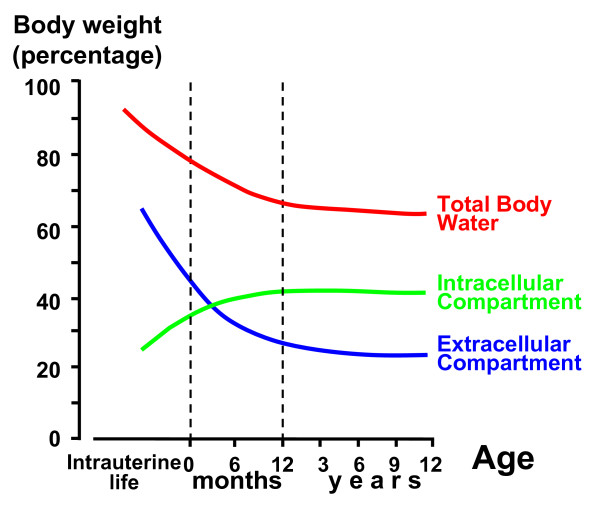
Winters diagram with the subdivision of total body water, intracellular fluid and extracellular fluid as a function of age. For clinical purpose the use of "the rule of 3" is recommended: 1. total body water makes up 2/3 of the body mass; 2. the intracellular compartment contains 2/3 of the total body water and the remaining (= 1/3) is held in the extracellular compartment; 3. the extracellular compartment is further subdivided into the interstitial and the intravascular compartments (blood volume), which contain 2/3 and 1/3 of the extracellular fluid, respectively. After puberty males generally have 2 to 10 percent higher water content than females.
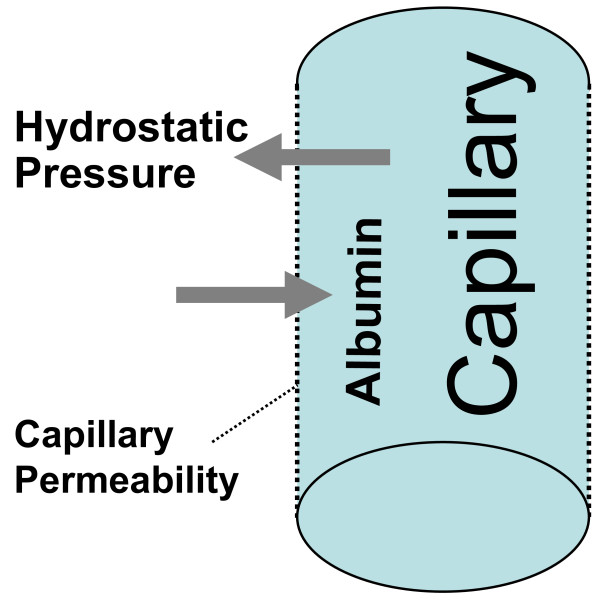
Distribution of ultrafiltrate across the capillary membrane. The barrel-shaped structure represents a capillary. A high hydrostatic pressure or an increased capillary permeability causes fluid to leave the vascular space. On the contrary an increased intravascular albumin concentration and, therefore, an increased oncotic pressure causes fluid to enter the vascular space.
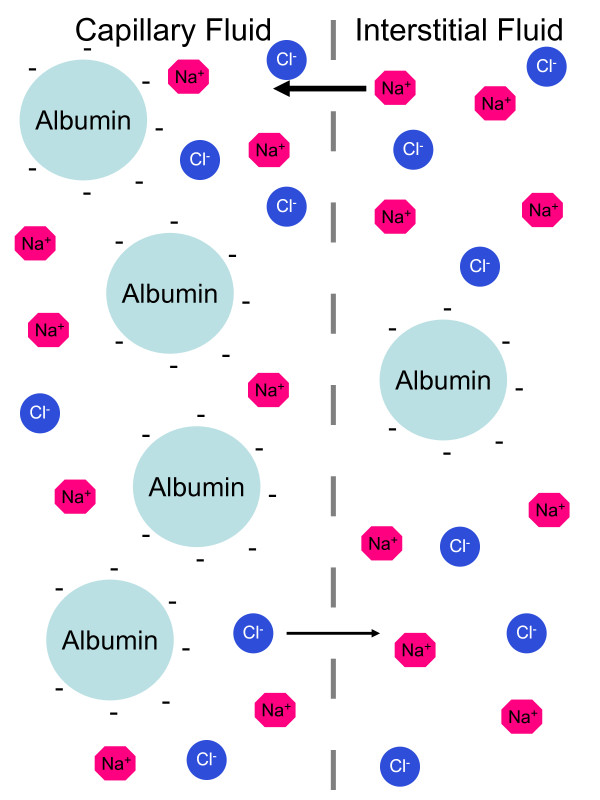
The Gibbs-Donnan effect. There is a different concentration in the concentration of anionic albumin, which is impermeant, between the vascular (albumin approximately 40 g/L) and the interstitial (albumin approximately 10 g/L) compartments. The negative charges of albumin "attract" cations (largely Na+) into the vascular compartment and "repell" anions (Cl- and HCO3 -) out. Because the concentration of Na+exceeds that of Cl- and HCO3-, "attraction" outweighs "repulsion". Consequently the Gibbs-Donnan effect increases the vascular compartment. The dashed line represents the capillary bed separating the intravascular and interstitial spaces is freely permeable to Na+, K+, Cl-, and glucose.

Extracellular and intracellular compartments in children with dehydration. Normally the extracellular compartment makes up approximately 20 percent and the intracellular 40 percent of the body weight (upper panel of the figure). The second, third and fourth panels depict the relationship between extracellular and intracellular compartment in three children with dehydration in the context of an acute diarrheal disease: dehydration is normotonic-normonatremic in the first, hypotonic-hyponatremic (mainly extracellular fluid losses) in the second, and hypernatremic (mainly intracellular fluid losses) in the third child. The lower panel depicts the relationship between extracellular and intracellular compartment (mainly intracellular fluid losses) in a child with dehydration in the context of diabetic ketoacidosis (hypertonic-"normonatremic" dehydration; in this context the concentration of circulating sodium is normal or even reduced). In each panel the solid circles denote sodium and open circles impermeable solutes that do not move freely across cell membranes (in the present example glucose). For reasons of simplicity, no symbols are given for potassium, the main intracellular cation.
References
-
- Hill LL. Body composition, normal electrolyte concentrations, and the maintenance of normal volume, tonicity, and acid-base metabolism. Pediatr Clin North Am. 1990;37:241–256. - PubMed
-
- Waterhouse J. Organization within the body: from molecules to body compartments. Anaesth Intensive Care Med. 2006;7:466–472. doi: 10.1053/j.mpaic.2006.09.003. - DOI
-
- Berry PL, Belsha CW. Hyponatremia. Pediatr Clin North Am. 1990;37:351–363. - PubMed
LinkOut - more resources
Full Text Sources
Other Literature Sources
