Review
. 2010 Mar;35(3):150-60.
doi: 10.1016/j.tibs.2009.10.008. Epub 2009 Nov 18.

The Sec14 superfamily and mechanisms for crosstalk between lipid metabolism and lipid signaling

Affiliations
Review

The Sec14 superfamily and mechanisms for crosstalk between lipid metabolism and lipid signaling

Vytas A Bankaitis et al. Trends Biochem Sci. 2010 Mar.

Abstract

Lipid signaling pathways define central mechanisms for cellular regulation. Productive lipid signaling requires an orchestrated coupling between lipid metabolism, lipid organization and the action of protein machines that execute appropriate downstream reactions. Using membrane trafficking control as primary context, we explore the idea that the Sec14-protein superfamily defines a set of modules engineered for the sensing of specific aspects of lipid metabolism and subsequent transduction of 'sensing' information to a phosphoinositide-driven 'execution phase'. In this manner, the Sec14 superfamily connects diverse territories of the lipid metabolome with phosphoinositide signaling in a productive 'crosstalk' between these two systems. Mechanisms of crosstalk, by which non-enzymatic proteins integrate metabolic cues with the action of interfacial enzymes, represent unappreciated regulatory themes in lipid signaling.


Figures

Figure 1
Figure 1
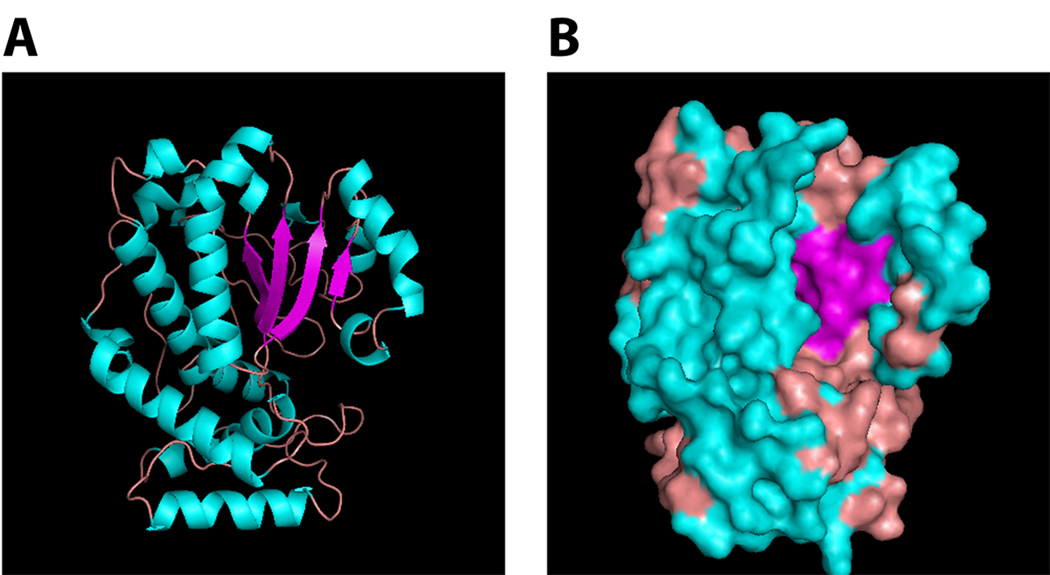
The Sec14-fold. The apo-Sec14 crystal structure (pdb 1AUA) is rendered as a ribbon diagram (a) and a surface drawing (b). Secondary structure elements are depicted in blue (α-helices), magenta (β-strands) and pink (random coil). The orientation of the molecule in en face with the floor of the lipid binding pocket identified by the β-sheet. This structure highlights not only the essential features of the Sec14-fold, but also the single large hydrophobic pocket in which Sec14-like proteins accommodate one hydrophobic ligand molecule at a time.
Figure 2
Figure 2
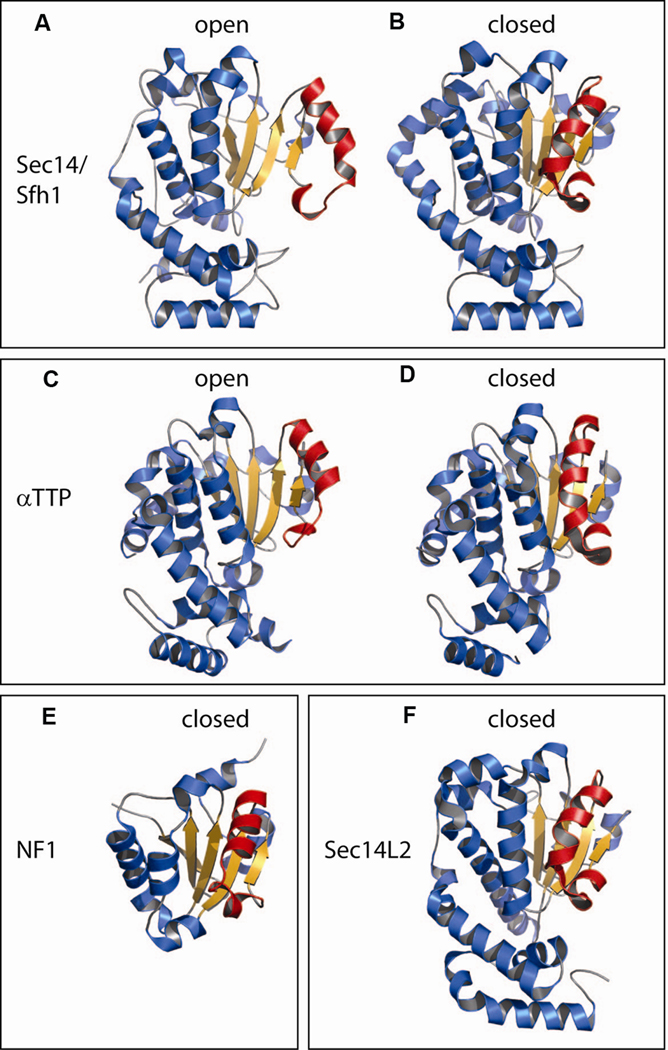
Sec14-like proteins gate access to the hydrophobic ligand binding pocket via a mobile helical substructure. Ribbon diagrams of open and closed conformations of a set of Sec14-like proteins or domains (for the NF1 and Sec14L2 structures) are shown. Comparisons of open vs closed conformers highlight the major differences in configuration of the helical substructure (rendered in red) that gates entry into the hydrophobic ligand-binding cavity. α-Helices are depicted in blue and β-strands in orange. The pdb identifiers are 1AUA (A; Sec14p open conformer bound to the detergent β-octylglucoside), 3B7N (B; Sfh1p closed conformer bound to PtdIns), 1OIZ (C; α-TTP open conformer bound to the detergent Triton X-100), 1R5L (D; α-TTP closed conformer bound to α-tocopherol), 2E2X (E; NF-1 Sec14-domain closed conformer bound to PtdEtn), and 1O6U (F; Sec14L2 closed conformer bound to rrr-α-tocopherylquinone), respectively. Neither bound detergent molecules nor bound ligands are represented.
Figure 3
Figure 3
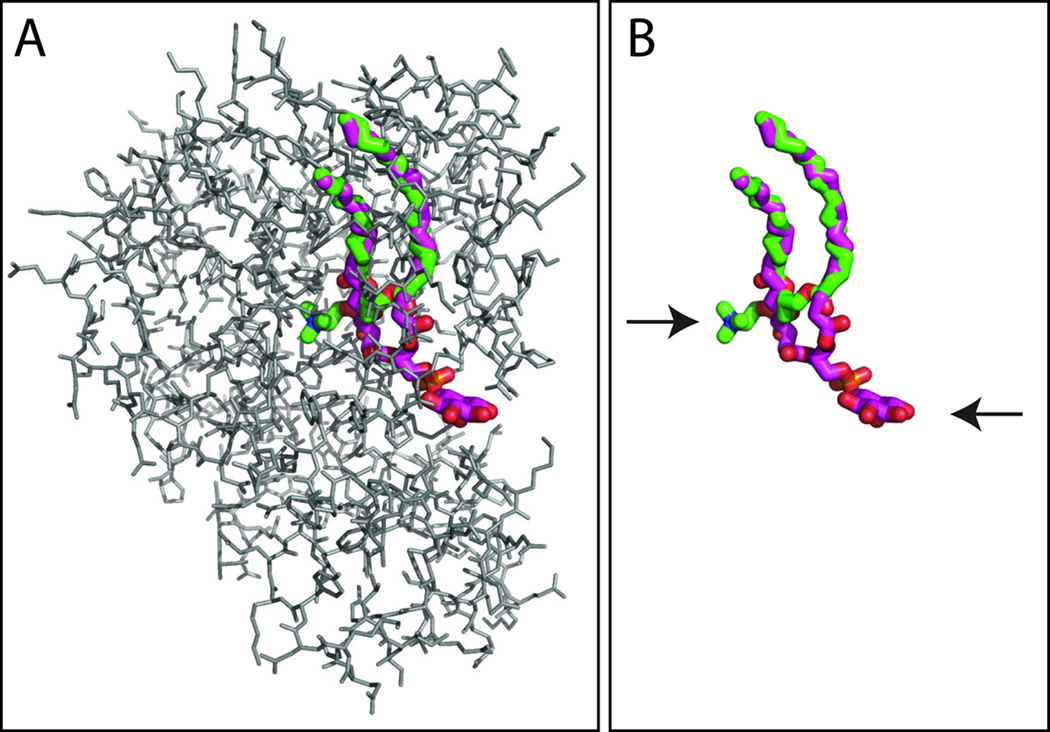
Sec14-like PITPs exhibit two distinct headgroup binding sites. Bound PtdIns (purple/red) and PtdCho (green/blue) is shown in the context of the Sec14-fold of Sfh1p (gray line drawing; A). (B) The phospholipid configurations are shown with protein electron density subtracted. The positions of the respective headgroups are indicated by arrows. Of note is the remarkable physical separation of the PtdIns and PtdCho headgroup binding regions within the hydrophobic cavity; however, the acyl chain binding regions for the two phospholipid species overlap. We propose that this engineering of the Sec14p molecule with regard to differential phospholipid binding forms the basis for how heterotypic exchange reactions present a PtdIns headgroup to lipid kinases. These depictions are derived from pdb 3B7Z which describes coordinates obtained from crystals composed of a mixture of Sfh1-PtdIns and Sfh1-PtdCho unit cells [25].
Figure 4
Figure 4
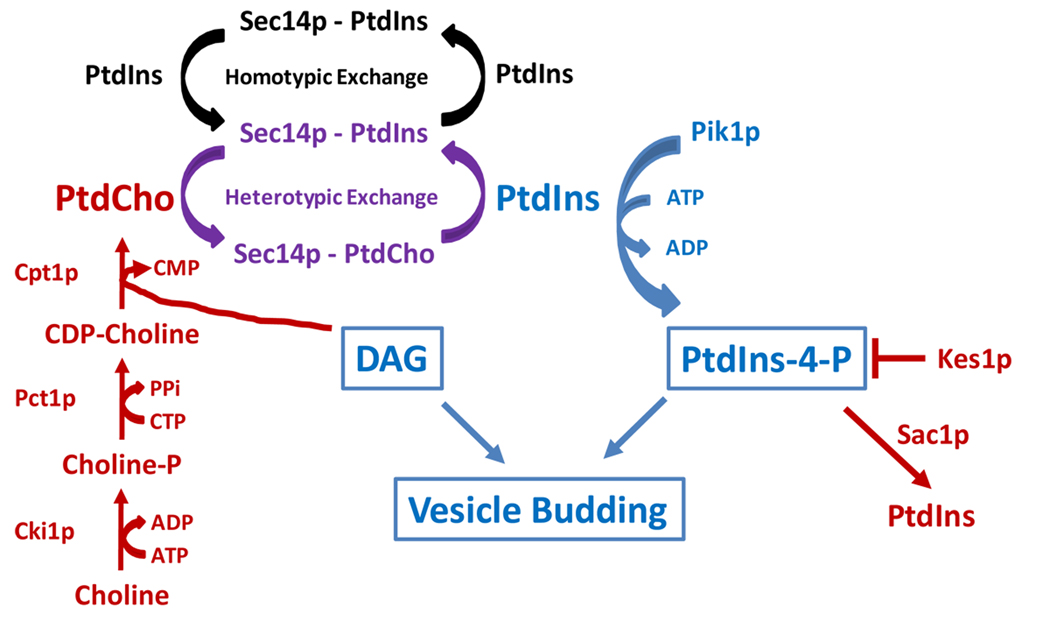
Sec14 and coordination of lipid metabolism with membrane trafficking. A DAG-requiring vesicle formation pathway is sensitive to flux through the cytidine-diphosphate (CDP)-choline pathway activity because PtdCho production via this mechanism occurs at the expense of DAG. Sec14 surveys flux by binding (sensing) the newly synthesized PtdCho (i.e. the accessible PtdCho pool). Sec14p initiates heterotypic exchange reactions and stimulates PtdIns-4-phosphate production by the Pik1p PtdIns 4-OH kinase. In a single vesicle budding pathway model, PIP substitutes for DAG in promoting vesicle budding. Alternatively, in a model where there are two pathways for vesicle budding, the two modes are distinguished by their threshold requirements for DAG and PtdIns-4-phosphate. Sec14p inactivation compromises both vesicle budding pathways. The activity of multiple pathways for vesicle formation in the yeast TGN/endosomal system is well-established [40]. Negative regulators of Sec14p-dependent vesicle budding pathways are highlighted in red -- including the proteins identified by loss-of-function ‘bypass Sec14p’ mutations (choline kinase, Cki1p; the choline-phosphate cytidylyltransferase, Pct1p; choline phosphotransferase, Cpt1p, the PtdIns-4-phosphatase Sac1p, the oxysterol binding protein Kes1p). Positive regulators of Sec14p-dependent vesicle budding pathways are highlighted in blue. The interface between these two opposing is regulated by Sec14p-mediated heterotypic phopsholipid exchange (purple).
Figure 5
Figure 5
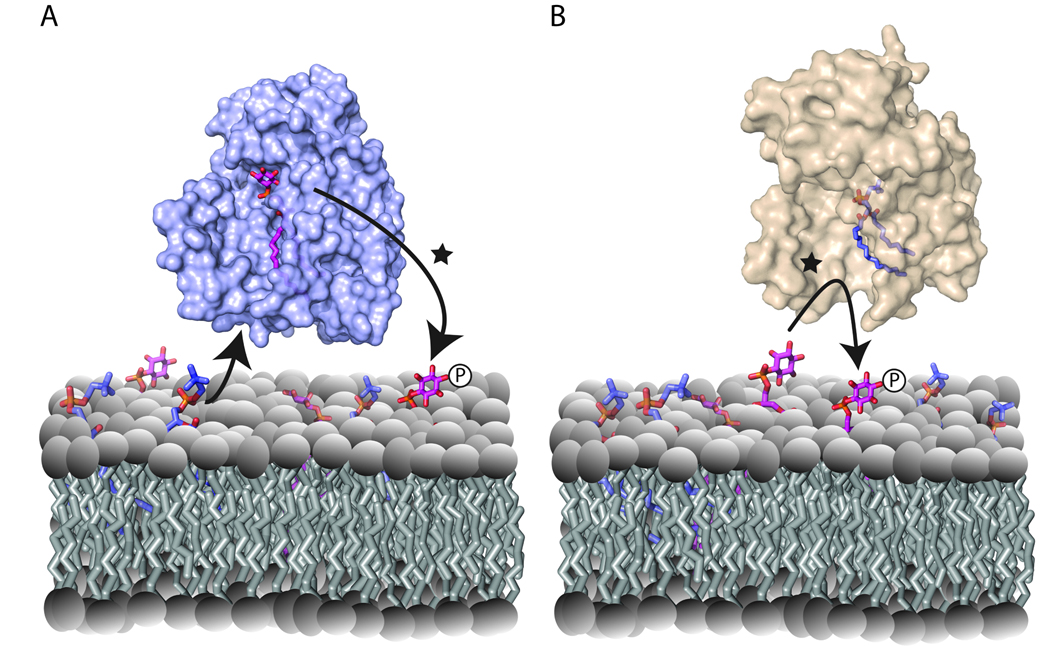
Heterotypic exchange and PtdIns presentation. Two possibilities for how heterotypic exchange reactions support PtdIns presentation are shown. (A) Sec14p-PtdIns represents the primed intermediate and PtdCho entry displaces bound PtdIns from the open Sec14p conformer in a vectorial head-first manner. The PtdIns 4-OH kinase (not shown) executes the modification on the leaving PtdIns substrate that exits through a portal (depicted by a star) distinct from that occupied by the invading PtdCho. (B) Sec14p-PtdCho represents the primed intermediate and the sequestered PtdCho molecule frustrates entry of the invading PtdIns into the hydrophobic pocket. The frustrated PtdIns is a superior substrate for PtdIns 4-OH kinase (not shown), which executes modification of the invading PtdIns substrate at its of entry portal (depicted by a star). Both models satisfy the requirement that nascent PtdIns-4-phosphate not collapse back into the hydrophobic pocket as that circumstance results in a dead-end Sec14p-PIP complex that cannot be further resolved by phospholipid exchange [26].

References

    1. Rothman JE. The protein machinery of vesicle budding and fusion. Pro. Science. 1996;5:185–194. - PMC - PubMed
    1. Schekman R, Orci L. Coat proteins and vesicle budding. Science. 1996;271:1526–1533. - PubMed
    1. Eberhardt DA, et al. Evidence that the inositol phospholipids are necessary for exocytosis: loss of inositol phospholipids and inhibition of secretion in permeabilized cells caused by bacterial phospholipase C and removal of ATP. Biochem. J. 1990;268:15–25. - PMC - PubMed
    1. Bankaitis VA, et al. An essential role for a phospholipid transfer protein in yeast Golgi function. Nature. 1990;347:561–562. - PubMed
    1. Cleves AE, et al. Mutations in the CDP-choline pathway for phospholipid biosynthesis bypass the requirement for an essential phospholipid transfer protein. Cell. 1991;64:789–800. - PMC - PubMed

Publication types

MeSH terms

Substances

LinkOut - more resources