Exercise stress echocardiography for the study of the pulmonary circulation
- PMID: 19926746
- PMCID: PMC2879460
- DOI: 10.1183/09031936.00076009
Exercise stress echocardiography for the study of the pulmonary circulation
Abstract
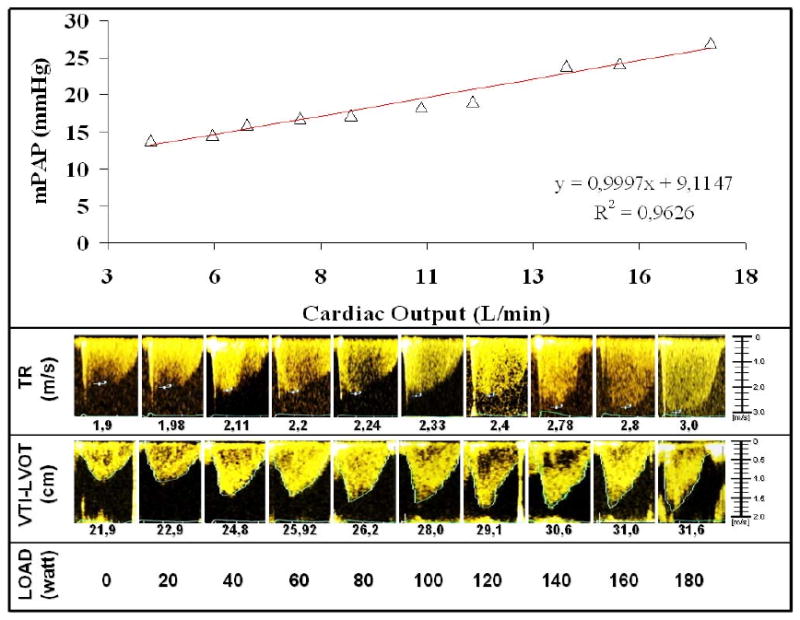
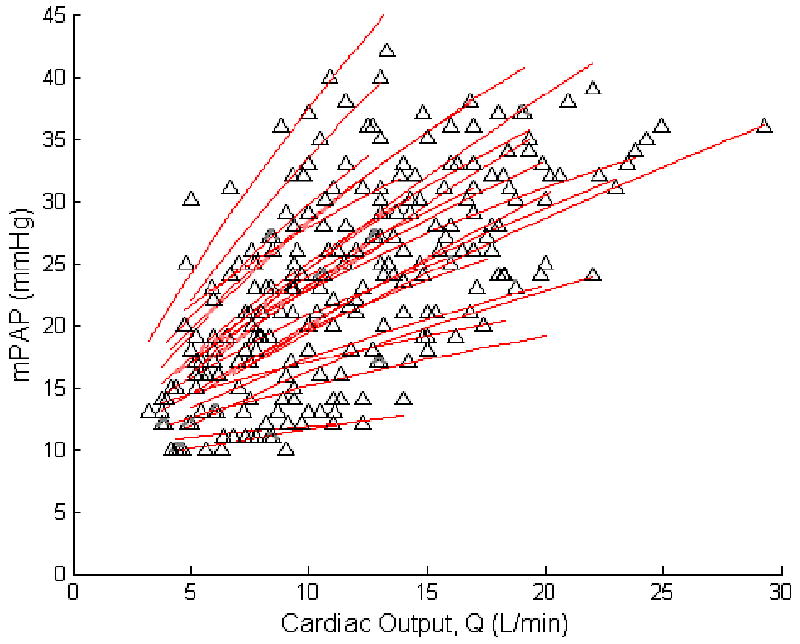
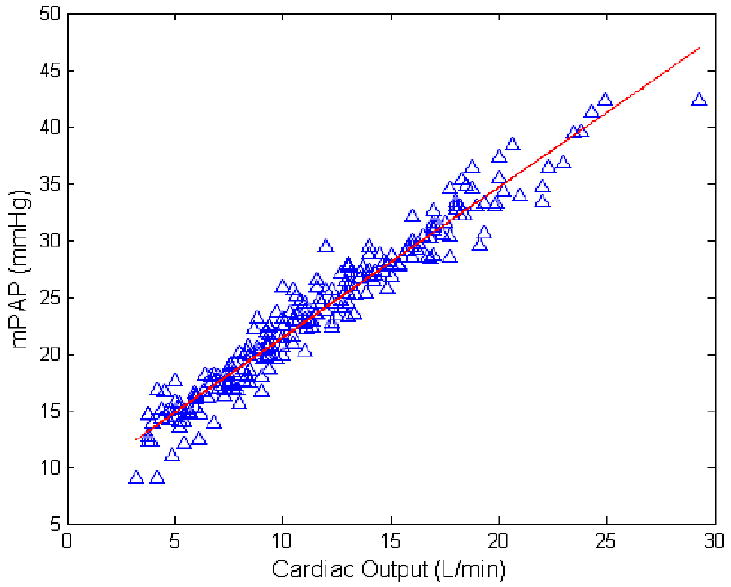
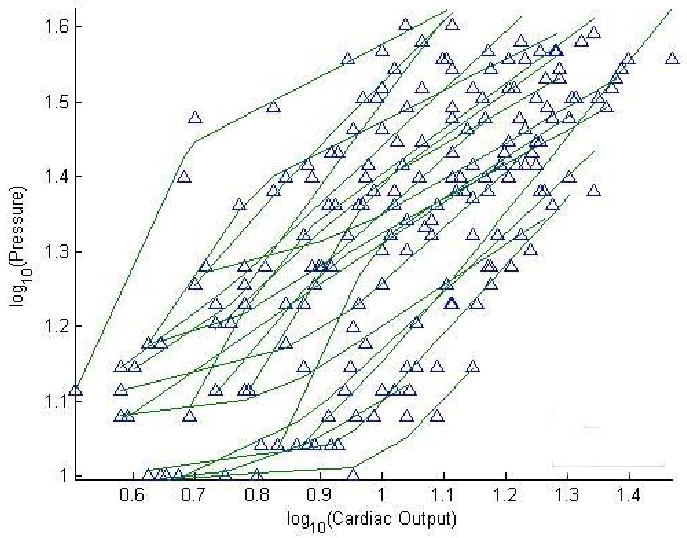
Exercise stress tests have been used for the diagnosis of pulmonary hypertension, but with variable protocols and uncertain limits of normal. The pulmonary haemodynamic response to progressively increased workload and recovery was investigated by Doppler echocardiography in 25 healthy volunteers aged 19-62 yrs (mean 36 yrs). Mean pulmonary artery pressure ((Ppa)) was estimated from the maximum velocity of tricuspid regurgitation. Cardiac output (Q) was calculated from the aortic velocity-time integral. Slopes and extrapolated pressure intercepts of (Ppa)-Q plots were calculated after using the adjustment of Poon for individual variability. A pulmonary vascular distensibility alpha was calculated from each (Ppa)-Q plot to estimate compliance. (Ppa) increased from 14+/-3 mmHg to 30+/-7 mmHg, and decreased to 19+/-4 mmHg after 5 min recovery. The slope of (Ppa)-Q was 1.37+/-0.65 mmHg x min(-1) x L(-1) with an extrapolated pressure intercept of 8.2+/-3.6 mmHg and an alpha of 0.017+/-0.018 mmHg(-1). These results agree with those of previous invasive studies. Multipoint (pa)-Q plots were well described by a linear approximation, from which resistance can be calulated. We conclude that exercise echocardiography of the pulmonary circulation is feasible and provides realistic resistance and compliance estimations. Measurements during recovery are unreliable because of rapid return to baseline.
Figures
References
-
- McLaughlin VV, Archer SL, Badesch DB, et al. ACCF/AHA 2009 Expert Consensus Document on Pulmonary Hypertension. A Report of the American College of Cardiology Foundation Task Force on Expert Consensus Documents and the American Heart Association. Circulation. 2009;119:2250–94. - PubMed
-
- Galie N, Torbicki A, Barst R, et al. The Task Force on Diagnosis and Treatment of Pulmonary Arterial Hypertension of the European Society of Cardiology. Eur Heart J. 2004;25:2243–78. - PubMed
-
- Reeves JT, Dempsey JA, Grover RF. Pulmonary circulation during exercise. In: Weir EK, Reeves JT, editors. Pulmonary Vascular Physiology and Physiopathology. chap 4. Marcel Dekker; New York: 1989. pp. 107–133.
-
- Naeije R. Pulmonary vascular function. In: Peacock AJ, Rubin LJ, editors. Pulmonary Circulation. Diseases and their Treatment. 2nd. chap 1. Arnold; London: 2004. pp. 3–13.
Publication types
MeSH terms
Grants and funding
LinkOut - more resources
Full Text Sources
Other Literature Sources
Medical
Miscellaneous