


Influence of lipophilicity on drug partitioning into sclera, choroid-retinal pigment epithelium, retina, trabecular meshwork, and optic nerve
- PMID: 19926800
- PMCID: PMC2835449
- DOI: 10.1124/jpet.109.161570
Influence of lipophilicity on drug partitioning into sclera, choroid-retinal pigment epithelium, retina, trabecular meshwork, and optic nerve
Retraction in
-
Re: Kadam RS and Kompella UB (2010) Influence of Lipophilicity on Drug Partitioning into Sclera, Choroid-Retinal Pigment Epithelium, Retina, Trabecular Meshwork, and Optic Nerve. J Pharmacol Exp Ther 332:1107-1120; doi:10.1124/jpet.109.161570.J Pharmacol Exp Ther. 2015 Feb;352(2):326. doi: 10.1124/jpet.114.02er15. J Pharmacol Exp Ther. 2015. PMID: 25542193 Free PMC article. No abstract available.
Abstract
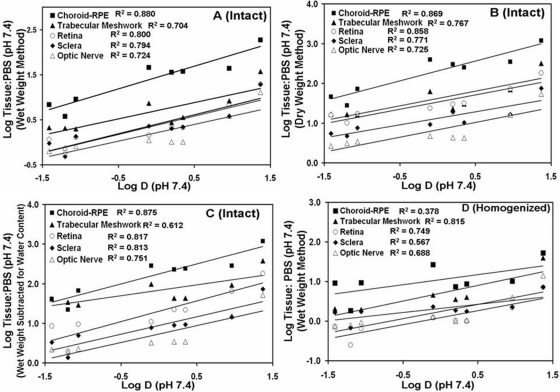
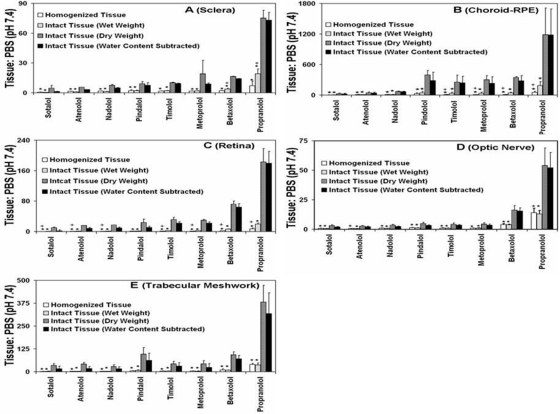
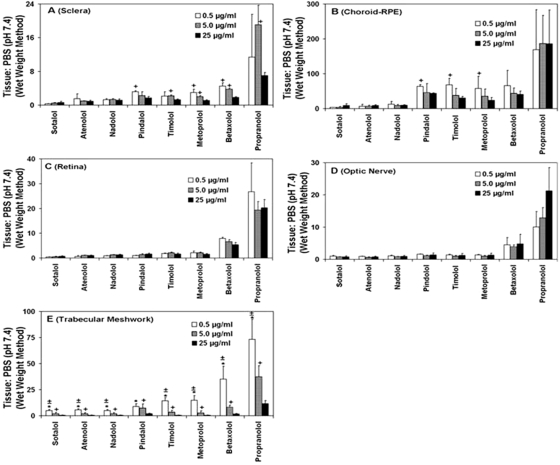
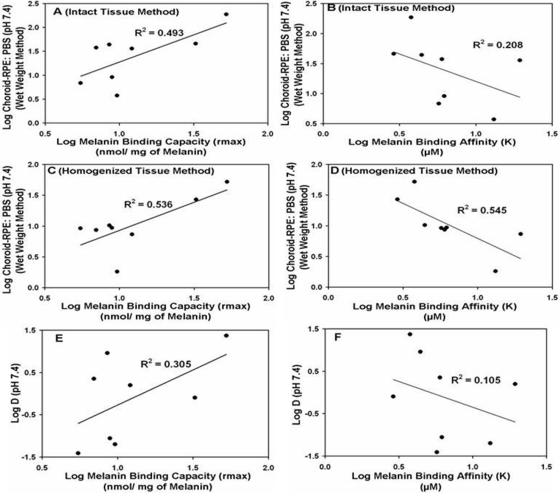
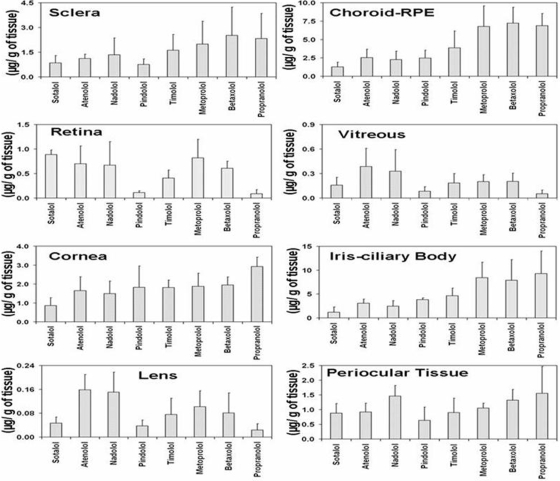
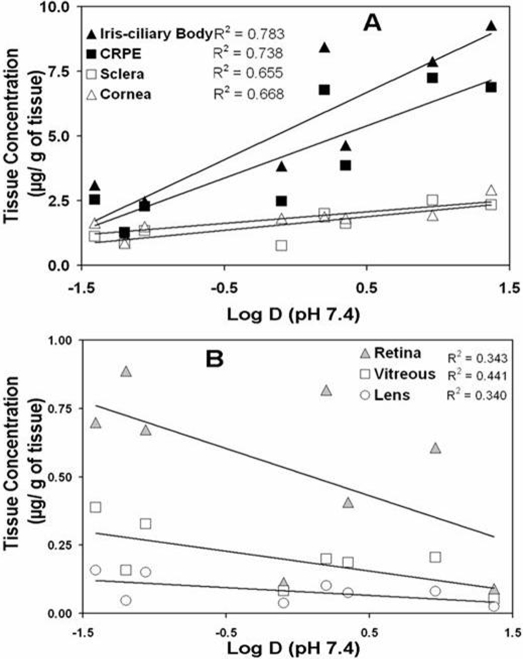
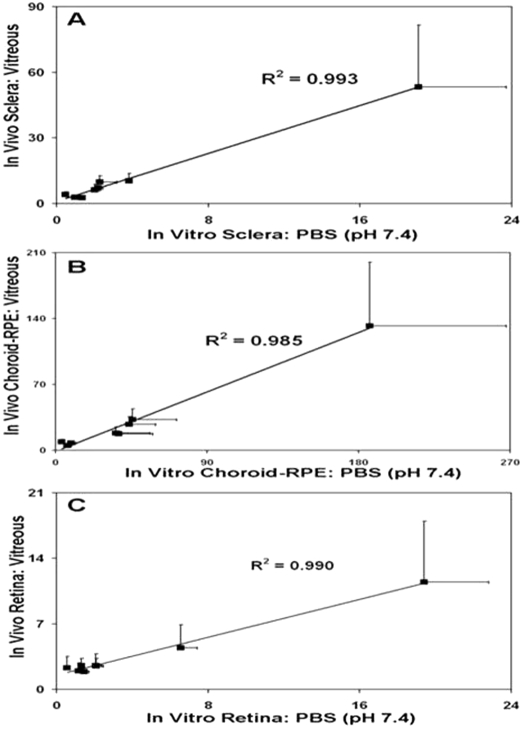
In vitro bovine eye tissue/phosphate-buffered saline, pH 7.4, partition coefficients (Kt:b), in vitro binding to natural melanin, and in vivo delivery at 1 h after posterior subconjunctival injection in Brown Norway rats were determined for eight beta-blockers. The Kt:b was in the order intact tissue, dry weight method >or= intact tissue, wet weight method corrected for tissue water and drug in tissue water >> intact tissue, wet weight method > homogenized tissue. In intact tissue methods, Kt:b followed the order choroid-retinal pigment epithelium (RPE) > trabecular meshwork > retina > sclera approximately optic nerve; propranolol > betaxolol > pindolol approximately timolol approximately metoprolol > sotalol approximately atenolol approximately nadolol. Intact tissue, wet weight log (Kt:b) correlated positively with log D for all tissues (R(2) of 0.7-0.9). Log (melanin binding capacity) correlated positively with choroid-RPE log (Kt:b) (R(2) of 0.5). With an increase in concentration, Kt:b decreased in trabecular meshwork for all beta-blockers and for some lipophilic beta-blockers in choroid-RPE and sclera. With an increase in drug lipophilicity, in vivo tissue distribution increased in choroid-RPE, iris-ciliary body, sclera, and cornea but exhibited a declining trend in retina, vitreous, and lens. In vitro bovine intact tissue, wet weight Kt:b correlated positively with rat in vivo tissue/vitreous humor distribution for sclera, choroid-RPE, and retina (R(2) of 0.985-0.993). In vitro tissue partition coefficients might be useful in predicting in vivo drug distribution after trans-scleral delivery. Less lipophilic solutes exhibiting limited nonproductive binding in choroid-RPE might exhibit greater trans-scleral delivery to the retina and vitreous.
Figures

Comment in
-
Findings of Research Misconduct.Fed Regist. 2018 Dec 6;83(234):62875. Fed Regist. 2018. PMID: 30556543 Free PMC article. No abstract available.
References
-
- Abrahamsson T, Boström S, Bräutigam J, Lagerström PO, Regårdh CG, Vauqelin G. (1988) Binding of the beta-blockers timolol and H 216/44 to ocular melanin. Exp Eye Res 47:565–577 - PubMed
-
- Ayalasomayajula SP, Kompella UB. (2004) Retinal delivery of celecoxib is several-fold higher following subconjunctival administration compared to systemic administration. Pharm Res 21:1797–1804 - PubMed
Publication types
MeSH terms
Substances
Grants and funding
LinkOut - more resources
Full Text Sources
