


Blood pressure and white-matter disease progression in a biethnic cohort: Atherosclerosis Risk in Communities (ARIC) study
- PMID: 19926835
- PMCID: PMC2803313
- DOI: 10.1161/STROKEAHA.109.566992
Blood pressure and white-matter disease progression in a biethnic cohort: Atherosclerosis Risk in Communities (ARIC) study
Abstract
Background and purpose: Blood pressure (BP) is a predictor of concurrent and subsequently measured white-matter hyperintensity (WMH), but longitudinal studies of WMH changes and data in black participants are lacking. We hypothesized that WMH progression would be (1) strongly related to BP in blacks and whites and (2) predicted more strongly by earlier (midlife) or cumulative BP measurements than by measures at older ages.
Methods: Participants were 983 individuals (49% black) from the Atherosclerosis Risk in Communities (ARIC) Study who underwent cerebral magnetic resonance imaging in 1993-1995 and 2004-2006. Associations between BP (measured at each of 5 visits, in addition to a time-averaged cumulative BP) and progression of WMHs were analyzed and compared.
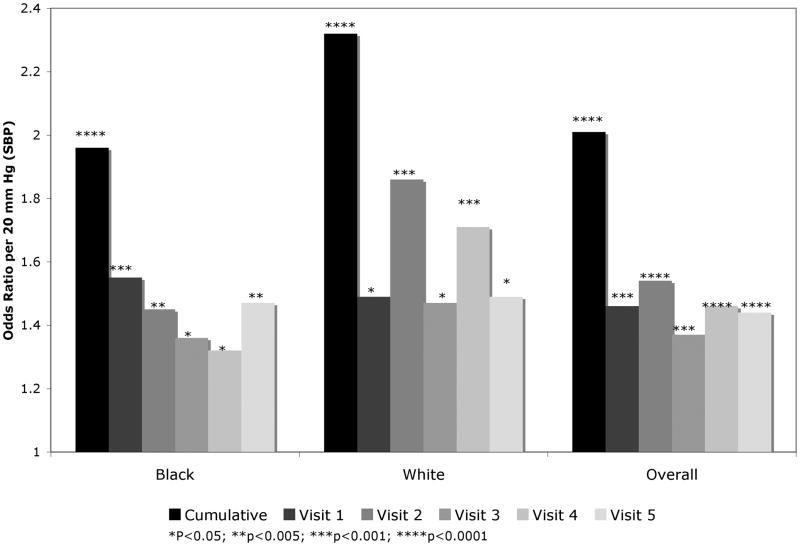
Results: Cumulative systolic BP (SBP) was the strongest BP predictor of WMH progression in adjusted models. Higher cumulative SBP (by 20 mm Hg) was associated with greater progression of WMHs and was similar in blacks (2.5 cm(3), P<0.0001) and whites (2.6 cm(3), P<0.0001). Higher cumulative SBP (per 20 mm Hg) was also associated with being in the top quintile of WMH progression (adjusted odds ratio=2.0; 95% CI, 1.6 to 2.6). Earlier SBP measurements were stronger predictors of WMH progression than were later SBP measurements, but in blacks only.
Conclusions: In this population-based cohort, cumulative SBP was a stronger predictor of WMH progression than SBP from individual visits, in both blacks and whites. Earlier BPs were stronger predictors than BPs measured at later time points in blacks only.
Conflict of interest statement
Figures
References
-
- Havlik RJ, Foley DJ, Sayer B, Masaki K, White L, Launer LJ. Variability in midlife systolic blood pressure is related to late-life brain white matter lesions. Stroke. 2002;33:26–30. - PubMed
-
- Jeerakathil T, Wolf PA, Beiser A, Massaro J, Seshadri S, D’Agostino RB, DeCarli C. Stroke risk profile predicts white matter hyperintensity volume. The Framingham study. Stroke. 2004;35:1857–1861. - PubMed
-
- Swan GE, DeCarli C, Miller BL, Reed T, Wolf PA, Jack LM, Carmelli D. Association of midlife blood pressure to late-life cognitive decline and brain morphology. Neurology. 1998;51:986–993. - PubMed
-
- Launer LJ, Masaki K, Petrovitch H, Foley D, Havlik RJ. The association between midlife blood pressure levels and late-life cognitive function. The Honolulu-Asia Aging Study. JAMA. 1995;274:1846–1851. - PubMed
-
- Freitag MH, Peila R, Masaki K, Petrovitch H, Ross GW, White LR, Launer LJ. Midlife pulse pressure and incidence of dementia: The Honolulu-Asia Aging Study. Stroke. 2006;37:33–37. - PubMed
Publication types
MeSH terms
Grants and funding
- N01 HC055022/HC/NHLBI NIH HHS/United States
- N01 HC055016/HL/NHLBI NIH HHS/United States
- N01 HC055019/HL/NHLBI NIH HHS/United States
- N01-HC-55016/HC/NHLBI NIH HHS/United States
- N01 HC055018/HC/NHLBI NIH HHS/United States
- N01 HC055015/HL/NHLBI NIH HHS/United States
- N01-HC-55021/HC/NHLBI NIH HHS/United States
- N01-HC-55019/HC/NHLBI NIH HHS/United States
- R01-HL70825/HL/NHLBI NIH HHS/United States
- N01-HC-55015/HC/NHLBI NIH HHS/United States
- N01-HC-55020/HC/NHLBI NIH HHS/United States
- N01 HC055015/HC/NHLBI NIH HHS/United States
- R01 HL070825/HL/NHLBI NIH HHS/United States
- N01-HC-55018/HC/NHLBI NIH HHS/United States
- N01 HC055016/HC/NHLBI NIH HHS/United States
- N01-HC-55022/HC/NHLBI NIH HHS/United States
- N01 HC055021/HL/NHLBI NIH HHS/United States
- N01 HC055020/HL/NHLBI NIH HHS/United States
- N01 HC055019/HC/NHLBI NIH HHS/United States
- N01 HC055021/HC/NHLBI NIH HHS/United States
- N01 HC055018/HL/NHLBI NIH HHS/United States
- N01 HC055022/HL/NHLBI NIH HHS/United States
- N01 HC055020/HC/NHLBI NIH HHS/United States
LinkOut - more resources
Full Text Sources
Medical
