


Sliding characteristic and material compressibility of human lung: parametric study and verification
- PMID: 19928094
- PMCID: PMC2852453
- DOI: 10.1118/1.3218761
Sliding characteristic and material compressibility of human lung: parametric study and verification
Abstract
Purpose: To find and verify the optimum sliding characteristics and material compressibility that provide the minimum error in deformable image registration of the lungs.
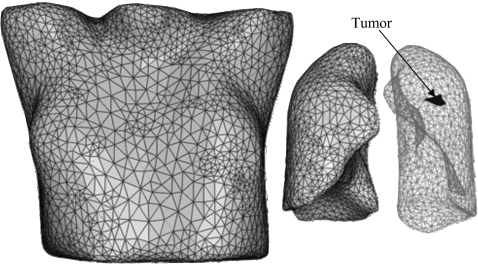
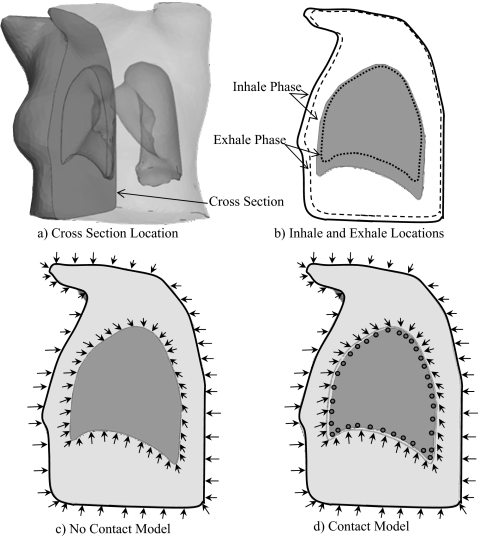
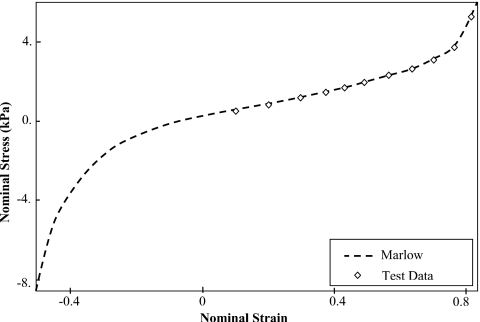
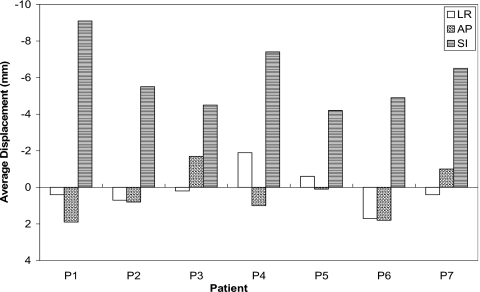
Methods: A deformable image registration study has been conducted on a total of 16 lung cancer patients. Patient specific three dimensional finite element models have been developed to model left and right lungs, chest (body), and tumor based on 4D CT images. Contact surfaces have been applied to lung-chest cavity interfaces. Experimental test data are used to model nonlinear material properties of lungs. A parametric study is carried out on seven patients, 20 conditions for each, to investigate the sliding behavior and the tissue compressibility of lungs. Three values of coefficient of friction of 0, 0.1, and 0.2 are investigated to model lubrication and sliding restriction on the lung-chest cavity interface. The effect of material compressibility of lungs is studied using Poisson's ratios of 0.35, 0.4, 0.45, and 0.499. The model accuracy is examined by calculating the difference between the image-based displacement of bronchial bifurcation points identified in the lung images and the calculated corresponding model-based displacement. Furthermore, additional bifurcation points around the tumor and its center of mass are used to examine the effect of the mentioned parameters on the tumor localization.
Results: The frictionless contact model with 0.4 Poisson's ratio provides the smallest residual errors of 1.1 +/- 0.9, 1.5 +/- 1.3, and 2.1 +/- 1.6 mm in the LR, AP, and SI directions, respectively. Similarly, this optimum model provides the most accurate location of the tumor with residual errors of 1.0 +/- 0.6, 0.9 +/- 0.7, and 1.4 +/- 1.0 mm in all three directions. The accuracy of this model is verified on an additional nine patients with average errors of 0.8 +/- 0.7, 1.3 +/- 1.1, and 1.7 +/- 1.6 mm in the LR, AP, and SI directions, respectively.
Conclusions: The optimum biomechanical model with the smallest registration error is when frictionless contact model and 0.4 Poisson's ratio are applied. The overall accuracies of all bifurcation points in all 16 patients including tumor points are 1.0 +/- 0.7, 1.2 +/- 1.0, and 1.7 +/- 1.4 mm in the LR, AP, and SI directions, respectively.
Figures
References
Publication types
MeSH terms
Grants and funding
LinkOut - more resources
Full Text Sources
Medical
