


Application of OMICS technologies in occupational and environmental health research; current status and projections
- PMID: 19933307
- PMCID: PMC2910417
- DOI: 10.1136/oem.2008.042788
Application of OMICS technologies in occupational and environmental health research; current status and projections
Abstract
OMICS technologies are relatively new biomarker discovery tools that can be applied to study large sets of biological molecules. Their application in human observational studies (HOS) has become feasible in recent years due to a spectacular increase in the sensitivity, resolution and throughput of OMICS-based assays. Although, the number of OMICS techniques is ever expanding, the five most developed OMICS technologies are genotyping, transcriptomics, epigenomics, proteomics and metabolomics. These techniques have been applied in HOS to various extents. However, their application in occupational environmental health (OEH) research has been limited. Here, we will discuss the opportunities these new techniques provide for OEH research. In addition we will address difficulties and limitations to the interpretation of the data that is generated by OMICS technologies. To illustrate the current status of the application of OMICS in OEH research, we will provide examples of studies that used OMICS technologies to investigate human health effects of two well-known toxicants, benzene and arsenic.
Conflict of interest statement
Figures
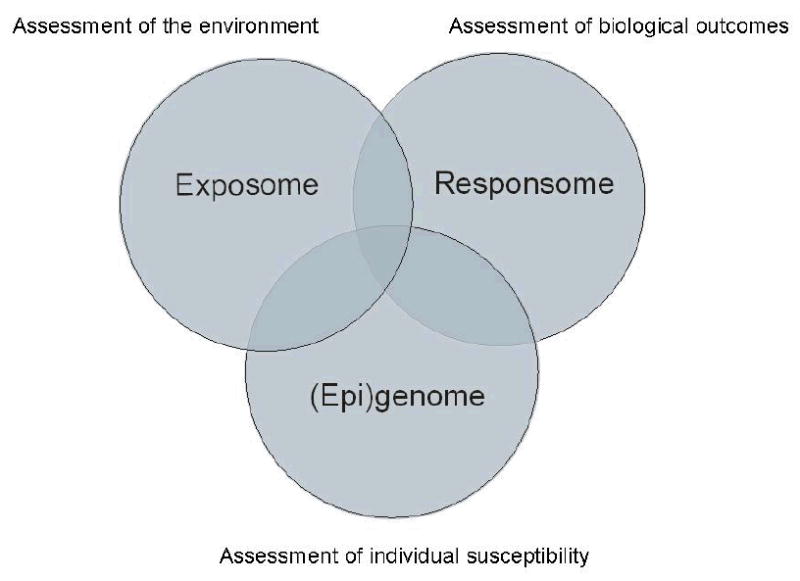
Comment in
-
OMICS technologies: an opportunity for "two-way" translation from basic science to both clinical and population-based research.Occup Environ Med. 2010 Feb;67(2):75-6. doi: 10.1136/oem.2009.051219. Epub 2009 Nov 12. Occup Environ Med. 2010. PMID: 19914910 No abstract available.
References
-
- Smith MT, Vermeulen R, Li G, Zhang L, Lan Q, Hubbard AE, et al. Use of ‘Omic’ technologies to study humans exposed to benzene. Chem Biol Interact. 2005;153-154:123–7. - PubMed
-
- Sachidanandam R, Weissman D, Schmidt SC, Kakol JM, Stein LD, Marth G, et al. A map of human genome sequence variation containing 1.42 million single nucleotide polymorphisms. Nature. 2001;409(6822):928–33. - PubMed
-
- Venter JC, Adams MD, Myers EW, Li PW, Mural RJ, Sutton GG, et al. The sequence of the human genome. Science. 2001;291(5507):1304–51. - PubMed
-
- Wild CP. Complementing the genome with an “exposome”: the outstanding challenge of environmental exposure measurement in molecular epidemiology. Cancer Epidemiol Biomarkers Prev. 2005;14(8):1847–50. - PubMed
-
- Smith MT. Future perspectives of molecular cancer epidemiology. IARC-EACR-AACR-ECNIS Symposium “Integrative Molecular Cancer Epidemiology”; 2008; Lyon, France.
Publication types
MeSH terms
Substances
Grants and funding
LinkOut - more resources
Full Text Sources
Other Literature Sources
